

Why Governance Is Non-Optional
Segmentation introduces something most organisations do not like:
- Fewer actions
- More waiting
- Hard “no” answers
Without governance:
- Pressure re-enters
- Exceptions multiply
- Firewalls soften
- Silence gets reframed as failure
Governance exists to:
Protect the system from short-term anxiety.
As customer engagement systems become more sophisticated, governance becomes essential. It ensures customer journeys remain consistent, regardless of campaign pressure or short-term targets.
What Governance Is (And Is Not)
Governance is NOT:
- A committee
- A monthly meeting
- A PDF no one reads
- A policing function
Governance IS:
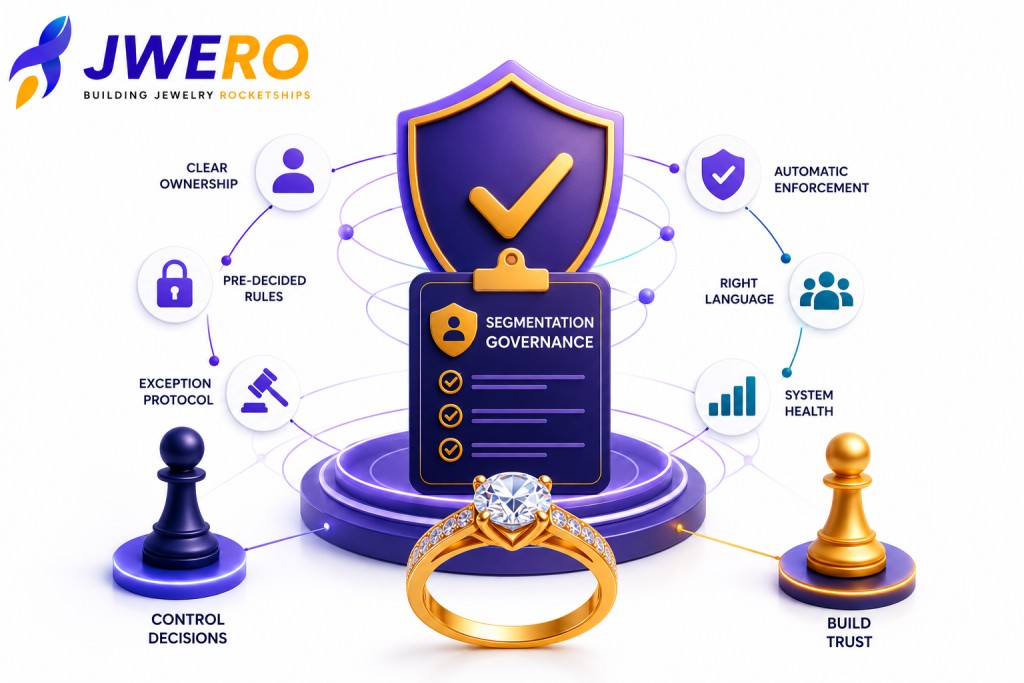
- Clear ownership
- Explicit authority
- Pre-decided rules
- Automatic enforcement
Good governance creates consistency across customer engagement, CRM workflows, and communication channels.
Part 1 — Ownership (This Must Be Clear)
The Segmentation Owner (Single Thread)
There must be one owner of segmentation logic.
Not:
- Marketing collectively
- Sales leadership
- Growth teams
But:
A named role or person
Responsibilities
- Owns segment definitions
- Approves changes to logic
- Reviews violations
- Defends silence decisions
They do not:
- Write campaign copy
- Run daily campaigns
- Chase numbers
This separation is critical.
Marketing Does Not Own the Firewall
This is important.
The segmentation firewall should be owned by:
- Operations
- RevOps
- CRM architecture
Not by the team under pressure to send messages.
The people who benefit from breaking rules must not own them.
Businesses using customer engagement platforms such as Jwero.ai often separate governance responsibilities from campaign execution for this exact reason.
Part 2 — What Can and Cannot Change
Immutable (Hard-Locked)
These can only change through formal review:
- Segment definitions
- Segment transition rules
- Pause behaviour
- Real-time approval rules
If these change casually:
The system is already decaying.
Mutable (Flexible)
These can change frequently:
- Campaign copy
- Creative formats
- Channels used
- Content themes
Creativity belongs here.
Control does not.
Part 3 — The Exception Protocol (This Saves Everything)
Teams will request exceptions.
That is normal.
What matters is how teams handle them.
The Only Valid Exception Path
When someone asks:
“Can we just send this once?”
The response must be:
1. Name the Segment
“They’re currently in Evaluation.”
2. Name the Risk
“Sending now increases hesitation.”
3. Offer the Protocol
“If we believe the segment logic is wrong, we review the logic — not bypass it.”
The Rule
Exceptions can only change segmentation logic, never bypass it.
This forces teams to confront:
- Whether the model is wrong
- Whether impatience is driving the request
Most exception requests stop here, correctly.
Part 4 — The Three Governance Metrics
Governance does not need many dashboards.
It needs three red-flag metrics.
Pause Violation Count
Target: Zero
Any non-zero value:
- Triggers review
- Names the source
- Fixes the leak
This is non-negotiable.
Segment-Unsafe Campaign Attempts
Track:
- Campaigns blocked by the firewall
- Journeys that did not meet the requirements
A rising number is not necessarily bad.
It often means the firewall is doing its job.
Manual Override Attempts
Track:
- Who tried
- When
- Why
You are not punishing.
You are detecting pressure points.
Pressure patterns matter more than individuals.
Part 5 — The Monthly Segmentation Review (30 Minutes)
This should be the only recurring governance ritual.
Agenda (Fixed)
- Pause violations
- Segment dwell anomalies
- Suppressed campaign volume
- Exception requests
- One key question:
“Where did pressure show up this month?”
No campaign performance reviews.
No creative debates.
No channel arguments.
This is system health, not marketing operations.
Part 6 — Language Governance (Subtle but Powerful)
Words shape behaviour.
Teams should actively discourage certain phrases.
Language to Retire
❌ Warm lead
❌ Hot prospect
❌ Re-engagement
❌ Wake them up
❌ Push them
These phrases:
- Encode pressure
- Encourage interpretation
- Bypass consent
Language to Promote
✅ Current segment
✅ Customer-initiated
✅ Segment-eligible
✅ Pause respected
✅ Readiness observed
Clear language encourages consistent actions
Part 7 — Onboarding New Team Members
This is where most governance decay begins.
New hires often bring:
- Old habits
- Funnel thinking
- Activity bias
The One Rule for Onboarding
New team members cannot send campaigns for 30 days.
During this time, they:
- Observe segmentation behaviour
- Review suppressed campaigns
- Learn silence patterns
This helps reset intuition.
Part 8 — When Governance Is Working
You will know governance is working when:
- Fewer debates about “should we send”
- More debates about “Is readiness real?”
- Silence feels normal
- Pressure feels visible
- Campaign volume stops being a proxy for effort
Most importantly:
Teams feel relieved, not constrained.
Good governance reduces anxiety.
Bad governance creates bureaucracy.
This charter aims for the first.
The Final Governance Reframe
Old belief:
“Governance slows teams down.”
Segmentation belief:
“Governance prevents teams from panicking.”
Panic is expensive.
Trust is not.
Frequently Asked Questions
What is segmentation governance?
Segmentation governance is a framework that defines ownership, rules, and enforcement for customer segmentation decisions.
Why is segmentation governance important?
It prevents pressure-led decisions, protects customer trust, and ensures segmentation rules remain consistent.
Who should own segmentation governance?
A single accountable owner, supported by operations or CRM architecture teams, should manage segmentation governance.
Can campaign teams bypass segmentation rules?
No. Governance works only when exceptions modify logic through review rather than bypassing established rules.
How does governance improve customer engagement?
It reduces unnecessary communication and helps businesses engage customers based on readiness rather than pressure.
Build Customer Journeys Around Readiness, Not Pressure
Strong customer engagement does not come from sending more messages.
It comes from understanding readiness, respecting timing, and maintaining consistent governance across every interaction.
Explore how connected CRM, communication, and customer engagement systems can support more disciplined customer journeys.
Learn more at Jwero.ai