

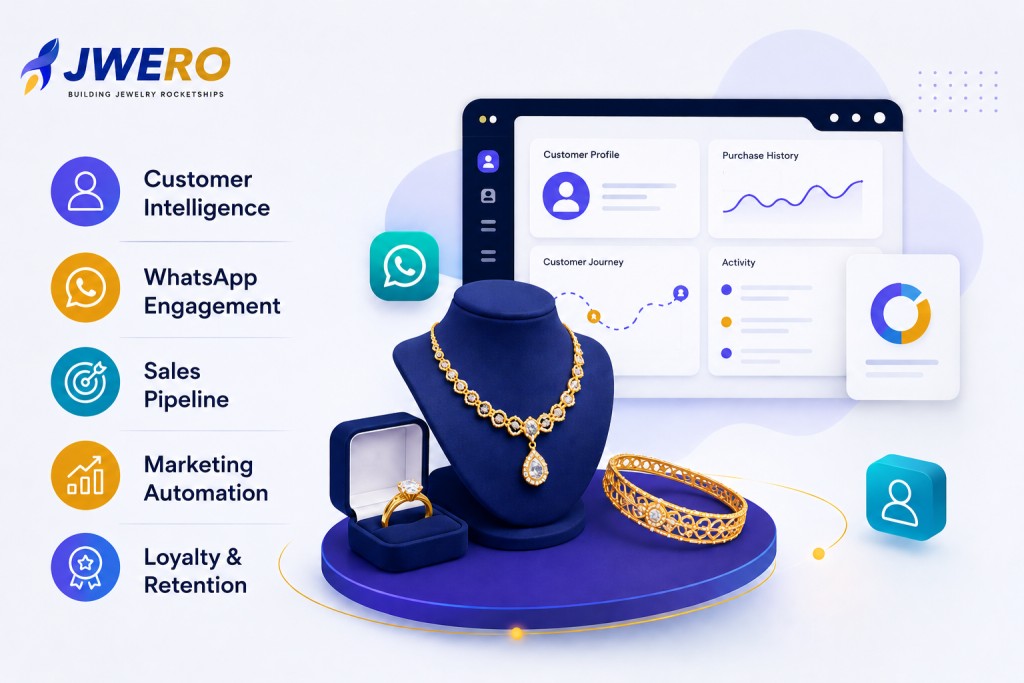
A jewellery CRM is software that helps jewellery businesses manage customer relationships, sales conversations, follow-ups, purchase history, preferences, occasions, loyalty, campaigns, and customer journeys in one place.
For jewellers, CRM is not just a contact database. It becomes the operating layer between the customer, sales team, marketing team, store, WhatsApp, ecommerce, catalogues, campaigns, and repeat purchase journeys.
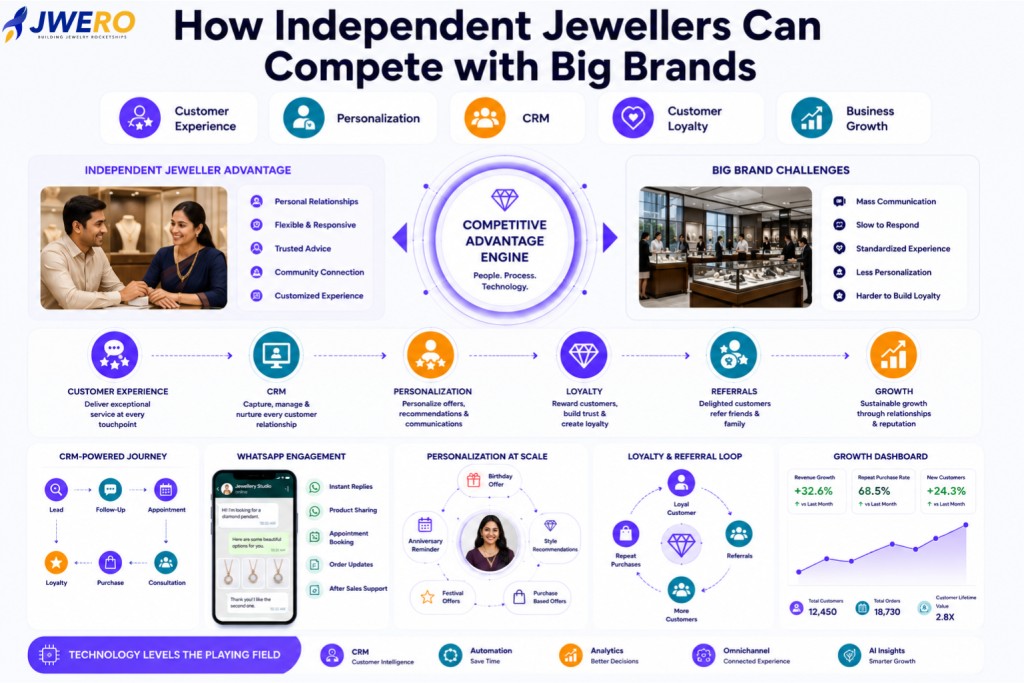
Jewellery is a relationship-led business. Customers do not only buy products. They buy trust, timing, taste, occasion relevance, family confidence, service quality, and long-term familiarity. A good jewellery CRM helps jewellers preserve that relationship at scale.
What Is Jewellery CRM?
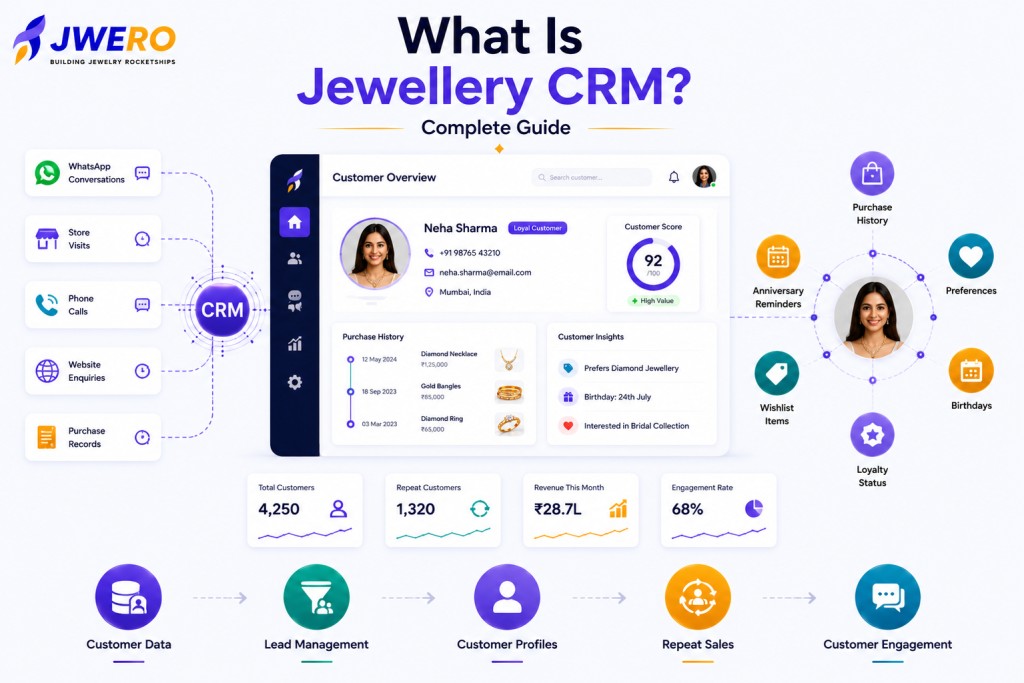
Jewellery CRM means Customer Relationship Management software built for jewellery businesses.
It helps jewellers track every customer interaction across channels such as store visits, WhatsApp, Instagram, website, ecommerce, forms, campaigns, calls, appointments, product enquiries, quotations, purchases, loyalty activity, birthdays, anniversaries, and follow-ups.
A jewellery CRM usually helps with:
- Customer profiles
- Lead capture
- Walk-in tracking
- WhatsApp and chat conversations
- Sales follow-ups
- Product interest tracking
- Occasion reminders
- Campaign segmentation
- Loyalty and rewards
- Repeat purchase journeys
- Customer service history
- Team task management
- Store and ecommerce customer data
The main purpose is simple: help jewellery businesses know every customer better and follow up at the right time with the right context.
Why Jewellery Stores Need CRM
Most jewellery businesses already have customer data. The problem is that the data is scattered.
Some data sits in Excel. Some sits in billing software. Some sits in WhatsApp chats. Some sits with salespeople. Some sits in Instagram messages. Some sits in ecommerce enquiries. Some sits in notebooks, visiting cards, call logs, or memory.
This creates a major growth problem.
A customer may visit the store, ask about bridal jewellery, receive a WhatsApp catalogue, compare a few designs, ask for pricing, leave without buying, return after two months, and finally purchase during a family occasion. Without CRM, that journey is hard to track.
With CRM, the jeweller can see:
- Who the customer is
- What they asked for
- Which products did they like
- Which salesperson handled them
- On which occasion are they shopping for
- What budget range did they indicate
- What follow-up is pending
- Which campaign did they came from
- Whether they purchased earlier
- Whether they are loyal, inactive, new, or high-value
Jewellery CRM helps turn disconnected customer activity into a structured customer journey.
How Jewellery CRM Is Different From Generic CRM
Generic CRM tools are usually built for broad sales teams. Jewellery businesses need something more specific.
Jewellery selling is highly visual, consultative, seasonal, emotional, and occasion-driven. A generic CRM may track a lead name, phone number, status, and notes. But jewellers often need more context.
Jewellery CRM should understand:
- Walk-ins and store visits
- Bridal and occasion-based buying
- Family purchase behaviour
- Gold, diamond, silver, gemstone, and custom jewellery interests
- Product catalogues and design sharing
- WhatsApp-first conversations
- Long consideration cycles
- Repeat buying around festivals and life events
- Loyalty points and customer tiers
- Salesperson-led assisted selling
- Customer preferences by style, budget, category, and occasion
A jewellery CRM is not only about “closing leads.” It is about building a customer relationship that can last for years.
Core Problems Jewellery CRM Solves
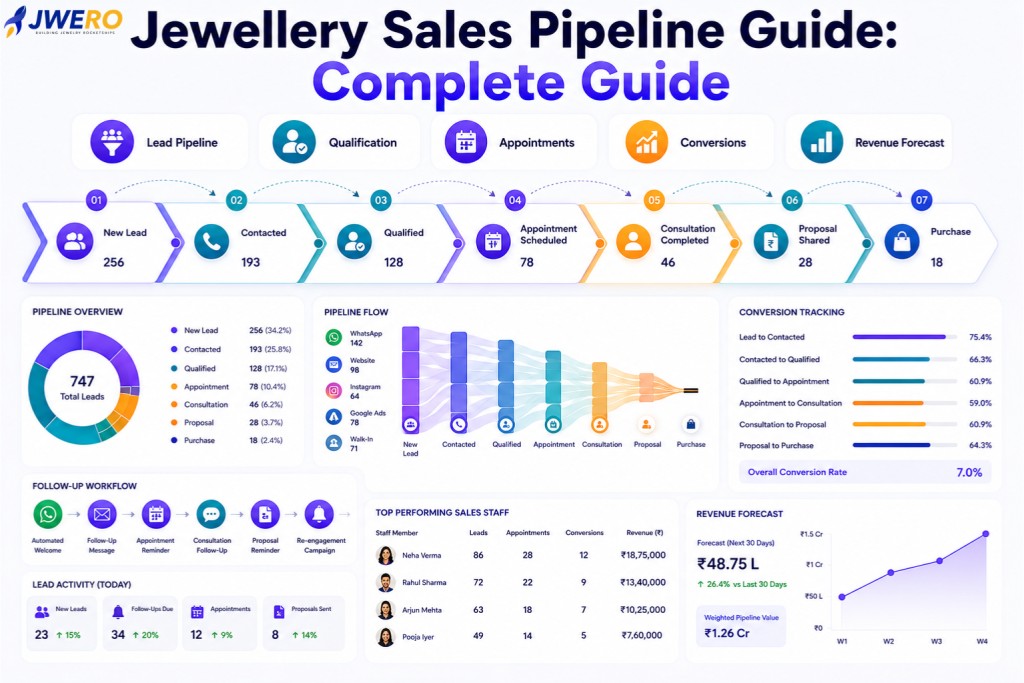
1. Lost Leads
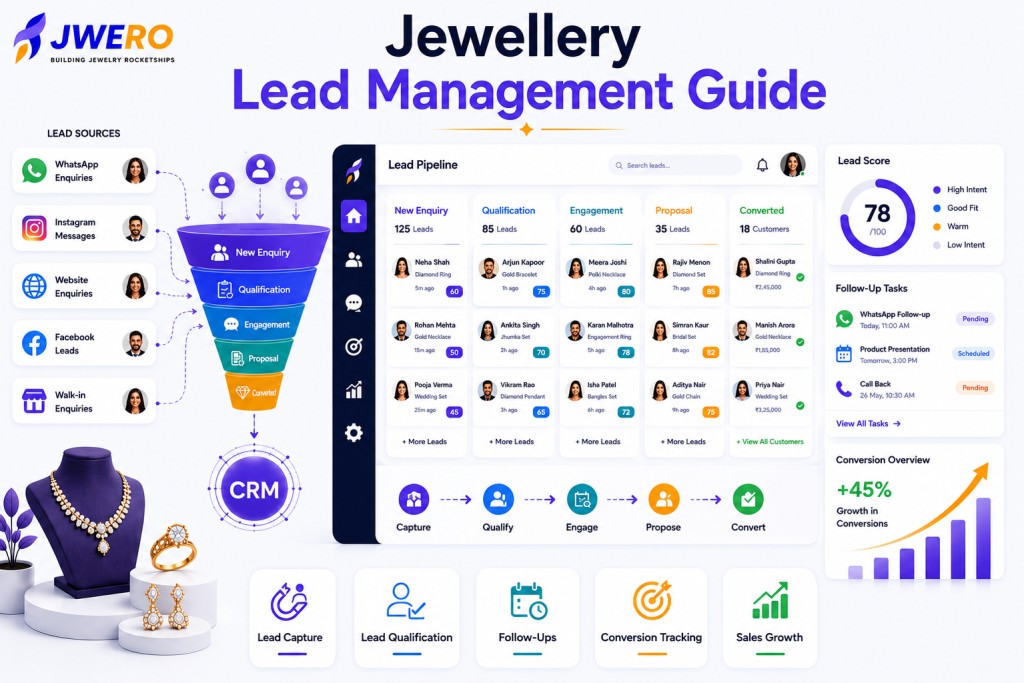
Many jewellery leads are lost because follow-ups are delayed, forgotten, or handled manually. A customer may enquire on WhatsApp, visit the store, or ask for a product catalogue, but if nobody follows up properly, the opportunity goes cold.
CRM helps capture leads from multiple sources and assign follow-up tasks.
2. Scattered Customer Data
Customer information often lives across POS, Excel, WhatsApp, Instagram, ecommerce, sales teams, and marketing tools. CRM brings this information into one customer profile.
3. Weak Follow-Up Discipline
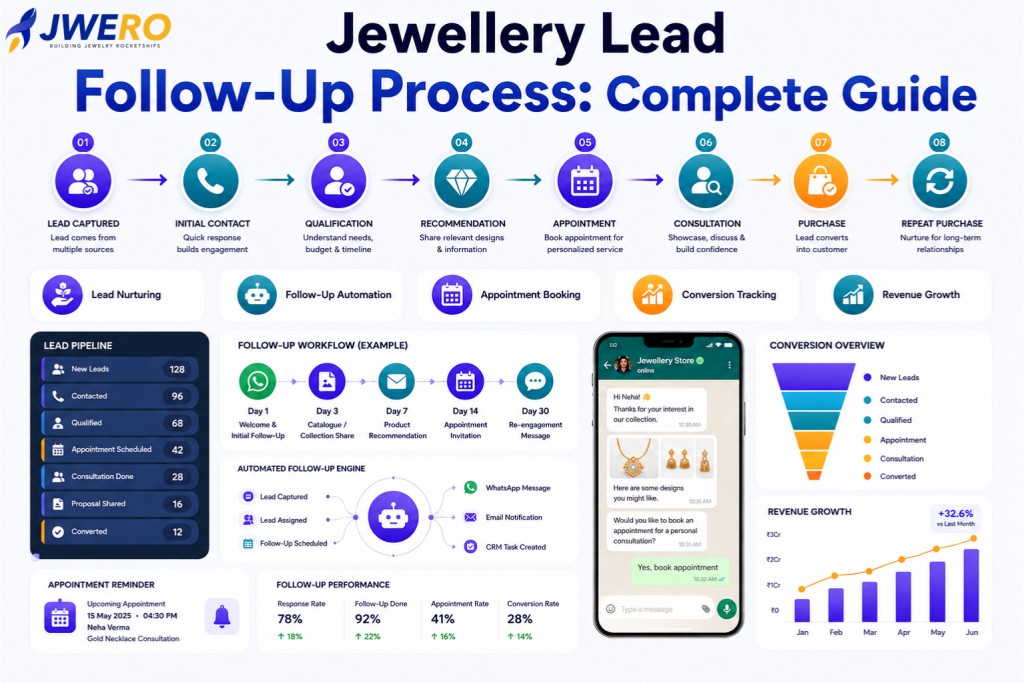
Jewellery purchases often need multiple conversations. CRM helps sales teams follow up after enquiries, visits, quotes, trials, product shares, abandoned carts, and campaign responses.
4. Poor Repeat Sales
Many jewellers focus heavily on first-time purchases but do not systematically nurture customers after purchase. CRM helps create repeat journeys through birthdays, anniversaries, festivals, new arrivals, loyalty campaigns, and category-based recommendations.
5. No Clear Customer Segmentation
Not every customer should receive the same message. CRM allows jewellers to segment customers by interest, purchase history, location, value, engagement, occasion, product preference, or lifecycle stage.
6. Low Visibility Into Sales Team Activity
Without CRM, store owners and managers often do not know which salesperson followed up, what was discussed, and which leads are pending. CRM creates visibility and accountability.
Essential Jewellery CRM Features
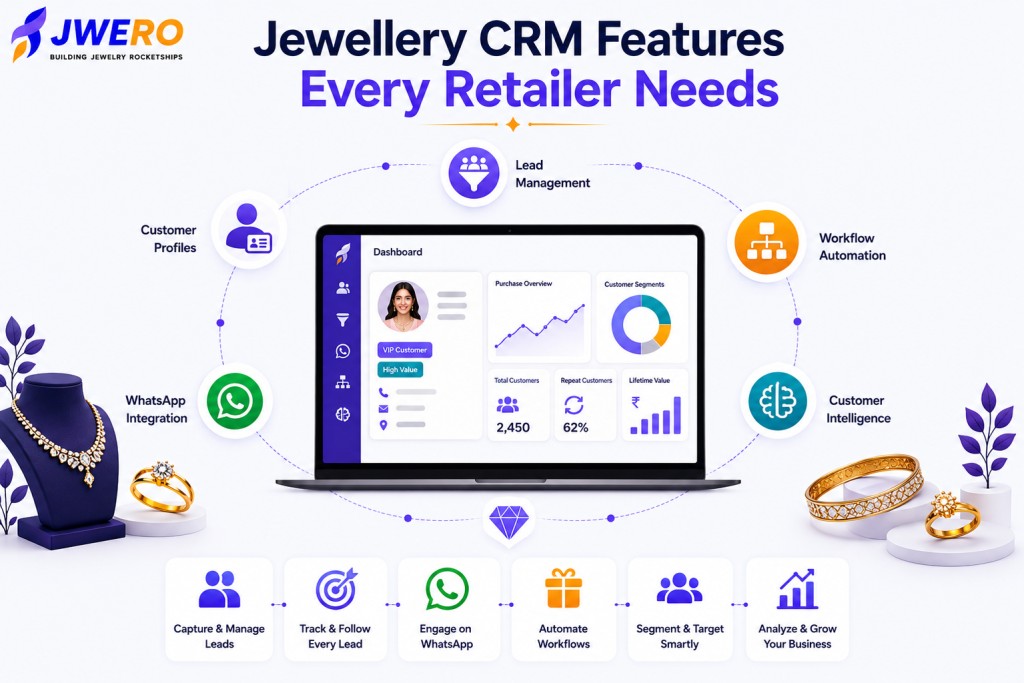
A strong jewellery CRM should include the following capabilities.
Unified Customer Profiles
Every customer should have a complete profile that includes contact details, purchase history, preferences, communication history, loyalty points, visits, notes, tasks, forms, chats, campaigns, and lifecycle stage.
For jewellery businesses, a 360-degree profile is extremely valuable because customer decisions are rarely based on one interaction.
Lead Management
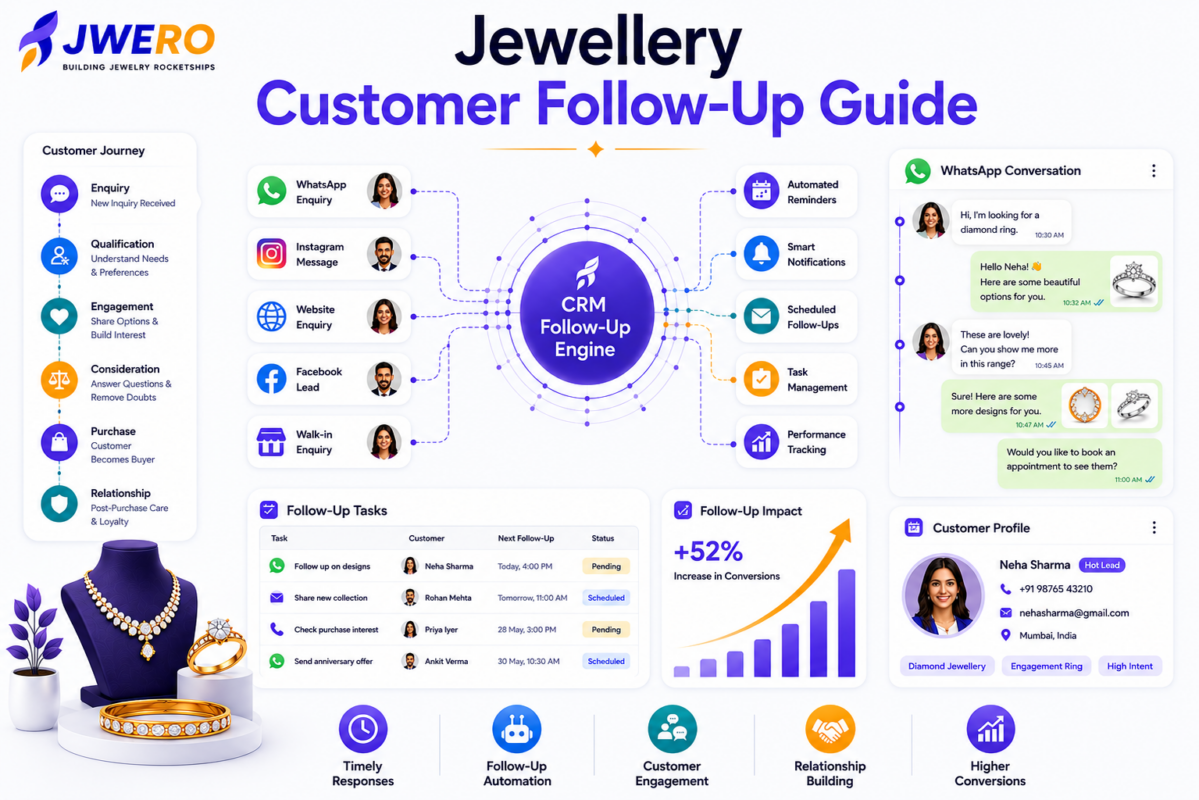
Jewellery CRM should capture leads from store visits, WhatsApp, website forms, ecommerce enquiries, social media, campaigns, product catalogues, Meta ads, referrals, and events.
Each lead should have a source, status, owner, interest area, next action, and follow-up date.
Walk-In Management
Walk-ins are a major revenue source for jewellery stores. CRM should help store teams capture walk-in details, record interests, check product availability, share recommendations, create estimates, and continue follow-up after the customer leaves.
WhatsApp and Chat Integration
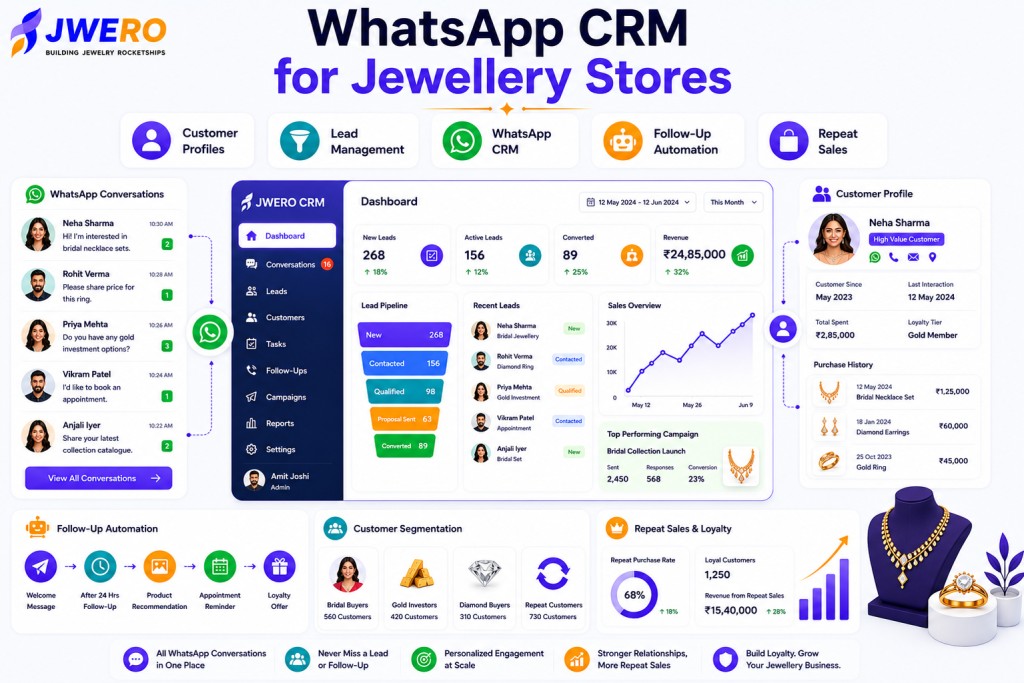
Jewellers rely heavily on WhatsApp. A jewellery CRM should connect WhatsApp conversations with customer profiles so that salespeople and managers can see chat history, enquiries, shared products, pending replies, and follow-up context.
It should also support communication across channels like Instagram, Facebook, Messenger, web chat, and other customer touchpoints where relevant.
Smart Segmentation
CRM should allow segmentation based on behaviour, engagement, demographics, geography, product interest, purchase history, customer value, lifecycle stage, custom fields, and campaign activity.
Examples:
- Bridal jewellery prospects
- High-value diamond buyers
- Customers inactive for 180 days
- Customers with birthdays this month
- Customers interested in bangles
- Repeat gold buyers
- WhatsApp-engaged customers
- First-time buyers not yet converted to repeat buyers
Campaign Management
Jewellery CRM should help run campaigns through channels such as WhatsApp, SMS, email, push notifications, RCS, and social media retargeting where available.
Campaigns should be tied to customer segments, not sent blindly to everyone.
Automation and Triggers
Automation helps jewellers send timely communication based on customer actions.
Examples:
- Send a follow-up after a store visit
- Remind salesperson after a high-value enquiry
- Trigger a birthday offer
- Send a catalogue after a product interest form
- Follow up after abandoned cart
- Send a thank-you message after purchase
- Start a bridal nurture journey after a bridal enquiry
Task and Team Management
CRM should help managers assign tasks, track follow-ups, monitor salesperson activity, and ensure no lead or customer request is missed.
Loyalty and Rewards
Jewellery CRM becomes more powerful when connected with loyalty. Jewellers can use CRM to identify loyal customers, reward repeat purchases, encourage referrals, and create tier-based engagement.
Reports and Views
CRM should offer useful views such as lead pipeline, customer segments, follow-up status, salesperson activity, campaign engagement, repeat customer trends, and customer lifecycle movement.
CRM for Walk-Ins and In-Store Selling
In jewellery retail, a walk-in is not just a visitor. It is a potential relationship.
A customer may enter the store to browse, compare, enquire, collect ideas, bring family later, or prepare for a future purchase. If the store team does not capture this properly, the business loses valuable intent data.
A jewellery CRM can help store teams:
- Capture walk-in customer details
- Record product interests
- Note occasion and budget
- Assign the salesperson
- Share catalogues or product links
- Create estimates or orders
- Schedule follow-ups
- Continue the conversation on WhatsApp
- Track whether the customer returned or purchased
This helps convert store traffic into structured sales opportunities.
CRM for WhatsApp, Chats, and Lead Follow-Up
For many jewellers, WhatsApp is already the real CRM. The issue is that WhatsApp alone is not enough.
WhatsApp chats are useful, but they are difficult to manage at scale when:
- Multiple salespeople handle customers
- Customers messages from different campaigns
- Product enquiries are mixed with service requests
- Managers need visibility
- Follow-ups are missed
- Customer history is not connected
- Conversations are not segmented
A WhatsApp-connected jewellery CRM helps convert chats into customer intelligence.
Instead of seeing only messages, the jeweller can see the full customer profile: previous purchases, product interests, loyalty status, notes, tasks, campaigns, visits, and follow-up history.
This is especially important because jewellery customers often ask many questions before buying. The better the context, the better the follow-up.
CRM for Segmentation and Campaigns
One of the biggest mistakes jewellers make is sending the same campaign to every customer.
A bridal prospect should not receive the same message as a silver jewellery buyer. A high-value diamond customer should not receive the same offer as a first-time lightweight jewellery buyer. A dormant customer needs a different journey from a loyal repeat buyer.
Jewellery CRM allows campaign precision.
Examples of useful segments:
- New leads
- Walk-ins not converted
- Customers who purchased once
- Repeat customers
- High-value customers
- Inactive customers
- Bridal prospects
- Festival shoppers
- Birthday and anniversary customers
- Customers interested in gold
- Customers interested in diamonds
- Customers who clicked a catalogue link
- Customers who engaged on WhatsApp
This improves relevance, which improves response quality.
CRM for Repeat Sales and Customer Journeys
Jewellery businesses grow stronger when they increase repeat sales.
A customer who buys once may return for birthdays, anniversaries, festivals, weddings, gifting, investment buying, upgrades, exchange, repairs, custom orders, or family purchases.
CRM helps create these journeys.
A jewellery CRM can support:
- Post-purchase thank-you journeys
- Birthday and anniversary reminders
- Festival campaigns
- New arrival alerts
- Loyalty nudges
- Referral journeys
- Re-engagement campaigns
- Bridal follow-up journeys
- Product-category recommendations
- High-value customer relationship management
The goal is not to spam customers. The goal is to remember them intelligently.
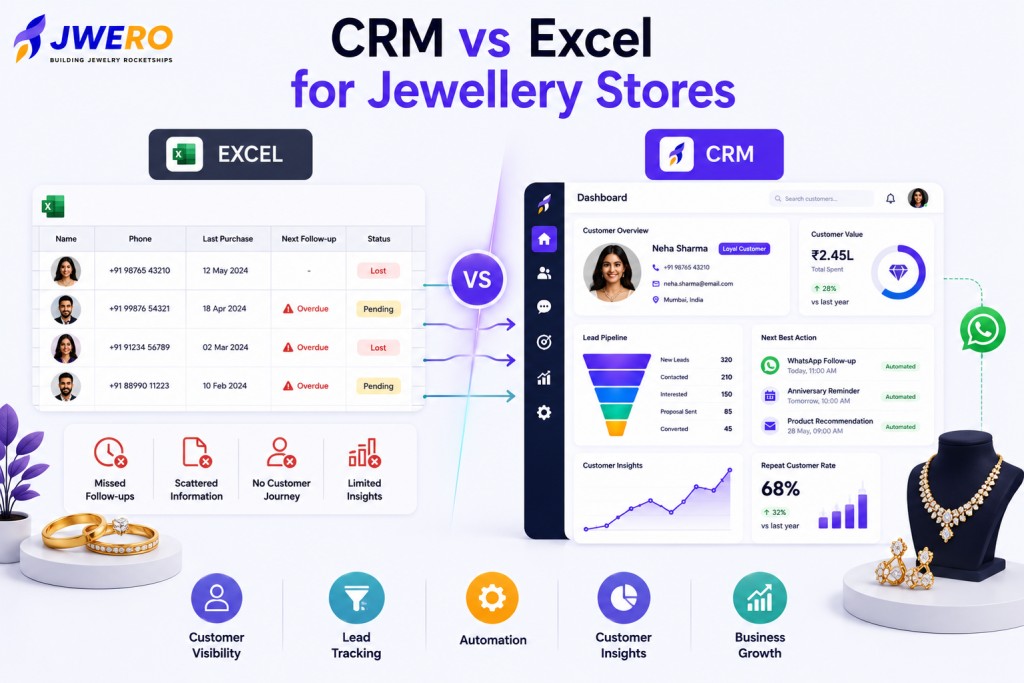
Jewellery CRM vs Excel
Excel can store customer data. But Excel is not designed to manage customer relationships.
Excel becomes limiting when jewellers need:
- Real-time follow-up tracking
- Salesperson accountability
- WhatsApp history
- Campaign segmentation
- Automated reminders
- Customer journey tracking
- Multi-store visibility
- Lead source tracking
- Loyalty integration
- Customer lifecycle reporting
Excel is useful as a starting point, but it cannot act as a connected CRM system.
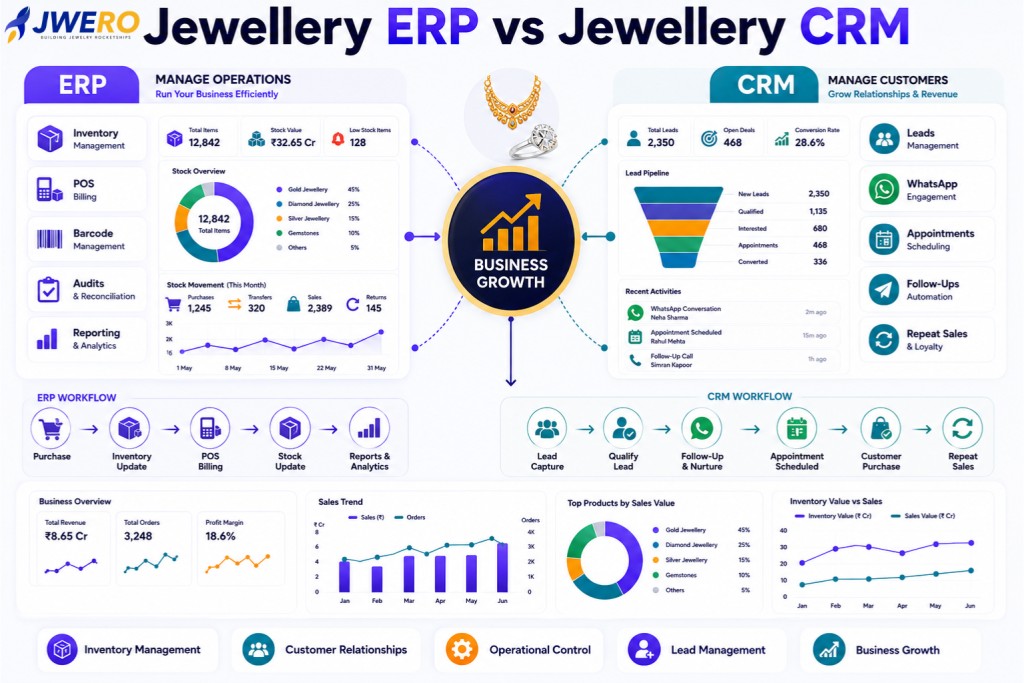
Jewellery CRM vs POS
POS software records transactions. CRM manages relationships.
A POS can tell you what a customer bought. A CRM can tell you who the customer is, what they liked, what they asked for, what they may buy next, what conversation happened, and when the team should follow up.
Jewellery businesses need both.
POS is transaction memory. CRM is relationship memory.
Jewellery CRM vs ERP
ERP manages operations such as inventory, finance, procurement, manufacturing, and backend workflows. CRM manages customer-facing growth.
ERP is important for operational control. CRM is important for sales, marketing, retention, and customer experience.
A jewellery business should not expect ERP alone to solve customer engagement.
Jewellery CRM vs WhatsApp Business App
WhatsApp Business App is helpful for direct communication. But it is not enough when the business has multiple team members, large customer volumes, many campaigns, and complex follow-ups.
A CRM connected with WhatsApp gives structure to conversations.
It helps convert chat activity into lead stat us, customer history, campaign response, sales follow-up, and lifecycle engagement.
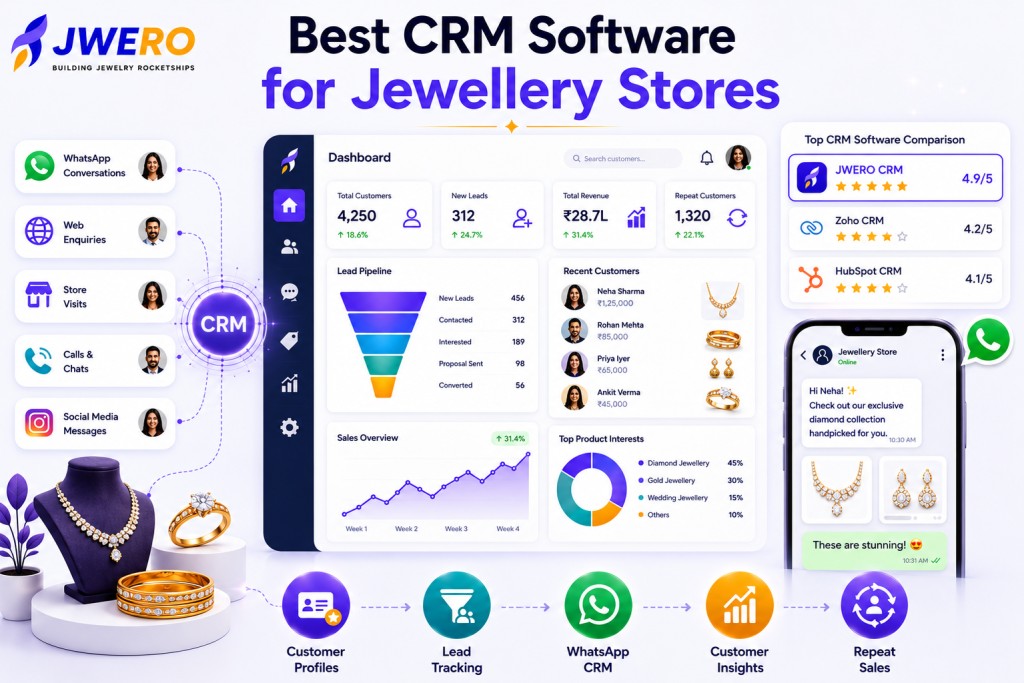
How to Choose Jewellery CRM Software
When choosing jewellery CRM software, jewellers should look for a platform that fits jewellery workflows rather than only generic sales tracking.
Important selection criteria:
- Does it support jewellery customer profiles?
- Can it capture walk-ins?
- Does it connect with WhatsApp and chat channels?
- Can it manage product interests and follow-ups?
- Does it support segmentation?
- Can it run campaigns?
- Does it support loyalty or rewards?
- Can it help sales teams with tasks?
- Does it work for store, ecommerce, and omnichannel journeys?
- Can managers see team activity and pending follow-ups?
- Is it easy enough for sales staff to adopt?
- Can it scale across stores, teams, and channels?
The best jewellery CRM is not the one with the most features. It is the one that helps the team actually use customer data every day.
How to Implement Jewellery CRM Successfully
CRM implementation should not start with software setup alone. It should start with customer journey clarity.
A practical CRM rollout can follow this sequence:
- Define customer lifecycle stages
Examples: new lead, walk-in, qualified prospect, quotation sent, follow-up pending, converted customer, repeat customer, inactive customer, loyal customer. - Clean existing customer data
Import useful customer details from Excel, POS, WhatsApp lists, ecommerce, and other systems where possible. - Define lead sources
Track whether leads come from walk-ins, WhatsApp, Instagram, website, ecommerce, ads, referrals, events, or campaigns. - Set follow-up rules
Decide when salespeople must follow up after enquiries, store visits, catalogue shares, quotations, and abandoned purchases. - Create segments
Start with simple segments such as new leads, inactive customers, birthday customers, high-value customers, and bridal prospects. - Train the team
The CRM must be easy for salespeople. If the team sees it only as reporting work, adoption will suffer. - Start with a few high-impact journeys
Begin with lead follow-up, walk-in follow-up, birthday campaigns, inactive customer reactivation, and post-purchase engagement. - Review weekly
Managers should review pending follow-ups, lead aging, campaign responses, and salesperson activity.
Common CRM Mistakes Jewellers Should Avoid
Mistake 1: Treating CRM as Only a Database
CRM should not be a passive list of customers. It should actively support selling, follow-up, campaigns, and retention.
Mistake 2: Not Capturing Walk-Ins
Walk-ins are valuable. Even if they do not buy immediately, their interests and occasion context should be captured.
Mistake 3: Sending Generic Campaigns
Mass messages without segmentation can reduce customer interest. CRM should help jewellers send relevant communication.
Mistake 4: No Follow-Up Ownership
Every important lead should have an owner and next action. Without ownership, CRM data becomes inactive.
Mistake 5: Poor Team Adoption
If CRM is difficult to use, sales teams will avoid it. The best CRM workflow should fit naturally into daily selling.
Mistake 6: Not Connecting WhatsApp
For jewellers, WhatsApp is often where the customer relationship happens. If CRM and WhatsApp are disconnected, important context is lost.
How Jwero Helps Jewellers With CRM
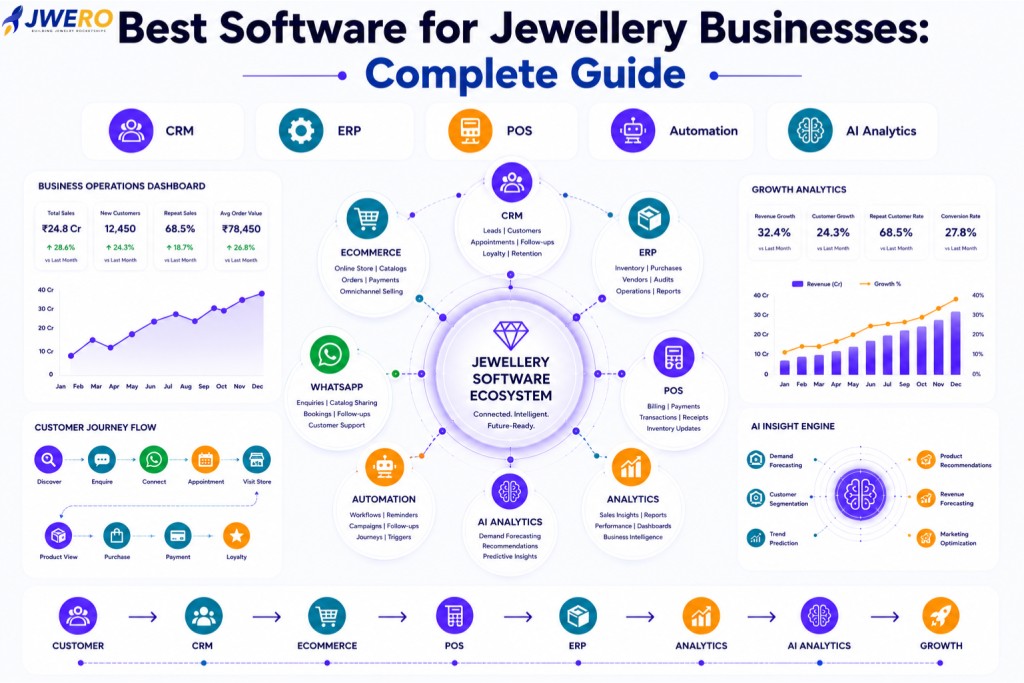
Jwero helps jewellery businesses manage customer relationships as part of a connected jewellery commerce system.
For jewellers, Jwero can bring together CRM, customer profiles, chats, campaigns, segmentation, loyalty, catalogues, ecommerce, assisted selling, quotations, and automation into one connected workflow.
Jwero’s CRM-led approach helps jewellers:
- Capture walk-ins and leads
- Build unified customer profiles
- Manage WhatsApp and chat conversations
- Track customer journeys and timelines
- Segment customers intelligently
- Automate follow-ups and campaigns
- Support sales teams with tasks and views
- Improve repeat engagement through loyalty and lifecycle journeys
- Connect store, ecommerce, and digital customer touchpoints
This matters because jewellery growth is not only about more traffic. It is about better customer memory, better follow-up, better segmentation, and better repeat relationships.
Final Takeaway
Jewellery CRM is becoming essential for modern jewellery businesses.
As customers move across stores, WhatsApp, Instagram, websites, ecommerce, catalogues, and campaigns, jewellers need a connected system to understand and serve them properly.
A good jewellery CRM helps businesses capture leads, manage walk-ins, organize customer profiles, improve follow-ups, personalize campaigns, increase repeat engagement, and build stronger long-term relationships.
For jewellery businesses that want to grow beyond manual follow-ups, disconnected WhatsApp chats, and scattered customer data, CRM is no longer optional. It is the foundation for modern jewellery customer growth.
FAQs
What is jewellery CRM?
Jewellery CRM is customer relationship management software designed for jewellery businesses. It helps jewellers manage leads, customer profiles, conversations, follow-ups, campaigns, loyalty, and repeat customer journeys.
Why do jewellery stores need CRM?
Jewellery stores need CRM because customer data is often scattered across store visits, WhatsApp, Instagram, ecommerce, salespeople, Excel, and billing systems. CRM brings this data together and helps teams follow up properly.
How is jewellery CRM different from generic CRM?
Jewellery CRM is built around jewellery-specific workflows such as walk-ins, product interests, occasions, WhatsApp conversations, bridal enquiries, loyalty, customer preferences, and repeat purchase journeys.
Can small jewellery stores use CRM?
Yes. Small jewellery stores can use CRM to organize customer data, track enquiries, manage WhatsApp follow-ups, and build repeat sales. CRM is useful even before a business becomes large.
Is Excel enough for jewellery customer management?
Excel can store customer data, but it cannot manage follow-ups, WhatsApp conversations, segmentation, campaigns, team tasks, loyalty, or customer journeys properly. CRM is better for active relationship management.
Does jewellery CRM help with WhatsApp?
Yes. A jewellery CRM connected with WhatsApp can help jewellers track customer conversations, enquiries, shared products, follow-ups, and customer history in one place.
What features should a jewellery CRM have?
A jewellery CRM should include customer profiles, lead management, walk-in capture, WhatsApp/chat integration, segmentation, campaign management, automation, task management, loyalty support, and reporting.
How does CRM increase repeat sales for jewellers?
CRM helps jewellers identify customer preferences, purchase history, occasions, inactive customers, loyalty segments, and follow-up opportunities. This makes it easier to run relevant campaigns and bring customers back.