

For many jewellery businesses, customer information starts in Excel.
A spreadsheet feels simple.
You can store:
- Customer names
- Phone numbers
- Purchase records
- Product interests
For a small business with limited customer volume, this may work initially.
However, as customer relationships become more complex, spreadsheets begin to create limitations.
Modern jewellery retail is increasingly driven by customer engagement, personalisation, repeat purchases, and customer intelligence.
Managing these activities effectively often requires more than a spreadsheet.
This is where CRM becomes important.
Why Most Jewellery Businesses Start With Excel
Excel is familiar.
Most businesses already use it.
It offers:
- Low cost
- Easy setup
- Basic reporting
- Customer lists
For very small customer databases, Excel can be sufficient.
The challenge begins when customer relationships become more important than customer records.
What Excel Does Well
Excel remains useful for:
Basic Customer Lists
Maintaining contact information.
Simple Reporting
Analysing basic sales information.
Small Databases
Managing limited customer records.
Internal Tracking
Recording operational information.
Excel is not a bad tool.
It simply was not designed to manage customer relationships.
What CRM Does Differently
CRM is built specifically for customer management.
Instead of storing data, CRM helps businesses:
- Build relationships
- Track customer journeys
- Manage leads
- Improve engagement
- Increase repeat sales
CRM focuses on customers rather than records.
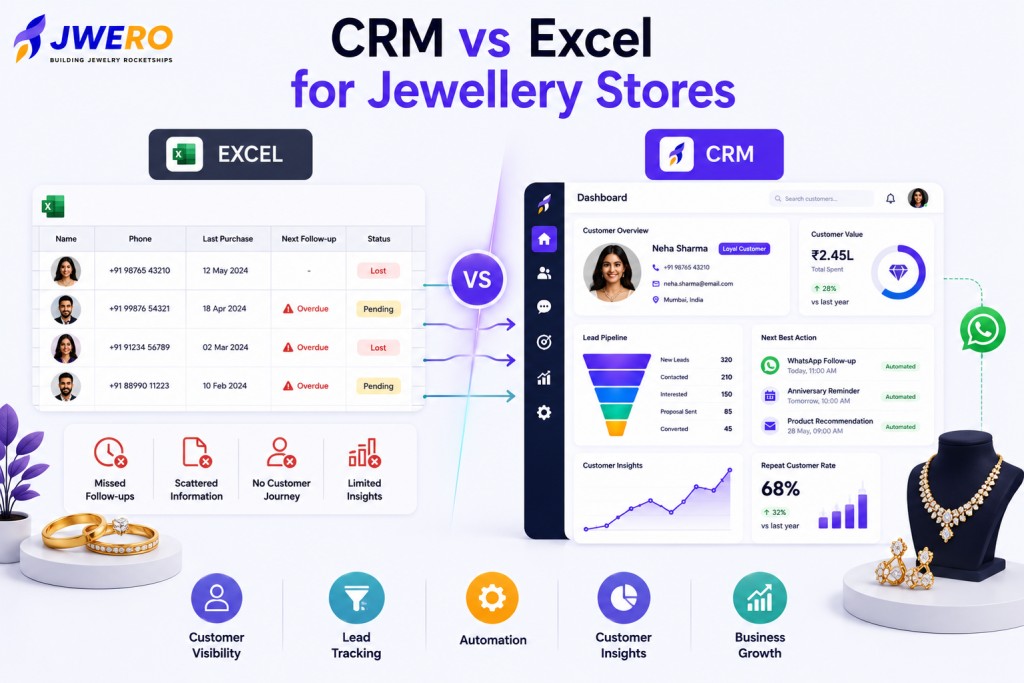
CRM vs Excel: Side-by-Side Comparison
| Feature | Excel | Jewellery CRM |
|---|---|---|
| Customer Database | ✅ | ✅ |
| Purchase History | Limited | Complete |
| Lead Tracking | Manual | Automated |
| Follow-Up Management | Manual | Structured |
| Customer Segmentation | Difficult | Easy |
| Customer Profiles | Basic | 360° View |
| WhatsApp Integration | No | Yes |
| Customer Journeys | No | Yes |
| Repeat Sales Tracking | Limited | Advanced |
| Scalability | Low | High |
The difference becomes more significant as customer volume increases.
Problem 1: Customer Information Becomes Fragmented
Many jewellery businesses store information across:
- Excel
- Billing software
- Staff phones
- Email systems
As a result:
- Information gets lost
- Customer context disappears
- Follow-ups become inconsistent
CRM centralises everything.
Problem 2: Follow-Ups Depend on Memory
A customer may enquire about:
- Diamond jewellery
- Bridal collections
- Gold investment products
Weeks later, the opportunity may be forgotten.
Excel does not proactively manage follow-ups.
CRM helps businesses:
- Schedule reminders
- Track opportunities
- Manage engagement
This improves conversion rates.
Problem 3: No Customer Journey Visibility
Excel shows records.
CRM shows relationships.
A CRM helps businesses understand:
- Where customers are in the buying journey
- Which leads need attention
- Which customers are ready to purchase
This visibility creates better customer experiences.
Problem 4: Customer Segmentation Is Difficult
Imagine sending a campaign only to:
- Bridal customers
- Diamond buyers
- High-value customers
In Excel, this often requires manual filtering.
CRM makes segmentation easier and more scalable.
Problem 5: Repeat Sales Opportunities Are Missed
Jewellery businesses generate significant revenue from repeat customers.
Examples include:
- Anniversaries
- Birthdays
- Upgrades
- Gifting occasions
CRM helps identify these opportunities.
Excel typically does not.
Why CRM Improves Customer Engagement
Customer engagement depends on relevance.
CRM helps businesses understand:
- Customer interests
- Purchase history
- Communication history
- Engagement patterns
This enables more personalised interactions.
CRM and WhatsApp
WhatsApp has become one of the most important communication channels for jewellery retailers.
CRM systems can connect customer information with WhatsApp engagement.
Benefits include:
- Better visibility
- Faster responses
- Improved customer experiences
Excel cannot support this effectively.
When Excel Is Still Enough
Excel may still work if:
- Customer volume is very low
- Follow-ups are minimal
- Personalisation is not a priority
- Growth ambitions are limited
However, most growing jewellery businesses eventually outgrow spreadsheets.
When CRM Becomes Essential
CRM becomes valuable when:
- Customer relationships matter
- Lead volume increases
- Repeat sales become important
- Multiple staff manage customers
- Personalisation becomes necessary
These conditions describe most modern jewellery retailers.
The Business Impact of CRM
Businesses often adopt CRM to improve:
Lead Conversion
Better opportunity management.
Customer Retention
Stronger relationships.
Customer Experience
More personalised engagement.
Operational Efficiency
Less manual work.
Revenue Growth
Improved repeat sales.
The benefits extend beyond the organisation.
How Jwero Helps Jewellery Businesses Move Beyond Excel
Jwero helps jewellery businesses transition from fragmented customer records to connected customer intelligence.
By combining:
- CRM
- Customer engagement
- WhatsApp communication
- Loyalty
- Customer journeys
businesses gain a complete view of customer relationships.
This enables more effective growth.
Final Thoughts
Excel remains a useful business tool.
However, it was never designed to manage customer relationships at scale.
CRM helps jewellery businesses move from record-keeping to relationship management.
The difference is not simply technology.
The difference is customer understanding.
As jewellery retail becomes increasingly relationship-driven, CRM becomes an essential growth platform rather than an optional software investment.
Frequently Asked Questions
Is CRM better than Excel for jewellery stores?
For customer relationship management, CRM provides significantly more visibility, automation, personalisation, and scalability than Excel
Why do jewellery businesses outgrow Excel?
As customer volume, follow-ups, and engagement complexity increase, spreadsheets become difficult to manage effectively.
Can Excel replace CRM?
Excel can store customer data, but it cannot effectively manage customer journeys, engagement, lead tracking, or relationship building.
Does CRM increase repeat sales?
Yes. CRM helps identify customer opportunities, improve follow-ups, and strengthen customer relationships.
Can CRM work with WhatsApp?
Many modern CRM platforms support WhatsApp engagement and customer communication workflows.
Is CRM useful for small jewellery businesses?
Absolutely. CRM helps businesses organise customer information and build stronger customer relationships regardless of size.