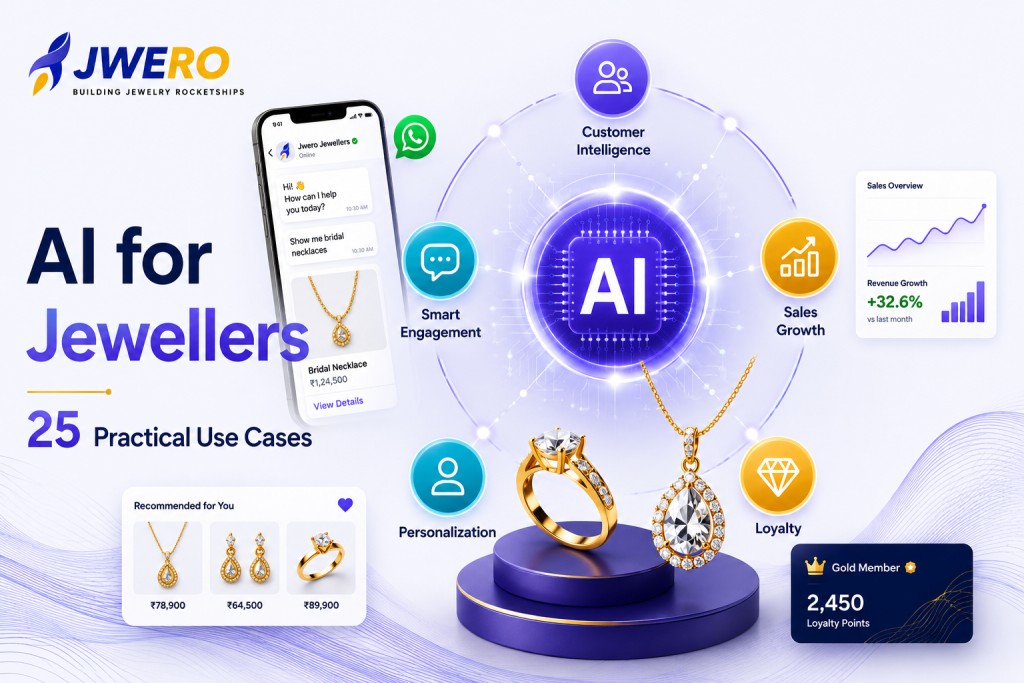


AI for jewellers means using artificial intelligence to improve how a jewellery business attracts customers, manages conversations, recommends products, follows up with leads, sells online, supports store teams, and brings customers back for repeat purchases. For jewellers, AI is most valuable when it is connected to CRM, WhatsApp, e-commerce, catalogues, marketing automation, loyalty, and in-store selling instead of being used as a standalone tool.
Jewellery retail has always depended on trust, timing, memory, and personal attention. A good salesperson remembers a customer’s occasion, budget, family preferences, earlier purchases, and style. A good store owner knows which enquiries need follow-up today, which customers are ready for bridal buying, which designs are moving, and which campaigns can bring people back.
AI helps jewellery businesses bring that kind of attentiveness into daily operations at scale. It can organise customer data, identify buying signals, suggest next actions, personalise messages, automate repetitive follow-ups, improve product discovery, and make ecommerce experiences easier to use.
But there is an important distinction. AI is not useful to jewellers just because it can write captions or generate images. AI becomes commercially useful when it helps a jewellery business convert more enquiries, serve customers faster, improve sales team productivity, and build stronger customer relationships.
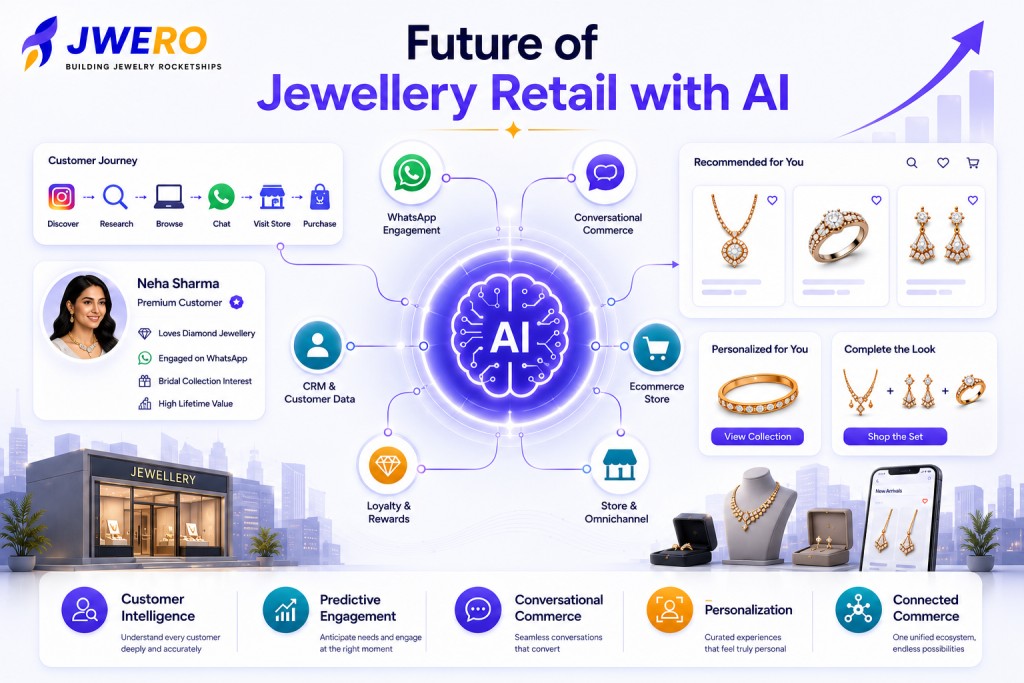
That is why the future of AI in jewellery is not only about AI tools. It is about connected jewellery commerce systems where CRM, WhatsApp, e-commerce, catalogues, automation, loyalty, and customer journeys work together.
What Is AI for Jewellers?
AI for jewellers refers to the use of artificial intelligence in jewellery retail, e-commerce, marketing, sales, customer engagement, product management, and operations. It helps jewellery businesses understand customers better, automate repetitive tasks, personalise communication, recommend products, and improve decision-making.
In practical terms, AI can help a jeweller answer questions like:
– Which leads should the sales team follow up with today?
– Which customers are likely to buy bridal jewellery, daily wear, gifting products, or gold savings plans?
– Which WhatsApp conversations need attention?
– Which products should be recommended to a customer based on budget, occasion, and past interest?
– Which e-commerce visitors are showing purchase intent?
– Which customer segment should receive a campaign before Akshaya Tritiya, Diwali, or the wedding season?
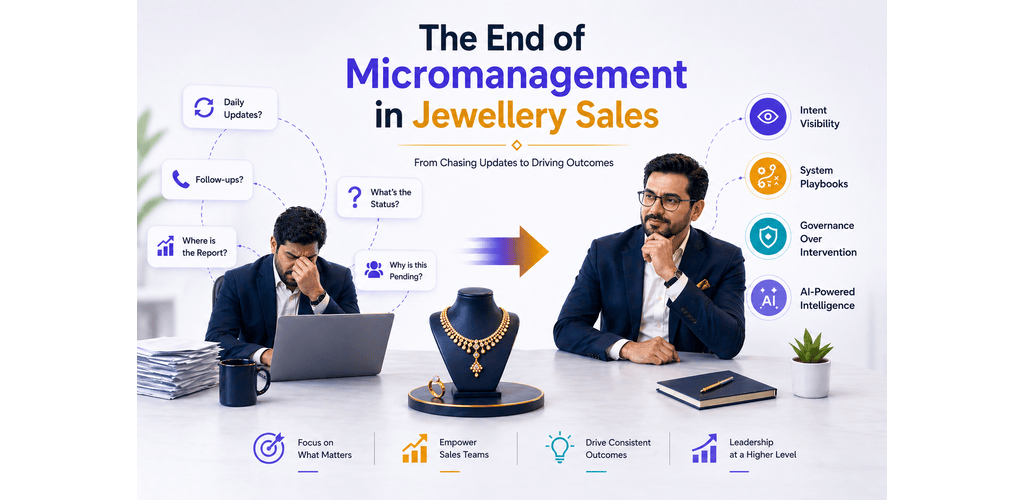
For jewellery businesses, the value of AI is not in replacing human relationships. The value is in giving store teams, marketers, and owners better visibility, faster workflows, and more consistent follow-up.
Why AI Matters Now for Jewellery Businesses
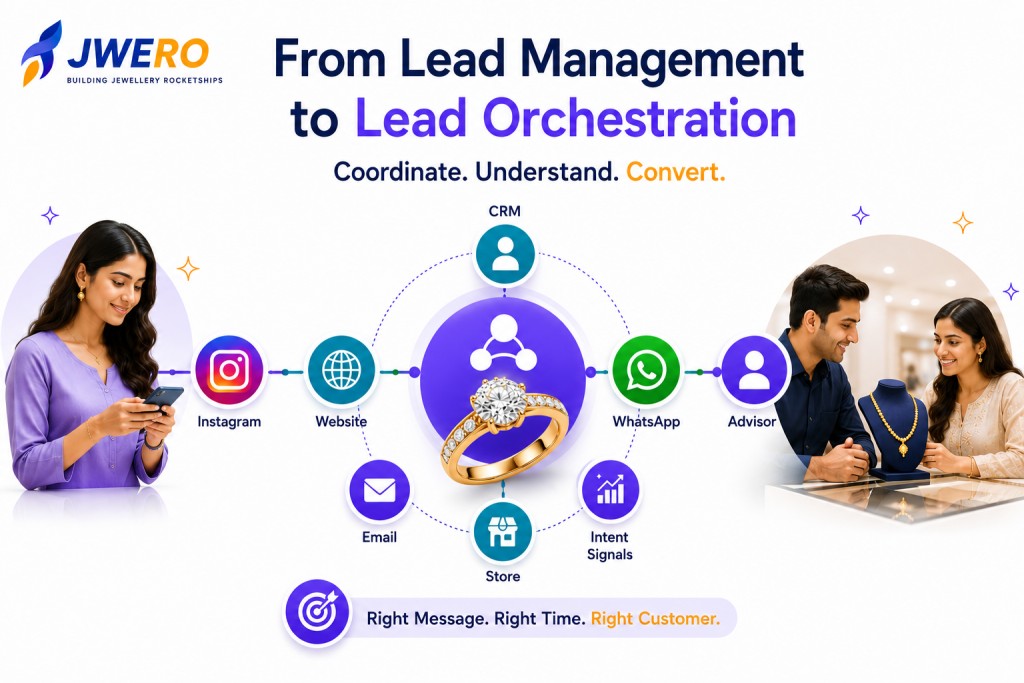
Jewellery customers now interact with brands across many touchpoints. A customer may discover a design on Instagram, ask a question on WhatsApp, visit the website, walk into the store, compare prices with family, come back during a festive campaign, and finally buy weeks later.
Without a connected system, these interactions often remain scattered across phones, spreadsheets, staff memory, e-commerce dashboards, and social media inboxes. That creates missed follow-ups, repeated questions, weak personalisation, and poor visibility into customer intent.
AI matters because it can help jewellers move from scattered activity to connected customer intelligence.
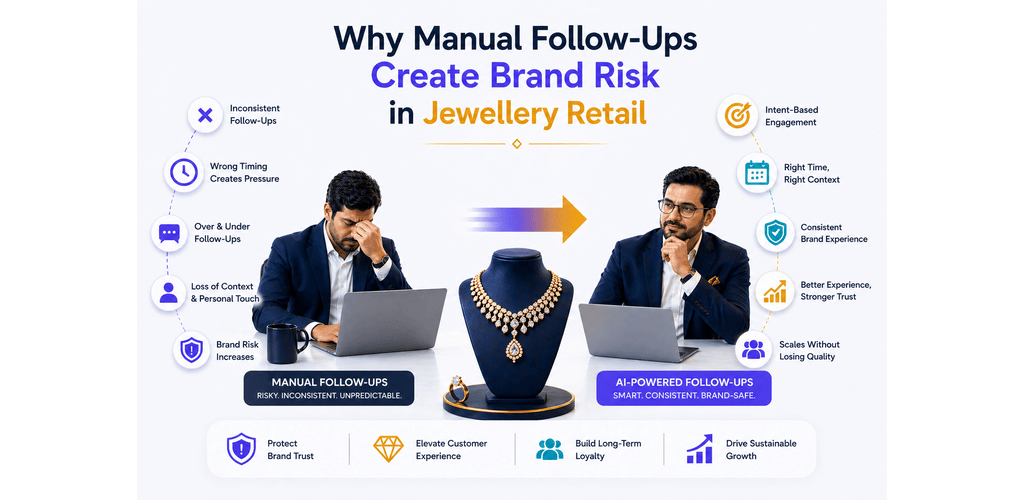
Old way vs AI-enabled way
Old way: Customer details live in notebooks, phones, or spreadsheets.
AI-enabled way: Customer profile, preferences, interactions, purchases, and engagement live in one view.
Old way: Follow-ups depend on individual salespeople’s discipline.
AI-enabled way: Follow-up reminders, triggers, and journeys can be automated.
Old way: Campaigns are sent broadly to everyone.
AI-enabled way: Campaigns can be segmented by occasion, interest, behaviour, value, and lifecycle stage.
Old way: Product discovery depends only on manual browsing.
AI-enabled way: Recommendations can be guided by budget, style, category, occasion, and past behaviour.
Old Day: WhatsApp conversations are hard to track.
AI-enabled way: Chats can be connected to CRM, lead stages, tasks, and customer history.
25 Practical AI Use Cases for Jewellers
The best AI use cases for jewellers are practical, commercial, and connected to daily work. Here are 25 high-value opportunities.
1. Lead scoring: Identify which enquiries are most likely to convert based on source, behaviour, product interest, and engagement.
2. Customer segmentation: Group customers by occasion, budget, purchase history, style preference, location, lifecycle stage, or campaign response.
3. WhatsApp response assistance: Help teams respond faster with suggested replies, product links, and next-step prompts.
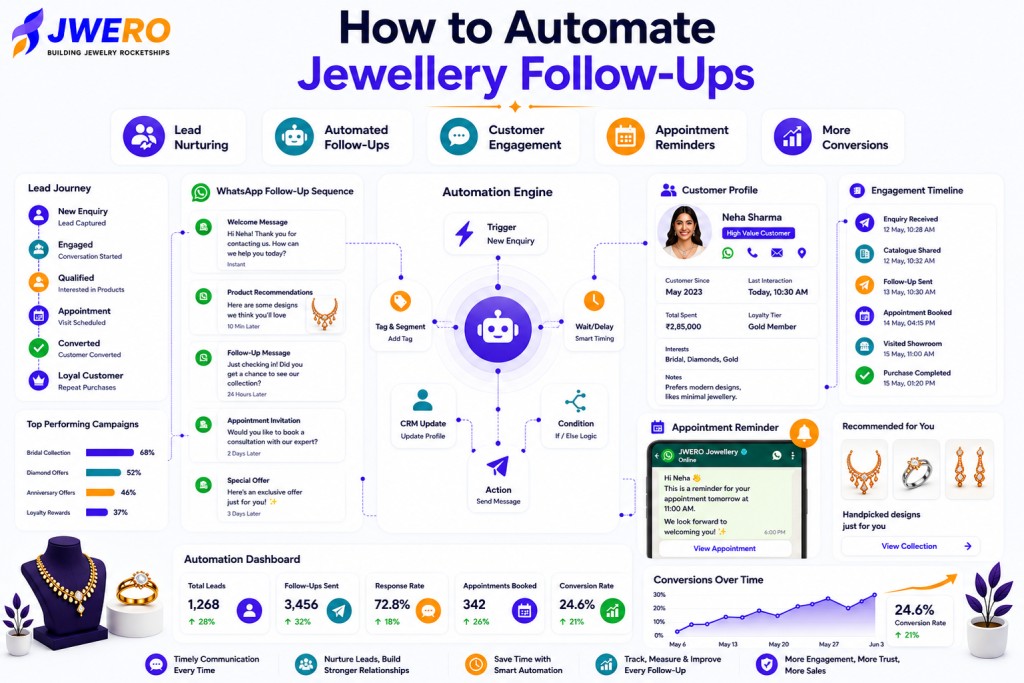
4. Follow-up automation: Trigger reminders or messages after store visits, product views, abandoned carts, missed calls, or chat enquiries.
5. Product recommendations: Recommend designs based on customer profile, budget, occasion, category, and previous interactions.
6. Catalogue personalisation: Create targeted product selections for bridal, gifting, daily wear, high-value, or repeat customers.
7. Campaign personalisation: Send different messages to different customer segments instead of one generic broadcast.
8. Customer journey automation: Build journeys for new leads, first-time buyers, repeat buyers, inactive customers, birthday/anniversary customers, and festive buyers.
9. Ecommerce product descriptions: Generate clearer product descriptions, titles, highlights, and SEO fields with human review.
10. Product tagging: Improve product categorisation by metal, stone, occasion, style, collection, price range, and gifting use case.
11. AI-assisted merchandising: Identify which product groups need better visibility, offers, or cross-sell placement.
12. Virtual try-on guidance: Help shoppers visualise rings, earrings, necklaces, and bridal jewellery before visiting or buying.
13. AI image enhancement: Improve product image preparation, background clean-up, and catalogue consistency where appropriate.
14. Abandoned cart recovery: Trigger personalised WhatsApp or email follow-ups for customers who leave without completing a purchase.
15. Store visit follow-ups: Send post-visit messages based on products viewed, estimate shared, occasion, and expected buying timeline.
16. Sales task management: Create tasks for teams when a lead becomes hot, a payment is pending, or a customer needs a callback.
17. Loyalty engagement: Identify customers who can be brought back with rewards, points, gold plans, or exclusive previews.
18. Gold savings journey reminders: Automate relevant reminders and nudges for customers in gold-saving or wallet-led journeys.
19. Customer lifetime value indicators: Spot higher-value customers based on purchase and engagement patterns.
20. Reactivation campaigns: Find inactive customers and trigger win-back offers, new collection previews, or occasion-led messages.
21. Festive campaign planning: Segment audiences before Akshaya Tritiya, Diwali, Valentine’s Day, wedding season, and regional festivals.
22. Review and referral prompts: Ask happy customers for reviews or referrals at the right moment after purchase.
23. Customer support routing: Route common questions to chatbot flows and complex queries to the right team member.
24. Business reporting: Summarise enquiries, conversations, campaign performance, product interest, and customer activity for owners.
25. Owner dashboards: Help decision-makers see where sales, marketing, and customer follow-up need attention.
AI for CRM and Customer Profiles
CRM is one of the most important places where AI can help jewellers. A jewellery purchase is rarely a simple transaction. It often involves personal preferences, trust, budget sensitivity, family influence, occasion timing, style exploration, and repeated conversations.
A jewellery CRM gives the business one place to understand the customer. AI can make that CRM more useful by helping teams identify patterns, segments, next actions, and buying signals.
For example, a customer profile may include:
– name, contact details, location, and demographic information
– purchase history and average order value
– preferred categories such as rings, necklaces, bangles, bridal sets, or daily wear
– budget range and metal preference
– WhatsApp, website, store, campaign, and social media interactions
– birthday, anniversary, wedding, or gifting occasions
– lead stage, tasks, notes, forms, loyalty points, and customer segments
When this profile is connected to automation, the business can move from generic selling to more relevant customer engagement. A bridal enquiry can receive different follow-ups from a daily-wear buyer. A high-value customer can receive exclusive previews. An inactive customer can receive a reactivation campaign. A gold savings customer can receive timely plan reminders.
Jwero angle: Jwero’s CRM-led approach is useful here because customer profiles, segments, tasks, chats, campaigns, loyalty, visits, and communication history can be connected instead of scattered across separate tools.
AI for WhatsApp, Chats, and Lead Follow-Up
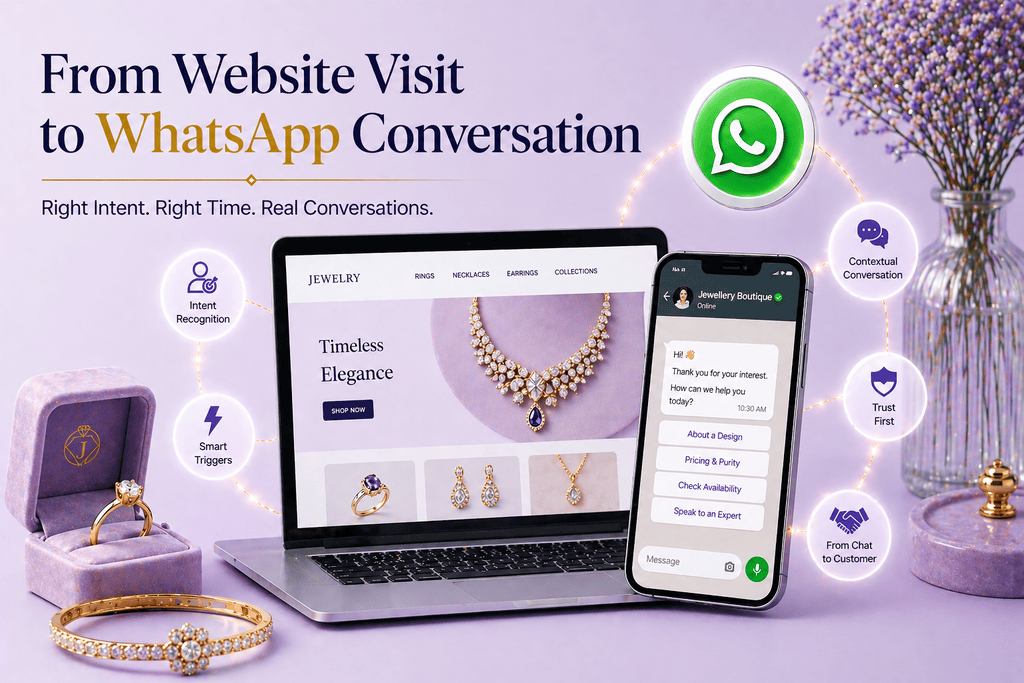
WhatsApp is one of the most important sales channels for jewellery businesses. Customers ask for prices, design options, availability, customisation, store location, video previews, appointment slots, and payment details through chat.
The challenge is that WhatsApp can become messy as volume increases. Leads get buried. Staff members reply inconsistently. Owners cannot always see which enquiries converted. Customers may ask on Instagram and continue on WhatsApp, making tracking harder.
AI and automation can improve WhatsApp-led selling in several ways:
– suggest replies based on product, occasion, and lead stage
– create tasks for unanswered or high-intent chats
– trigger follow-ups after product enquiries
– route customers to the right salesperson or store
– send catalogues, product links, estimates, forms, or appointment prompts
– connect WhatsApp conversations to CRM profiles
– segment customers based on chat behaviour and campaign response
For jewellers, the real advantage is not just faster replies. It is better continuity. When a customer returns after three weeks, the team should know what they asked for, what budget they mentioned, which products were shared, and what next step was promised.
AI for Ecommerce, Catalogues, and Product Pages
Jewellery ecommerce is harder than ordinary ecommerce because products are emotional, high-consideration, and detail-heavy. Customers want to understand design, metal, stone, making charges, certification, trust, price breakup, returns, customisation, delivery, payment options, and store credibility.
AI can help ecommerce teams improve product discovery and conversion, especially when combined with jewellery-specific catalogue and pricing workflows.
Useful e-commerce applications include:
– SEO-friendly product titles, descriptions, and meta fields
– product tags by occasion, style, collection, metal, stone, price range, and buyer type
– cross-sell and up-sell recommendations
– custom product collections for bridal, gifting, daily wear, festive, and premium buyers
– abandoned cart follow-ups through WhatsApp, email, or SMS
– product page improvements based on customer questions
– better catalogue sharing for store teams and chat teams
A strong jewellery e-commerce platform should also respect jewellery-specific complexity such as gold rate updates, diamond and gemstone calculations, making charges, taxes, discounts, ERP integration, payment gateways, and product availability. AI becomes more powerful when it works inside that business context.
Jwero angle: Jwero ecommerce materials point to jewellery-specific capabilities such as product categorisation, filters, offers, dynamic pricing, gold/diamond/gemstone/making charge calculations, ERP integration, WhatsApp enquiry, visitor chat, coupons, analytics, payment integrations, and SEO fields. These are the kinds of workflows AI content should reference to stay credible for jewellers.
AI for Marketing Campaigns and Customer Journeys
Many jewellery businesses still market in a broad way: one message to every customer, one festive campaign for everyone, one discount-led broadcast, or one generic Instagram push. AI can help jewellers become more precise.
Instead of treating all customers the same, a jeweller can create segments such as:
– bridal buyers
– repeat gold buyers
– inactive customers
– birthday or anniversary customers
– high-value customers
– customers who viewed diamond jewellery
– customers who asked about rings but did not buy
– customers who purchased during the last Diwali or Akshaya Tritiya
Each segment can receive a different message, offer, product selection, or follow-up journey. This improves relevance and reduces the feeling of spam.
AI can also support campaign planning by identifying which customer groups should be targeted, which message angle is most relevant, and which channel should be used. For example, WhatsApp may work better for high-intent product follow-ups, email may work better for collection launches, and push notifications may work better for app users.
AI for In-Store Teams and Assisted Selling
AI is not only for e-commerce. Physical jewellery stores can also benefit from AI-assisted workflows.
A store team can use connected customer data to understand a walk-in customer more quickly. If the customer has visited before, browsed products online, chatted on WhatsApp, or received a campaign, the salesperson can start with context instead of asking everything again.
AI-assisted in-store selling can help with:
– capturing walk-ins directly into CRM
– checking product availability
– recommending designs based on budget and occasion
– sharing catalogues instantly
– creating estimates, orders, invoices, and payment links
– setting follow-up tasks after store visits
– connecting store conversations to customer profiles
This is especially useful for bridal jewellery, premium purchases, family buying, customisation, and customers who compare multiple designs before deciding.
What Small Jewellery Stores Should Automate First
Small and mid-sized jewellery stores do not need to automate everything at once. The best starting point is the work that directly affects conversion, repeat sales, and customer experience.
1. Lead capture and customer profile creation: No enquiry should be lost across walk-ins, WhatsApp, website, ads, or social media.
2. Follow-up reminders: Most jewellery sales need timely follow-up after the first conversation.
3. WhatsApp catalogue sharing: Customers often want quick product options before visiting or buying.
4. Customer segmentation: Different customers need different messages, products, and timing.
5. Festive and occasion journeys: Jewellery demand is strongly influenced by festivals, weddings, birthdays, anniversaries, and gifting moments.
6. Post-purchase engagement: Repeat sales, referrals, reviews, loyalty, and gold plans depend on continued relationship building.
The practical rule is simple: automate the workflows that help the business respond faster, follow up better, and personalise communication without overwhelming the team.
AI Tools vs AI-Powered Jewellery Commerce OS
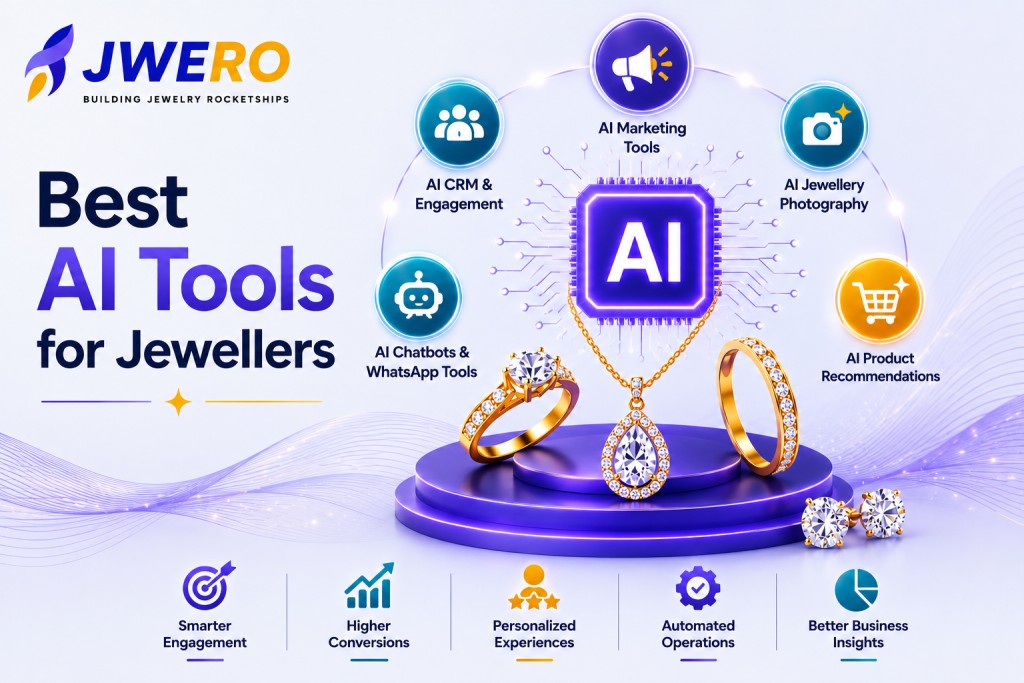
Many jewellers start by trying separate AI tools for captions, images, chat replies, or product descriptions. These tools can be useful, but they often remain disconnected from the actual business workflow.
A standalone AI tool may help create a message. But it may not know whether the customer is a bridal lead, whether they visited the store, whether they already received a catalogue, whether a salesperson promised a callback, or whether they bought during the last wedding season.
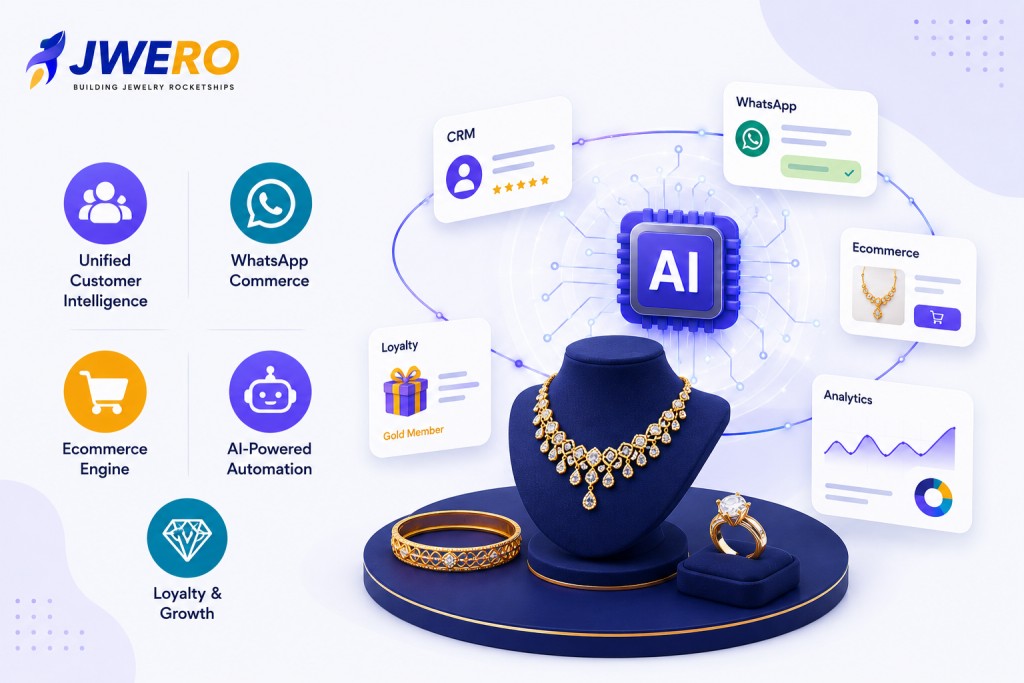
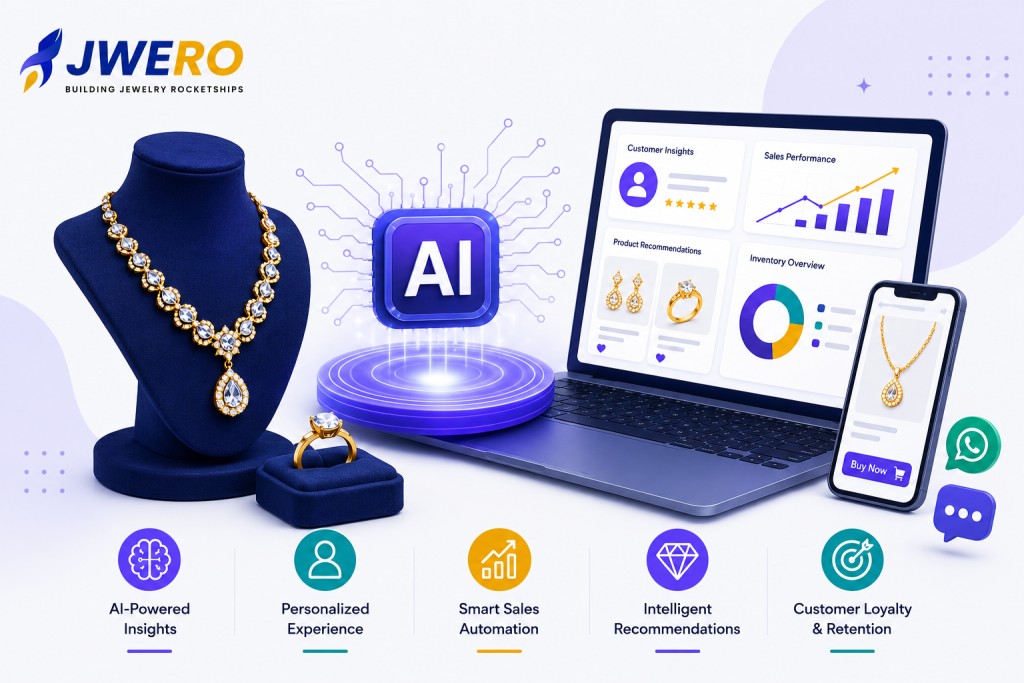
An AI-powered Jewellery Commerce OS is different. It connects AI with CRM, chats, e-commerce, catalogues, automation, campaigns, loyalty, wallet, and store workflows.
Standalone AI tool vs AI-powered Jewellery Commerce OS
Standalone AI tool: Helps with one task at a time.
Commerce OS: Connects multiple jewellery business workflows.
Standalone AI tool: May not know customer history.
Commerce OS: Uses CRM, chat, purchase, campaign, and behaviour data.
Standalone AI tool: Often depends on copy-paste work.
Commerce OS: Can trigger tasks, journeys, segments, and follow-ups.
Standalone AI tool: Useful for content creation.
Commerce OS: Useful for conversion, retention, customer engagement, and sales operations.
Standalone AI tool: Works outside the business system.
Commerce OS: Works inside the jewellery commerce workflow.
For a jewellery business, the second model is more valuable because growth depends on connected execution, not isolated content generation.
How to Implement AI Without Disrupting the Team
AI adoption can fail when teams feel it is too complex or disconnected from their daily work. Jewellery businesses should implement AI in stages.
1. Start with one clear business problem, such as missed follow-ups or weak WhatsApp tracking.
2. Centralise customer data before expecting AI to personalise communication.
3. Connect chats, leads, campaigns, store visits, and e-commerce behaviour to customer profiles.
4. Create simple segments that teams understand, such as bridal leads, inactive customers, repeat buyers, or festive buyers.
5. Automate reminders and journeys before attempting advanced prediction.
6. Train staff on workflows, not only software features.
7. Review results weekly and improve the process gradually.
The best AI implementation feels like a better operating system for the business, not an extra burden for the team.
Common Mistakes Jewellers Make With AI
– Using AI only for captions and ignoring sales follow-up.
– Keeping WhatsApp, CRM, ecommerce, and store data disconnected.
– Sending the same broadcast to every customer instead of segmenting.
– Automating messages before cleaning customer data.
– Trying too many tools instead of improving one customer journey at a time.
– Replacing human selling with automation instead of supporting sales teams with better context.
– Ignoring measurement, such as enquiry response time, follow-up completion, repeat sales, and campaign conversion.
AI should make jewellery selling more personal, not less personal. The goal is to help teams remember better, respond faster, recommend smarter, and follow up consistently.
FAQs About AI for Jewellers
What is AI for jewellers?
AI for jewellers is the use of artificial intelligence to improve jewellery CRM, WhatsApp conversations, ecommerce, catalogues, marketing campaigns, assisted selling, customer journeys, and business decision-making.
How can AI help a jewellery store increase sales?
AI can help a jewellery store increase sales by improving lead follow-up, customer segmentation, product recommendations, WhatsApp response speed, campaign personalisation, ecommerce conversion, and repeat customer engagement.
Is AI useful for small jewellery stores?
Yes. Small jewellery stores can use AI and automation for practical workflows such as lead capture, WhatsApp follow-up, customer segmentation, catalogue sharing, festive campaigns, and post-purchase engagement.
Can AI replace jewellery salespeople?
No. AI should support jewellery salespeople by giving them better customer context, reminders, recommendations, and follow-up workflows. Jewellery selling still depends heavily on trust, relationship, and human judgement.
What is the best first AI use case for jewellers?
The best first use case is usually lead and follow-up management. If a jeweller can capture every enquiry, connect it to a customer profile, and follow up at the right time, AI and automation can quickly support revenue impact.
How does AI help with WhatsApp marketing for jewellers?
AI can help organise WhatsApp conversations, suggest replies, create follow-up tasks, trigger customer journeys, segment audiences, and connect chat history to CRM profiles.
How does AI help jewellery ecommerce?
AI can help jewellery ecommerce by improving product descriptions, product tagging, recommendations, abandoned cart recovery, catalogue personalisation, customer support, and SEO-friendly product pages.
What is an AI-powered Jewellery Commerce OS?
An AI-powered Jewellery Commerce OS is a connected platform that brings CRM, WhatsApp, ecommerce, catalogues, automation, marketing, loyalty, and customer journeys together so jewellers can manage growth from one system.
Final Takeaway
AI is becoming important for jewellers because jewellery customers now move across stores, WhatsApp, ecommerce, social media, campaigns, and repeat purchase journeys. The businesses that win will not be the ones using the most AI tools. They will be the ones who use AI to connect customer intelligence, sales follow-up, product discovery, and personalised engagement.
For jewellery retailers, AI should help answer the most practical growth question: who should we speak to, what should we show them, when should we follow up, and how do we make the experience feel more personal?
Explore how Jwero helps jewellers use AI-powered CRM, WhatsApp, ecommerce, catalogues, and automation from one connected Jewellery Commerce OS.