

Jewellery marketing is becoming increasingly complex.
Customers interact with brands through:
- Google Search
- Ecommerce websites
- Physical stores
A single customer may engage with a jewellery business dozens of times before making a purchase.
Traditional marketing struggles to keep up with these expectations.
Artificial Intelligence is changing this.
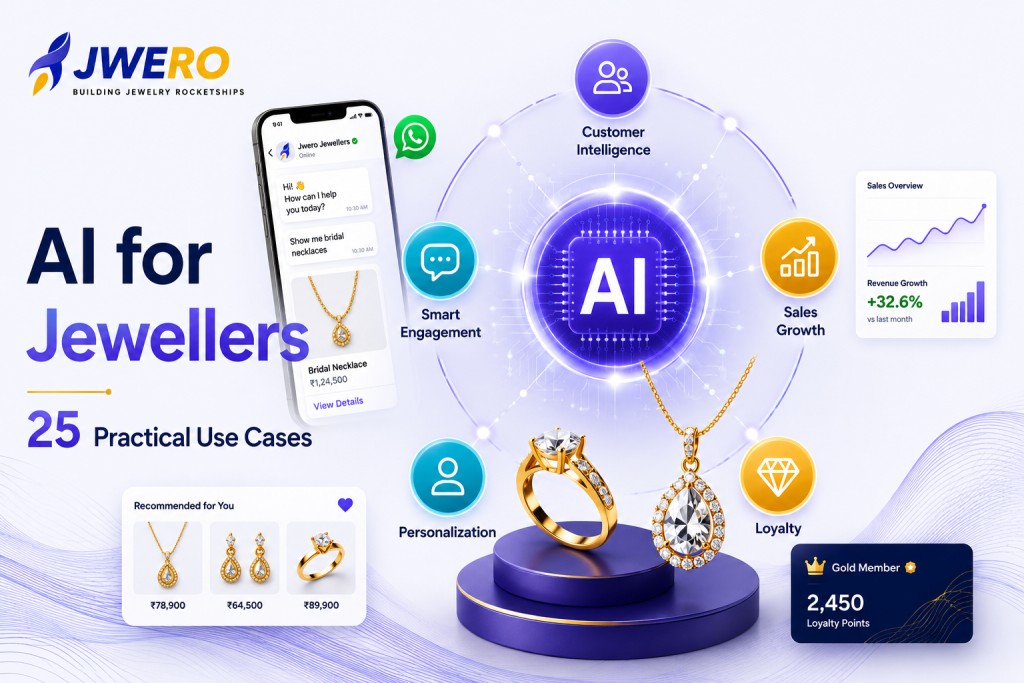
AI helps jewellers create more relevant, personalised, and effective marketing experiences while reducing manual effort.
The result is better customer engagement, stronger relationships, and improved marketing performance.
Why Traditional Jewellery Marketing Is Becoming Less Effective
For years, jewellery marketing followed a simple formula.
Create a campaign
Send it to everyone
Hope for results
Today’s customers expect much more.
They want:
- Personalized recommendations
- Relevant offers
- Timely communication
- Consistent experiences
Generic campaigns increasingly generate lower engagement because customers are overwhelmed by marketing messages.
Relevance has become more important than volume.
What Is AI Jewellery Marketing?
AI Jewellery Marketing refers to the use of Artificial Intelligence to improve how jewellery businesses attract, engage, convert, and retain customers.
AI helps businesses:
- Understand customer behaviour
- Personalize communication
- Optimize campaigns
- Improve targeting
- Predict customer needs
- Automate repetitive marketing tasks
Rather than replacing marketers, AI helps them make better decisions.
How AI Is Transforming Jewellery Marketing
The biggest change AI introduces is intelligence.
Instead of relying on assumptions, businesses can make decisions based on customer behaviour.
This creates more effective marketing.
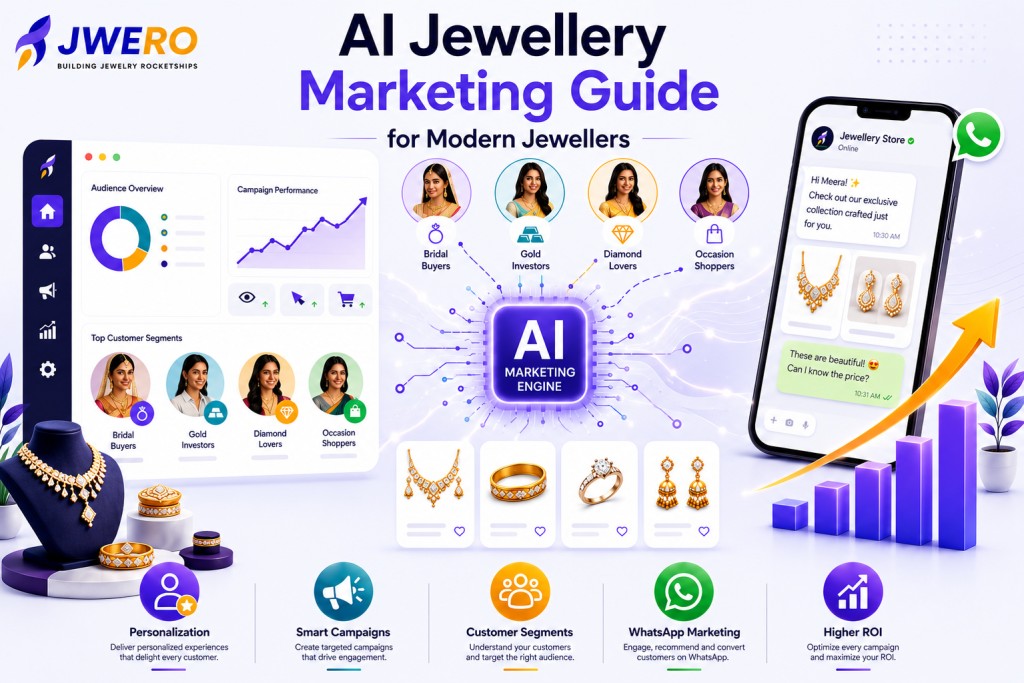
1. AI Customer Segmentation
Not all jewellery customers are the same.
Some are interested in:
- Bridal jewellery
- Diamond jewellery
- Daily wear jewellery
- Gold investment products
- Luxury collections
AI automatically groups customers based on behaviour and interests.
This enables more relevant communication.
For example:
A bridal customer should not receive the same campaign as a customer purchasing investment gold.
2. AI-Powered Personalisation
Personalisation is one of the most powerful applications of AI.
AI can personalise:
- Product recommendations
- Email campaigns
- WhatsApp communication
- Website experiences
- Promotional offers
Customers receive content that aligns with their interests.
This improves engagement and conversion rates.
3. AI Audience Creation
Creating marketing audiences manually can be time-consuming.
AI helps businesses identify:
- High-value customers
- Repeat buyers
- At-risk customers
- High-intent prospects
- Loyalty candidates
This allows marketers to focus on the right audiences.
4. AI Campaign Optimisation
Many campaigns underperform because of poor targeting, timing, or messaging.
AI can analyse campaign performance and identify opportunities for improvement.
This helps marketers:
- Improve open rates
- Increase engagement
- Boost conversions
- Reduce wasted spend
Optimisation becomes continuous rather than occasional.
5. AI Content Creation
Creating marketing content consistently is challenging.
AI can help generate:
- Social media captions
- Product descriptions
- Campaign copy
- Email content
- Blog ideas
This reduces production time while supporting marketing teams.
Human review remains important, but AI accelerates the process.
6. AI WhatsApp Marketing
WhatsApp has become one of the most important channels for jewellery businesses.
AI helps improve WhatsApp marketing through:
- Personalized communication
- Automated follow-ups
- Product recommendations
- Customer journey triggers
- Conversation insights
This creates a more engaging customer experience.
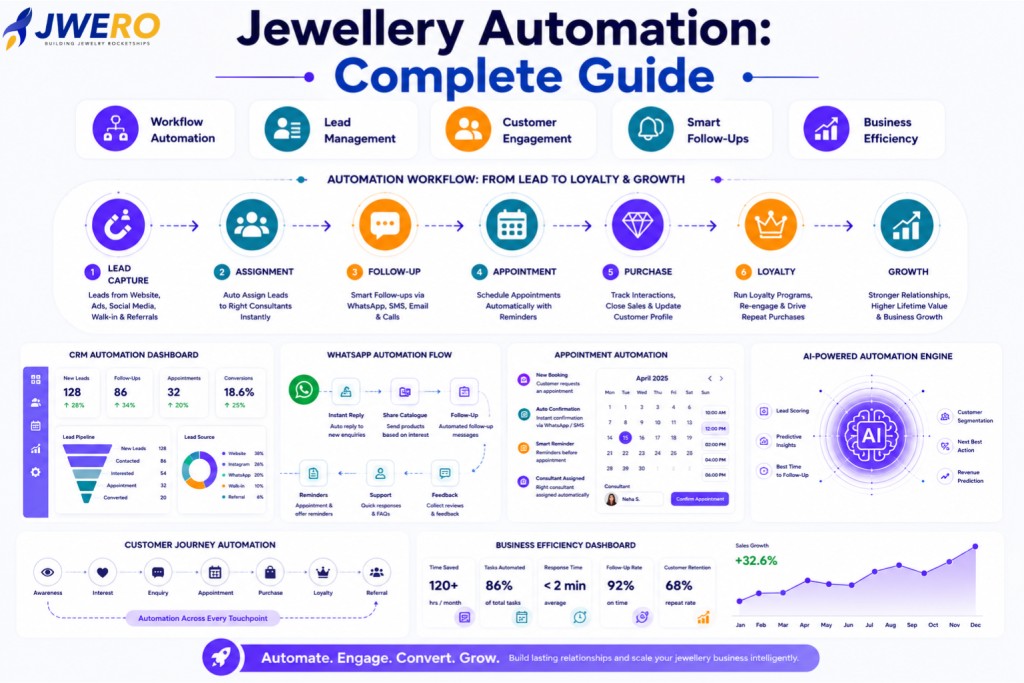
7. AI Customer Journey Automation
Customers move through multiple stages before making a purchase.
Examples include:
Discovery
Finding the brand.
Consideration
Exploring products.
Evaluation
Comparing options.
Purchase
Making a decision.
Loyalty
Becoming a repeat customer.
AI helps businesses automate engagement across these stages.
This ensures customers receive relevant communication at the right time.
8. AI Marketing Analytics
Many businesses collect marketing data but struggle to use it effectively.
AI helps uncover insights from:
- Campaign performance
- Customer behaviour
- Conversion trends
- Engagement activity
These insights help improve future campaigns.
9. AI Predictive Marketing
Predictive marketing uses AI to anticipate customer behaviour.
Examples include:
- Identifying customers likely to purchase
- Predicting churn risk
- Forecasting campaign performance
- Anticipating product interest
This allows businesses to engage proactively rather than reactively.
10. AI Loyalty Marketing
Retaining customers is often more profitable than acquiring new ones.
AI helps improve loyalty marketing through:
- Personalized rewards
- Customer lifecycle journeys
- Occasion-based engagement
- Repeat purchase campaigns
This strengthens long-term relationships.
Why Personalisation Matters in Jewellery Marketing
Jewellery purchases are emotional.
Customers buy jewellery for:
- Weddings
- Anniversaries
- Birthdays
- Celebrations
- Investments
- Personal milestones
These occasions create opportunities for personalised engagement.
AI helps businesses recognise these moments and communicate appropriately.
The result is more meaningful customer experiences.
Traditional Marketing vs AI Marketing
| Traditional Marketing | AI Marketing |
|---|---|
| Broad targeting | Intelligent targeting |
| Generic campaigns | Personalized experiences |
| Manual segmentation | Dynamic segmentation |
| Reactive marketing | Predictive marketing |
| Limited insights | Customer intelligence |
AI does not replace marketing fundamentals.
It enhances them.
Common AI Marketing Mistakes
Sending More Messages
AI should improve relevance, not increase noise.
Over-Automation
Customers still value human interaction.
Ignoring Customer Data
AI is only as effective as the data it uses.
Focusing Only on Acquisition
Retention and loyalty deserve equal attention.
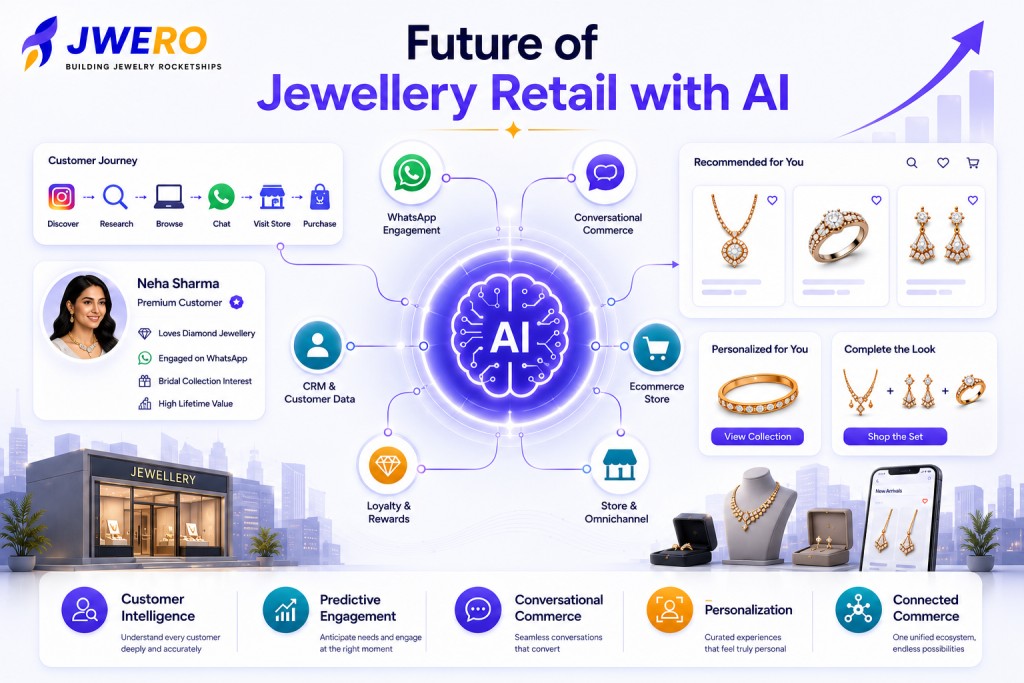
The Future of Jewellery Marketing
Marketing is moving toward:
- Hyper-personalization
- Customer intelligence
- Predictive engagement
- Omnichannel experiences
- AI-powered customer journeys
The businesses that embrace these capabilities today will be better positioned tomorrow.
How Jwero Supports AI Jewellery Marketing
Jwero helps jewellery businesses apply AI across:
- Customer segmentation
- CRM
- WhatsApp engagement
- Campaign automation
- Customer journeys
- Loyalty programs
- Customer intelligence
By connecting customer data and engagement into a single ecosystem, businesses can create more personalised marketing experiences at scale.
Final Thoughts
The future of jewellery marketing is not about sending more campaigns.
It is about creating better customer experiences.
AI helps businesses understand customers, personalise engagement, optimise campaigns, and build stronger relationships.
The jewellers who succeed in the coming years will be the ones who combine technology with genuine customer understanding.
Frequently Asked Questions
What is AI Jewellery Marketing?
AI Jewellery Marketing uses Artificial Intelligence to improve customer targeting, personalisation, campaign optimisation, and customer engagement.
How does AI improve jewellery marketing?
AI helps businesses segment customers, personalise communication, optimise campaigns, and predict customer behaviour.
Can small jewellers use AI marketing?
Yes. Many AI-powered marketing tools are designed for businesses of all sizes and can significantly improve efficiency and effectiveness.
Does AI help with WhatsApp marketing?
Yes. AI can automate follow-ups, personalise communication, and improve customer engagement through WhatsApp.
What is the biggest benefit of AI marketing?
The biggest benefit is relevance. AI helps businesses deliver the right message to the right customer at the right time.
Can AI improve customer retention?
Yes. AI supports loyalty programs, lifecycle marketing, and personalised engagement, strengthening long-term customer relationships.