

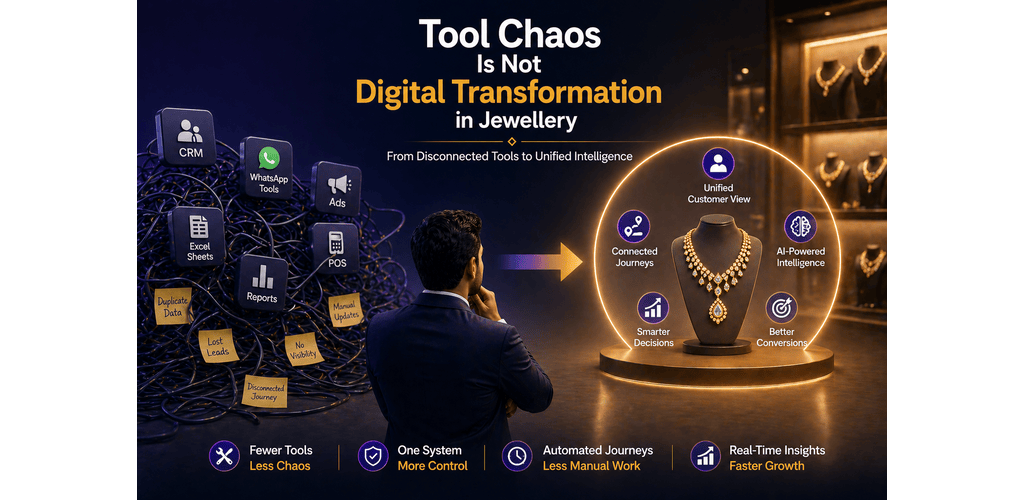
More Software Has Not Made Jewellery Businesses Smarter
Most jewellery businesses today proudly say:
- “We have a CRM”
- “We use WhatsApp tools”
- “We run ads”
- “We have ERP, POS, and reports”
- “We have Website & Apps”
On paper, they look digitally mature.
In reality, many are:
- Slower in decision-making
- More dependent on people
- Less clear on lead journeys
- More stressed at scale
This contradiction has a name:
Tool Chaos.
And tool chaos is often mistaken for digital transformation.
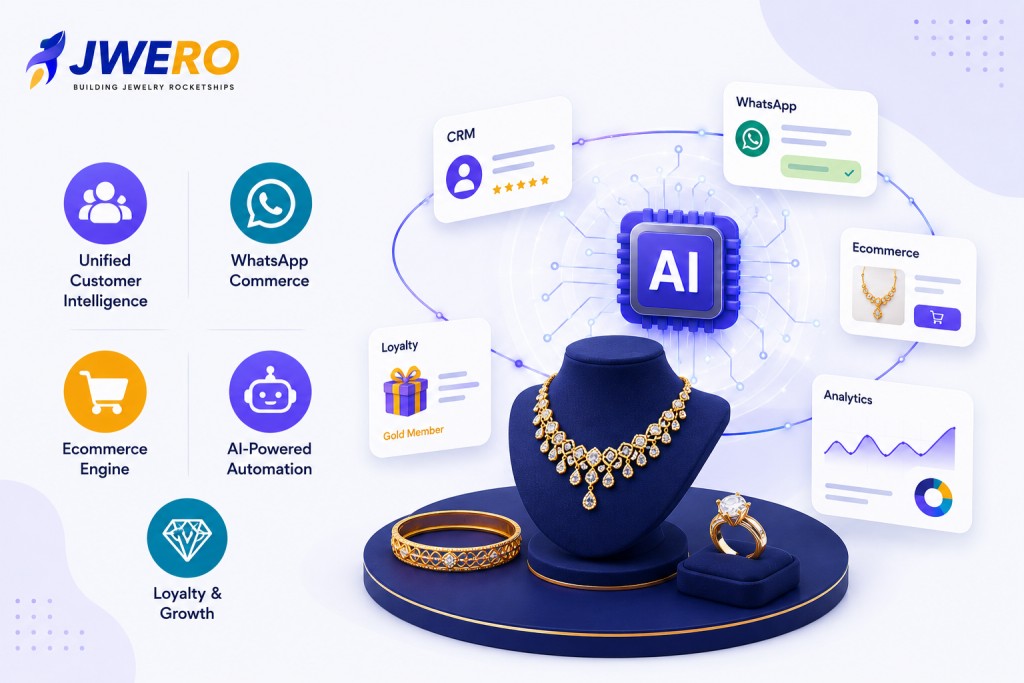
Many modern jewellery retailers are now realising that fragmented systems create operational complexity instead of intelligence. This is why unified ecosystems like JWERO.ai are becoming increasingly important for connected customer engagement and retail orchestration.
The Jewellery Digitalization Illusion
Jewellery businesses rarely adopt technology as a system.
They adopt it as patches.
- CRM to manage enquiries
- WhatsApp tool to reply faster
- ERP to manage inventory
- POS to bill
- Ad platforms to generate leads
- Website to manage products online
Each tool solves a local problem.
None solve the end-to-end business reality.
This creates disconnected workflows where customer journeys become fragmented across departments and platforms.
Retailers using platforms like JWERO CRM are increasingly shifting toward unified engagement visibility instead of isolated software management.
What Tool Chaos Looks Like Inside Jewellery Businesses
If you see these signs, tool chaos already exists:
- Same customer appears in multiple systems
- Sales staff switch between 5–6 tools daily
- Managers depend on WhatsApp updates
- Online and store teams don’t share context
- Reports look healthy but feel unreliable
The business is “digitised” — but not intelligent.
Disconnected workflows create operational fatigue and reduce leadership visibility into actual customer journeys.
Why Jewellery Is Especially Vulnerable to Tool Chaos
Jewellery is uniquely complex:
- High-value transactions
- Long decision cycles
- Omnichannel journeys
- Offline + online dependency
- Emotional and trust-based buying
Generic tools are not designed for this complexity.
So jewellers keep adding tools instead of fixing architecture.
Omnichannel jewellery retail requires systems that connect conversations, engagement behaviour, store interactions, and customer intent into a single operational layer.
The False Belief: “More Tools = More Control”
This belief quietly damages businesses.
In reality:
- Every new tool adds another data silo
- Every silo breaks journey continuity
- Every break reduces conversion probability
Control does not come from more software.
It comes from fewer systems with deeper intelligence.
Operational simplicity creates better visibility than fragmented complexity.
How Tool Chaos Breaks Lead Management
Let’s look at leads specifically.
Typical setup:
- Ads generate leads in Meta & Google
- WhatsApp conversations live on phones
- Website behaviour is invisible
- Walk-ins are remembered manually
- CRM stores partial data
Result:
- Leads exist everywhere
- Journeys exist nowhere
This is why:
- Follow-ups fail
- Attribution is unclear
- Managers micromanage
Centralized engagement ecosystems like JWERO Chats help jewellery retailers unify customer communication across WhatsApp, Instagram, Facebook, and Meta Ads conversations.
Why CRM Alone Cannot Fix Tool Chaos
CRM is often used as the “central solution”.
But CRM:
- Depends on manual updates
- Cannot read behaviour automatically
- Cannot unify offline signals
- Cannot predict intent
CRM organises records.
Jewellery businesses need orchestration.
Modern jewellery operations require systems capable of interpreting customer journeys rather than simply storing customer data.
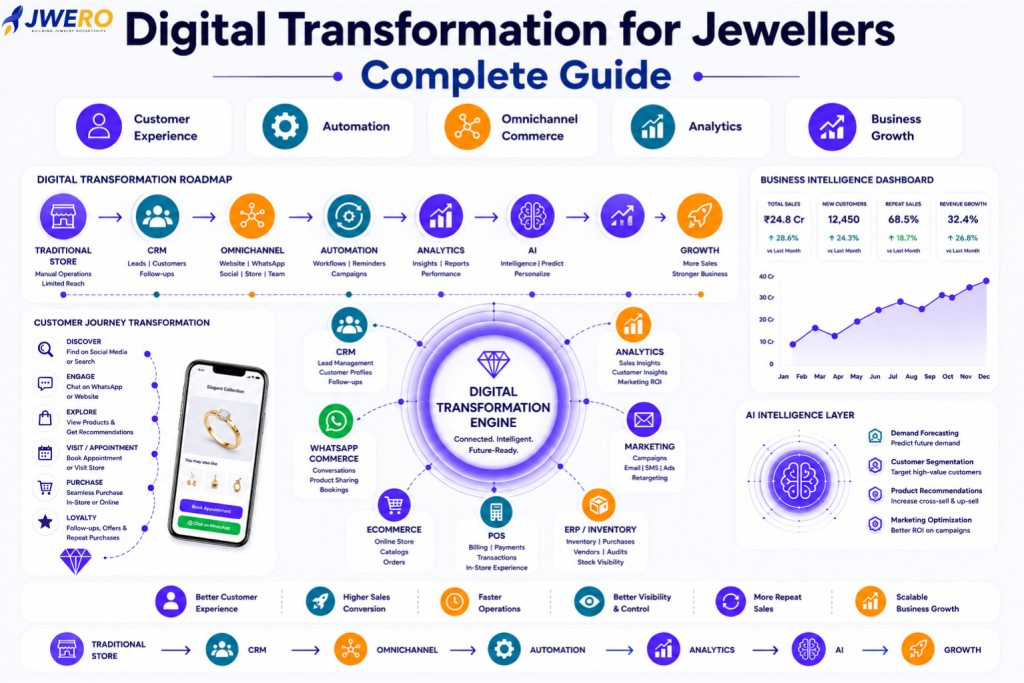
Digital Transformation ≠ Digitisation
This is the most important distinction.
Digitisation
- Moving processes to software
- Using tools instead of paper
- Faster execution of old workflows
Digital Transformation
- Rethinking workflows around intent
- Connecting systems into journeys
- Automating decisions, not just actions
- Reducing dependency on individuals
Most jewellery businesses digitise.
Very few transform.
This distinction defines whether technology creates clarity or complexity.
What Real Digital Transformation Looks Like in Jewellery
True transformation creates:
- One view of the customer
- One continuous journey
- One source of truth
- One logic governing engagement
This means:
- Walk-ins, WhatsApp, web, and social all connect
- Intent is tracked automatically
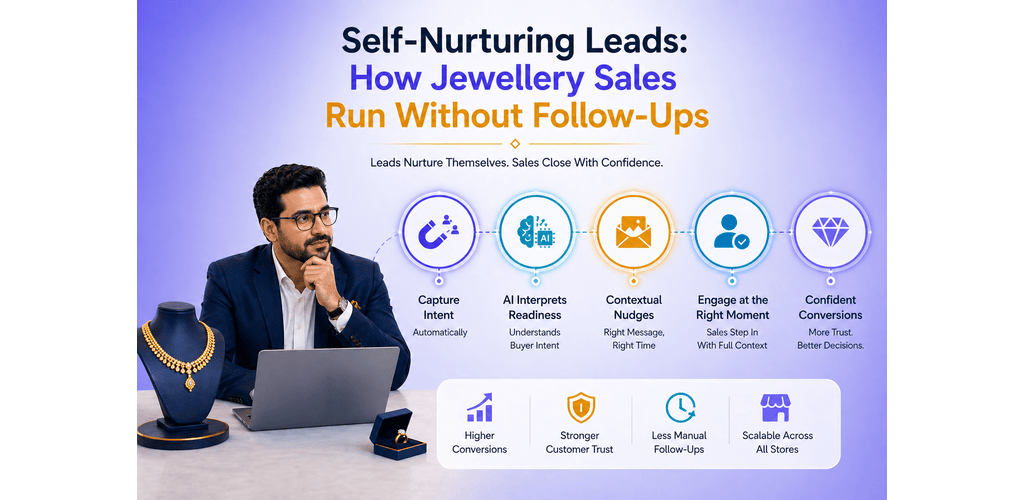
- Follow-ups are system-driven
- Managers see reality, not reports
Transformation simplifies — it doesn’t complicate.
Retailers increasingly use systems like JWERO Ecommerce to connect digital storefronts with customer engagement and operational visibility.
The Role of AI in Ending Tool Chaos
AI does not replace tools.
It connects and interprets them.
AI:
- Reads signals across systems
- Understands customer behaviour
- Scores intent continuously
- Triggers next-best actions
- Alerts leadership before damage occurs
Without AI:
- Data remains fragmented
- Decisions stay reactive
AI-powered systems reduce operational dependency on manual coordination and disconnected reporting.
Solutions like JWERO WhatsApp Automation help unify customer engagement workflows while preserving timing, context, and continuity.
Why Tool Chaos Gets Worse as Jewellery Businesses Scale
As scale increases:
- More stores adopt different habits
- More teams use tools differently
- More handoffs break journeys
Without a unifying intelligence layer:
- Inconsistency grows
- Control weakens
- Leadership intervenes manually
Growth exposes architectural weaknesses.
This is one of the biggest operational risks in expanding jewellery retail chains.
Geography & Tool Chaos
India
- Heavy WhatsApp usage
- Manual store coordination
- CRM under-utilisation
Middle East
- Strong digital presence
- Fragmented attribution
- Luxury experience inconsistency
Southeast Asia
- App + promotion overload
- Data without interpretation
Different markets.
Same outcome without orchestration.
Why Jwero Is Designed to Eliminate Tool Chaos
Jwero is not another tool.
It is the intelligence layer that:
- Connects CRM, WhatsApp, POS, ERP, ads, websites, mobile apps, sales apps, email, SMS, and engagement systems
- Tracks journeys, not just actions
- Automates engagement logic
- Gives leadership unified visibility
With JWERO.ai, jewellery retailers gain connected operational intelligence instead of fragmented software management.
Jwero doesn’t add complexity.
It removes it.
Jwero turns fragmented tools into a single, intelligent system.
Frequently Asked Questions
What is tool chaos in jewellery businesses?
Tool chaos occurs when multiple disconnected software platforms create fragmented customer journeys, operational confusion, and dependency on manual coordination.
Is CRM enough for digital transformation in jewellery retail?
No. CRM is only one component. Jewellery businesses need unified customer engagement, journey orchestration, and omnichannel operational intelligence.
How does AI reduce tool chaos?
AI connects signals across systems, interprets customer behaviour, automates engagement decisions, and improves visibility across fragmented workflows.
Can digital transformation simplify jewellery operations?
Yes. Real digital transformation reduces complexity by replacing disconnected workflows with unified operational systems and automated intelligence.
Why do jewellery retailers struggle with disconnected software?
Because most generic tools solve isolated operational problems instead of connecting customer journeys, engagement data, and sales workflows into a unified ecosystem.
How can jewellery businesses improve omnichannel visibility?
By implementing systems that centralize conversations, customer behaviour tracking, sales engagement, and operational intelligence across all channels.
Final Thought
Adding tools feels productive.
Fixing architecture feels hard.
But only one creates real control.
In jewellery retail, digital transformation is not about having more tools — it’s about having fewer decisions left to chance.
Replace Tool Chaos With Intelligent Jewellery Retail Operations
Discover how JWERO.ai helps jewellery retailers unify customer journeys, centralize communication, automate engagement workflows, and eliminate operational fragmentation across stores and channels.
Explore capabilities including:
- Omnichannel customer engagement
- AI-powered journey orchestration
- WhatsApp automation workflows
- Centralized CRM visibility
- Jewellery ecommerce integration
- Unified operational intelligence
why more software does not improve jewellery retail operations, how tool chaos affects jewellery business growth, why jewellery retailers need unified systems, how AI reduces software fragmentation in jewellery retail, best digital transformation strategy for jewellers, why CRM alone is not enough for jewellery businesses, how jewellery retailers can unify customer journeys, problems caused by disconnected software tools in jewellery retail, how jewellery businesses can reduce operational complexity, intelligent automation systems for jewellery retailers