

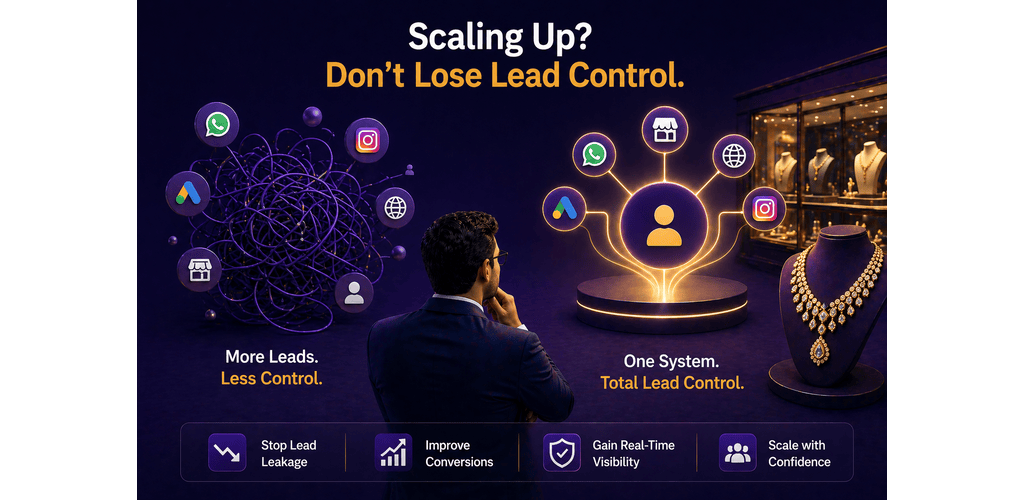
Growth Is Supposed to Feel Like Progress — Not Pressure
Every jewellery business wants to grow.
More stores.
More staff.
More marketing.
More leads.
Yet somewhere between the third store and the tenth, something changes.
Owners say:
- “We have more enquiries than ever, but less clarity.”
- “Teams are busy, but conversions feel unpredictable.”
- “Everything works — but only when I’m personally involved.”
This is not a coincidence.
This is what happens when lead systems don’t scale at the same pace as the business.
As jewellery businesses expand across channels, stores, and customer touchpoints, operational visibility becomes harder without connected engagement systems like JWERO.ai.
The Jewellery Scaling Paradox
Jewellery businesses face a paradox that few other industries do:
- Revenue grows ✔
- Brand recognition grows ✔
- Lead volume grows ✔
- Control shrinks ✖
This is because jewellery growth is not linear.
Each new store, channel, and team member multiplies complexity, not just volume.
This complexity becomes even harder to manage when customer conversations, lead tracking, and engagement systems remain disconnected.
Why Lead Control Breaks During Jewellery Expansion
Let’s break this down structurally — not emotionally.
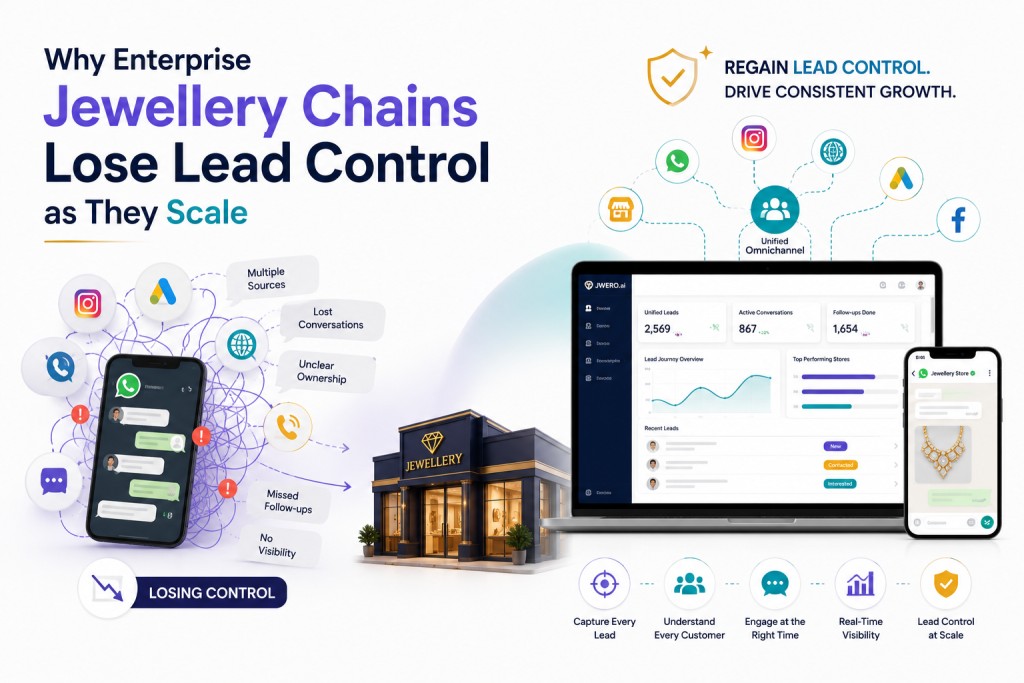
1. Lead Sources Multiply Faster Than Systems
At small scale:
- Walk-ins
- One WhatsApp number
- Word-of-mouth
At scale:
- Multiple stores
- Multiple WhatsApp numbers
- Instagram, Google, website, ads
- Gold schemes, apps, referrals
Leads start entering from dozens of entry points.
If systems don’t unify them:
- The same customer appears multiple times
- Journeys fragment
- Ownership becomes unclear
Volume increases, visibility decreases.
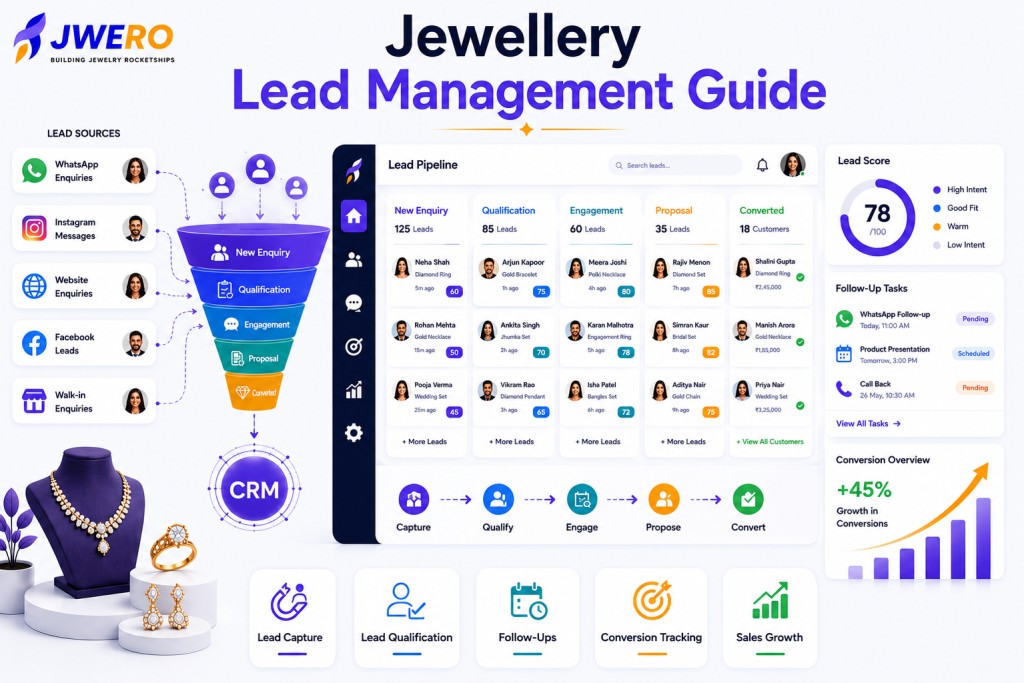
Retailers increasingly use platforms like JWERO Chats to centralize conversations across WhatsApp, Instagram, Facebook, and Meta Ads interactions.
2. People Become the Glue Holding the Business Together
In growing jewellery businesses:
- Senior managers remember customers
- Experienced staff connect dots
- Owners intervene to “fix things”
This works — until it doesn’t.
People-based systems fail when:
- Someone leaves
- Someone is absent
- Load increases suddenly (festivals, weddings)
When knowledge lives in heads, scale creates fragility.
Operational continuity requires systems that preserve customer context instead of relying on memory and manual coordination.
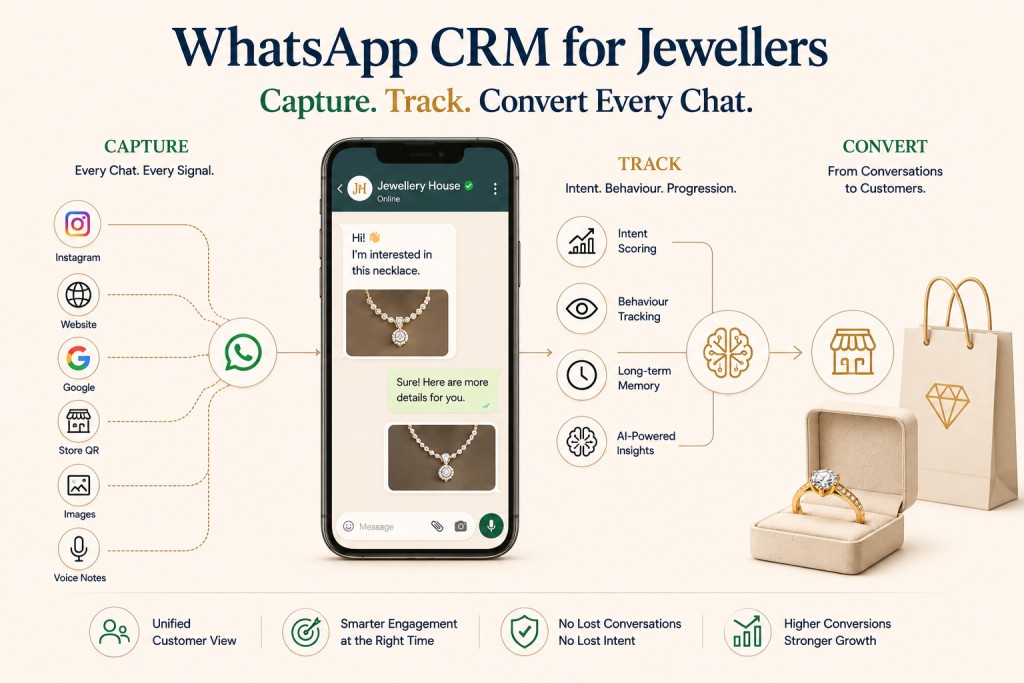
3. WhatsApp Chaos Grows Invisibly
WhatsApp is a blessing early on.
At scale, it becomes a silent risk.
Typical symptoms:
- Multiple numbers per store
- No ownership rules
- Leads stuck in personal phones
- Conversations lost when staff changes
Management assumes:
“WhatsApp is working.”
In reality:
Leads are leaking quietly.
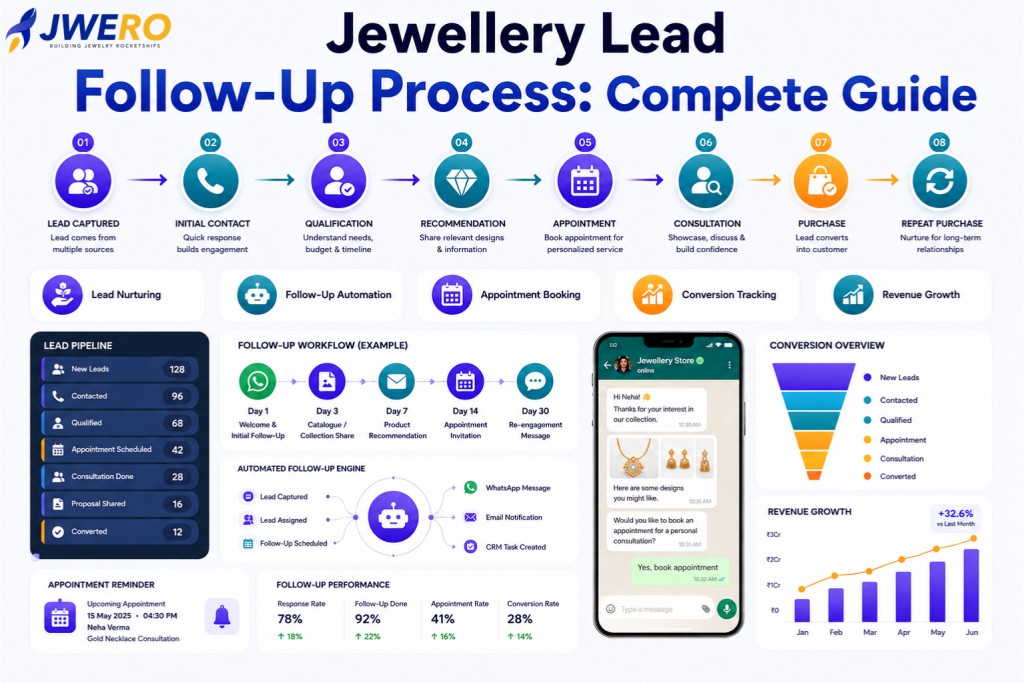
This is why jewellery retailers are increasingly adopting structured systems like JWERO WhatsApp Automation to improve follow-up continuity, ownership tracking, and centralized communication visibility.
4. Offline and Online Journeys Drift Apart
As scale increases:
- Marketing teams focus on digital
- Store teams focus on walk-ins
- Systems don’t connect the two
A customer:
- Engages online
- Visits a store
- Is treated like a stranger
This resets trust and kills conversion momentum.
Disconnected journeys are expensive at scale.
Jewellery businesses need omnichannel customer journey visibility instead of isolated digital and offline workflows.
5. Reporting Looks Healthy — But Lies
Large jewellery businesses often rely on:
- Enquiry counts
- Billing numbers
- Store-wise revenue
These metrics show:
- Activity
- Output
They do not show:
- Lead leakage
- Missed follow-ups
- Silent drop-offs
- Intent decay
By the time revenue dips, the damage is already weeks old.
Real operational intelligence requires visibility into customer intent and engagement quality — not just reporting dashboards.
6. Managers Become Firefighters, Not Strategists
As lead chaos increases:
- Managers chase updates
- Follow-ups are pushed manually
- Teams are micromanaged
This creates:
- Burnout
- Inconsistency
- Reactive decision-making
Leadership time is spent fixing symptoms, not building systems.
Retail growth becomes stressful when operational systems fail to scale with customer engagement complexity.
7. Expansion Exposes Inconsistent Selling Quality
At scale:
- Not all salespeople perform equally
- Not all stores follow best practices
- Customer experience varies widely
Without systemised lead logic:
- Star performers carry results
- Weak links silently lose leads
- Brand consistency erodes
Growth amplifies weaknesses.
This is especially dangerous for jewellery brands where trust and continuity directly impact conversions.
The Root Cause: Scaling Activity Without Scaling Intelligence
Most jewellery businesses scale:
- Marketing activity
- Store footprint
- Team size
But do not scale:
- Lead understanding
- Intent tracking
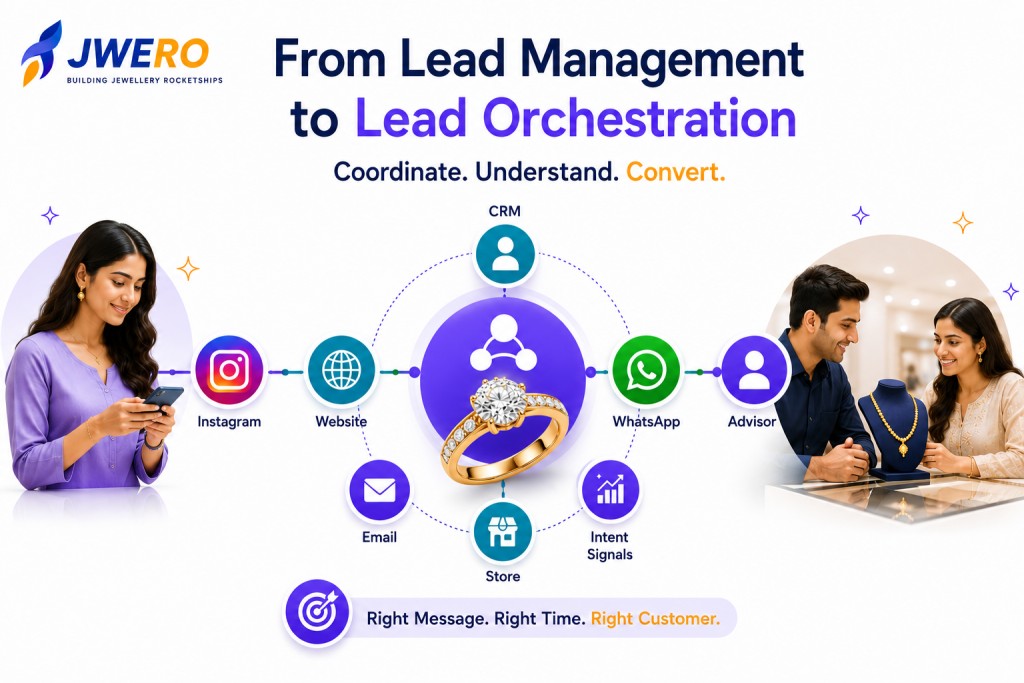
- Journey orchestration
This creates a widening gap between what is happening and what leadership can see.
Platforms like JWERO CRM help jewellery retailers move beyond fragmented lead tracking toward centralized customer journey intelligence.
Why Traditional CRM Fails Faster at Scale
CRM struggles at scale because:
- Data entry becomes inconsistent
- Updates lag reality
- Offline behaviour is invisible
- Context is lost across handoffs
CRM depends on discipline.
Scale destroys discipline.
This is why growing jewellery businesses increasingly require automation-driven engagement orchestration instead of record-based management alone.
The Shift Required: From Lead Volume to Lead Control
Successful enterprise jewellers stop asking:
“How many leads did we get?”
They start asking:
“Do we have control over every buying signal?”
Lead control means:
- Every lead source is captured automatically
- Every interaction adds context
- Every journey is visible
- Every follow-up is system-driven
- No lead depends on one person
This is the operational shift that separates scalable jewellery brands from chaotic ones.
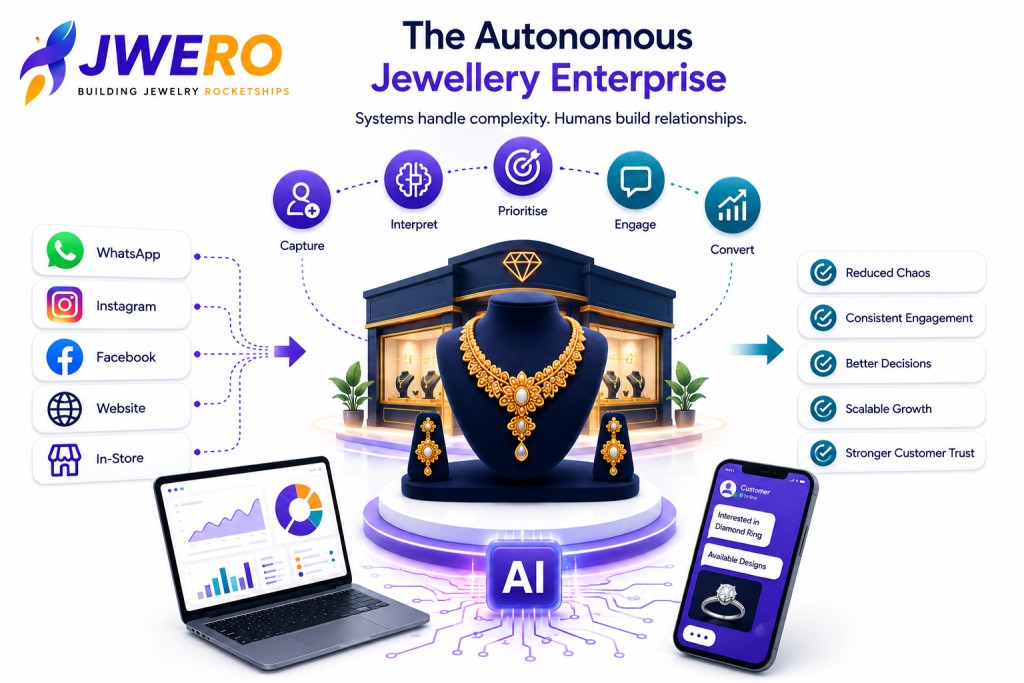
How Jwero AI Restores Control at Scale
AI doesn’t add complexity.
It absorbs it.
AI enables:
- Continuous intent tracking
- Automatic prioritisation
- Consistent engagement logic
- Early warning signals for leakage
- Real-time visibility for leadership
Instead of reacting late, leaders see problems forming early.
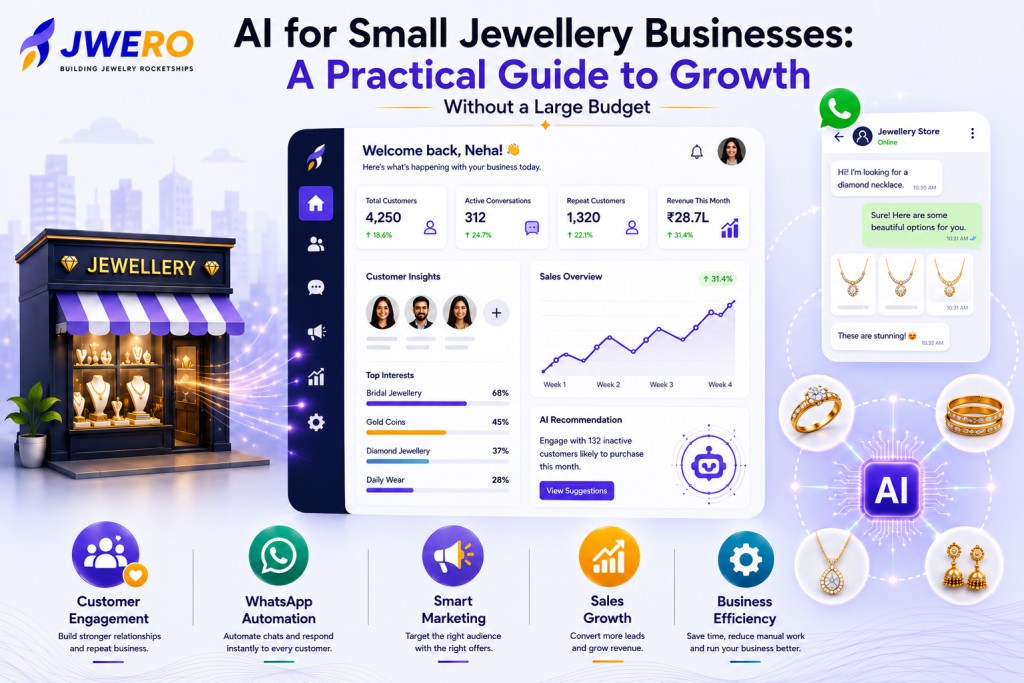
Solutions like JWERO.ai help jewellery businesses centralize operational intelligence across stores, teams, and engagement channels.
Geography & Scale: Different Markets, Same Problem
India
- Store-heavy expansion
- WhatsApp-driven chaos
- Gold scheme complexity
Middle East
- Multi-location luxury brands
- Instagram & Google lead fragmentation
- High expectation of continuity
Southeast Asia
- App + promotion-driven scale
- Faster cycles
- Attribution challenges
Different markets.
Same structural breakdown without intelligence.
Why Jwero Is Built for Scaled Jewellery Businesses
Jwero is designed for the point where growth breaks traditional systems.
Jwero:
- Unifies all lead sources
- Connects online + offline journeys
- Tracks intent continuously
- Automates follow-ups and nurturing
- Gives leadership real-time control dashboards
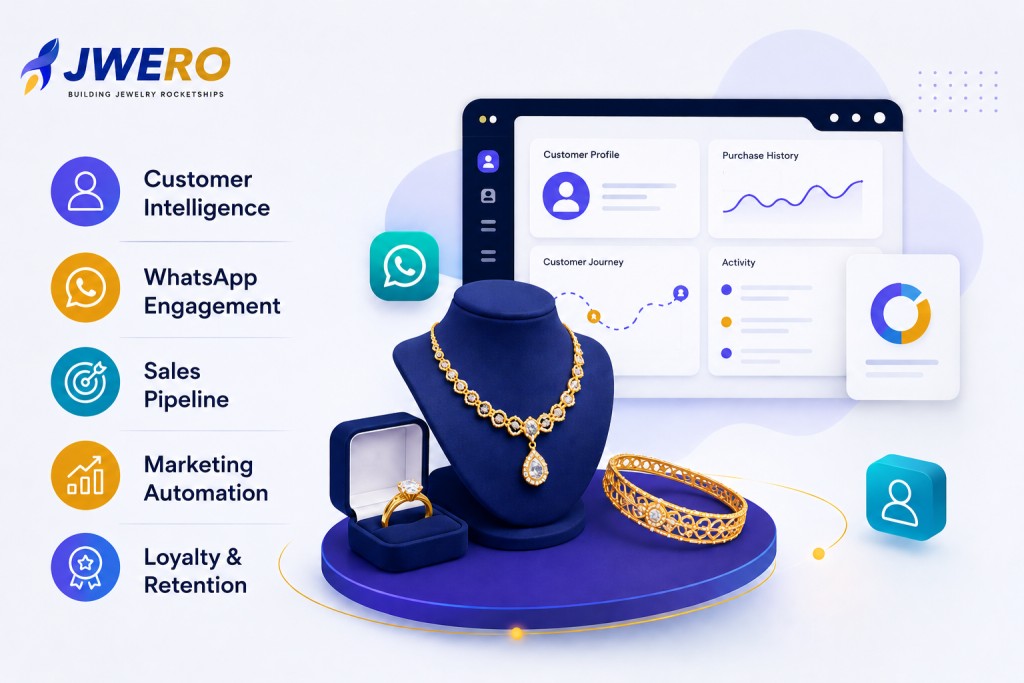
With JWERO One, jewellery retailers gain connected engagement visibility, omnichannel customer orchestration, and scalable operational control designed specifically for jewellery businesses.
Jwero does not slow growth.
It stabilises it.
Jwero replaces people-dependent scaling with system-driven certainty.
Frequently Asked Questions
Why do jewellery businesses lose control as they grow?
Because lead sources, communication channels, and operational complexity increase faster than the systems managing them.
Is lead loss higher in large jewellery chains?
Yes. Multiple stores, fragmented communication, and disconnected workflows increase lead leakage without centralized visibility and automation.
Can AI really improve control in jewellery businesses?
Yes. AI improves lead prioritisation, intent tracking, customer journey visibility, and engagement consistency across stores and channels.
Is CRM enough for multi-store jewellery businesses?
No. CRM is important, but growing jewellery retailers also need omnichannel engagement orchestration and intelligent operational visibility.
Why is WhatsApp management important for jewellery retailers?
Because unmanaged WhatsApp communication often causes fragmented customer journeys, missed follow-ups, ownership confusion, and lead leakage.
How can jewellery businesses scale without operational chaos?
By centralizing customer journeys, automating engagement workflows, connecting online and offline touchpoints, and using AI-driven operational intelligence.
Final Thought
Growth is not dangerous.
Uncontrolled growth is.
In jewellery retail, the winners are not those who grow fastest — but those who grow with control.
Scale Your Jewellery Business Without Losing Operational Control
Discover how JWERO.ai helps jewellery retailers unify customer journeys, automate engagement workflows, centralize lead visibility, and scale operations without chaos.
Explore capabilities including:
- AI-powered lead orchestration
- Omnichannel customer engagement
- WhatsApp automation workflows
- Centralized CRM visibility
- Online + offline journey tracking
- Real-time operational intelligence
- Why jewellery businesses lose control as they grow
- How jewellery retailers manage leads at scale
- Why CRM fails in growing jewellery businesses
- how AI improves jewellery lead management
- best lead management systems for jewellery retailers
- How jewellery chains reduce lead leakage
- Why jewellery businesses need omnichannel visibility
- How jewellery retailers scale without operational chaos
- lead tracking challenges in jewellery retail
- How jewellery retailers improve customer journey visibility