

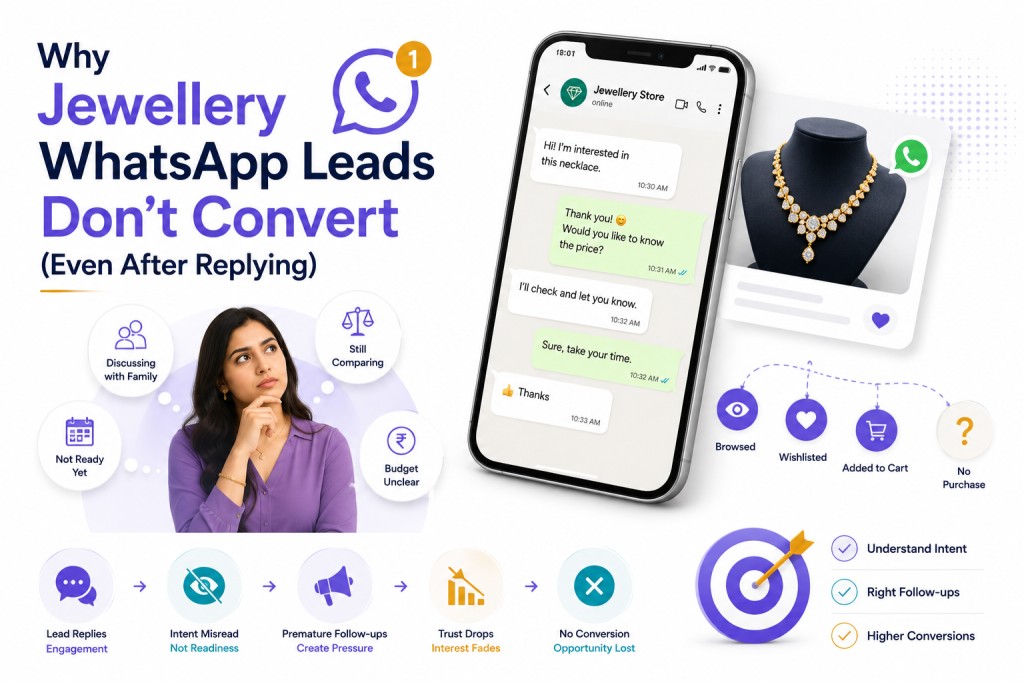
Many jewellery brands assume something simple:
“If the customer replied, the sale should move forward.”
But jewellery conversations rarely work that way.
A WhatsApp reply does not automatically mean buying intent.
Very often, it means:
- curiosity
- politeness
- reassurance seeking
- comparison
- emotional exploration
This misunderstanding quietly damages conversions across jewellery retail.
Because brands mistake engagement for readiness.
And once that happens, follow-ups usually become too aggressive, too early.
Table of Contents
- Why Replies Don’t Always Mean Buying Intent
- Where WhatsApp Actually Sits in the Jewellery Journey
- Common Reasons Jewellery WhatsApp Leads Stop Converting
- Why Customers Reply Even When They Are Unsure
- The Hidden Purpose of Jewellery WhatsApp Conversations
- Why Treating Every Reply Equally Hurts Conversion
- How Better Jewellery Brands Read Customer Intent
- Why AI Improves Jewellery WhatsApp Conversion
- Why Replies Create a False Sense of Progress
- From Reply Tracking to Readiness Tracking
1. Why Replies Don’t Always Mean Buying Intent
In fast-moving ecommerce categories, replies often signal urgency.
Jewellery behaves differently.
A customer replying on WhatsApp may still be:
- weeks away from purchasing
- discussing options with family
- comparing multiple jewellers
- uncertain about the budget
- emotionally undecided
The conversation may be active.
But the decision process may still be early.
That distinction matters enormously.
Because many jewellery teams start selling aggressively the moment a reply appears.
And that pressure usually slows trust instead of building it.
2. Where WhatsApp Actually Sits in the Jewellery Journey
Most jewellery decisions begin before WhatsApp.
Customers often discover products through:
- websites
- reels
- wishlists
- referrals
And many decisions finish after WhatsApp.
Usually through:
- store visits
- family discussions
- emotional reassurance
- final confidence building
WhatsApp sits in the middle of this process.
Its role is usually uncertainty reduction.
Not instant conversion.
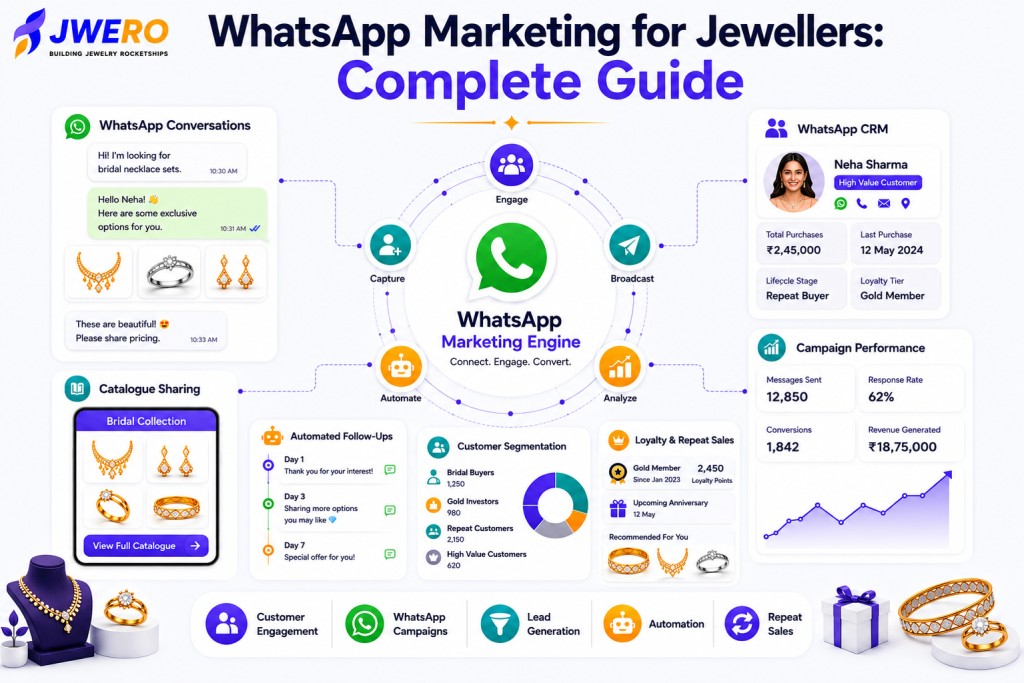
Jewellery businesses using connected systems like Jwero Chats often perform better because conversations stay connected to the larger customer journey instead of becoming isolated chats.
3. Common Reasons Jewellery WhatsApp Leads Stop Converting
The biggest conversion mistakes usually happen immediately after the customer replies.
Advisors Restart the Journey
Customers often receive questions like:
- “What is your budget?”
- “What are you looking for?”
- “Which category do you want?”
But the customer may have already explored products for weeks.
Restarting the conversation frustrates momentum.
It makes the interaction feel transactional instead of informed.
Teams Lack Customer Context
Many advisors cannot see:
- viewed products
- wishlist activity
- previous enquiries
- browsing behaviour
- earlier conversations
So the conversation begins blindly.
That creates disconnected customer experiences.
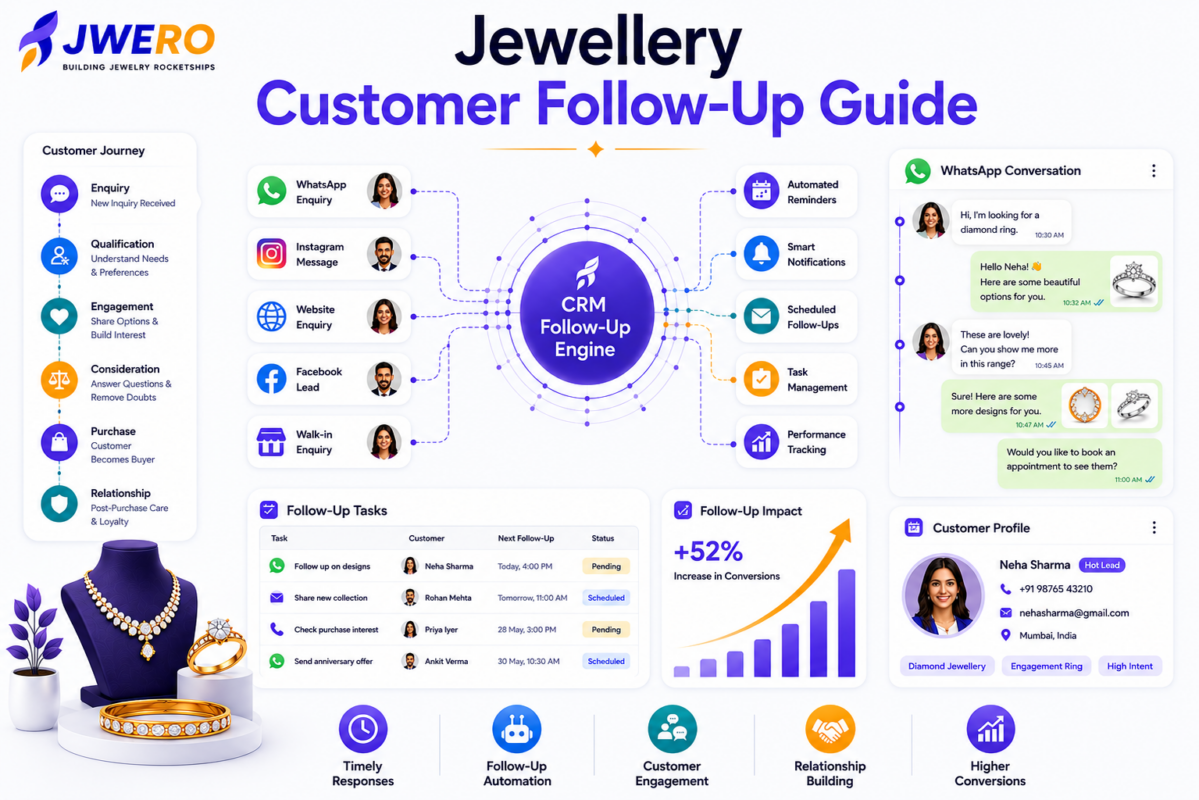
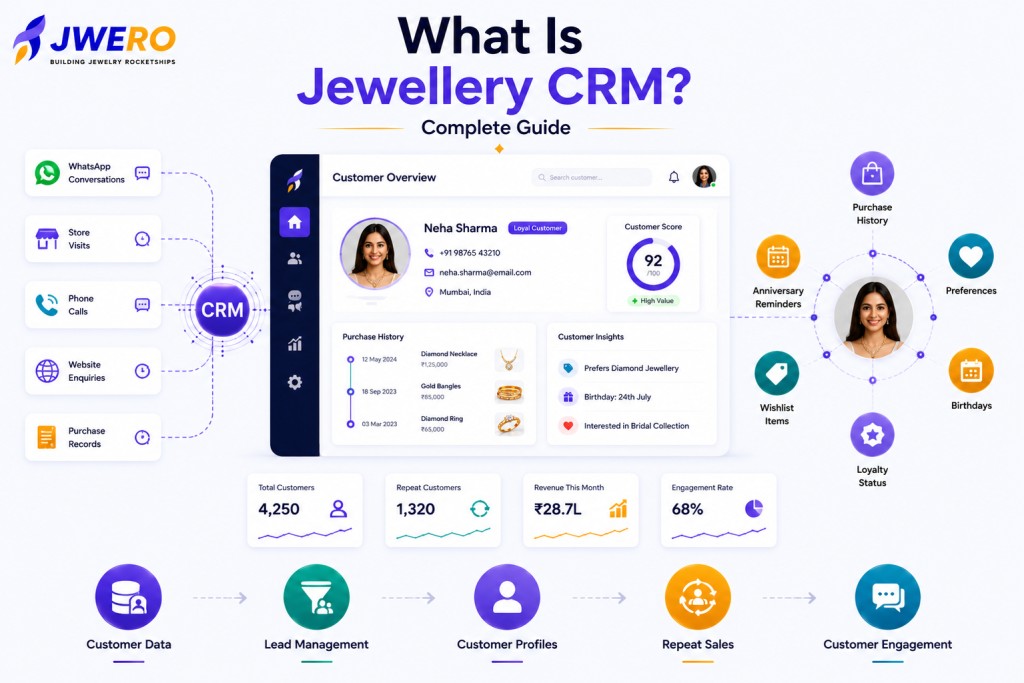
This is why jewellery CRM systems increasingly need unified customer context instead of separate communication silos.
Replies Trigger Instant Selling
The moment customers reply, many brands immediately introduce:
- discounts
- urgency
- visit pressure
- repeated follow-ups
That usually damages trust early.
Especially in luxury jewellery retail.
Because jewellery customers rarely want to feel rushed.
4. Why Customers Reply Even When They Are Unsure
This is where many jewellery teams misread behaviour completely.
Customers often reply because they want to:
- keep options open
- collect information
- stay polite
- avoid awkward silence
- Revisit the conversation later
The reply is often a holding action.
Not a purchase decision.
A customer saying:
“Will check.”
does not carry the same intent as:
- requesting videos
- sharing references
- asking for availability repeatedly
- discussing customization
But many systems treat these signals equally.
That creates major conversion mistakes.
5. The Hidden Purpose of Jewellery WhatsApp Conversations
Many jewellery WhatsApp conversations exist purely to maintain confidence.
Customers use them to:
- validate designs
- reduce hesitation
- check responsiveness
- avoid fear of regret
- maintain emotional comfort
This is especially common in high-ticket purchases.
Sometimes the customer is not disappearing.
The decision is simply taking longer.
Brands that misunderstand this usually increase pressure too early.
And that pressure often pushes customers away quietly.
6. Why Treating Every Reply Equally Hurts Conversion
Not all replies carry equal intent.
That sounds obvious.
But many jewellery workflows still fail here.
Messages like:
- “Okay”
- “Nice”
- “Will see”
- “Thanks”
often receive the same follow-up intensity as stronger buying signals.
Meanwhile, actions like:
- catalogue revisits
- Repeated image requests
- voice notes
- customization discussions
usually indicates much deeper engagement.
Reply count alone is misleading.
Intent strength matters far more.
7. How Better Jewellery Brands Read Customer Intent
Stronger jewellery brands rarely judge customers only by chat activity.
They watch what happens around the conversation.
For example:
- Does browsing continue?
- Do wishlists return?
- Are products revisited?
- Does engagement deepen?
- Does silence follow?
That creates a more realistic understanding of customer readiness.
Systems like Jwero.ai help jewellery businesses connect these behavioural signals instead of relying only on chat replies.
Because conversations alone rarely reveal the full decision journey.
8. Why AI Improves Jewellery WhatsApp Conversion
AI becomes useful because it reduces emotional overreaction in sales workflows.
Instead of celebrating every reply equally, AI can:
- Classify reply quality
- detect hesitation patterns
- suppress unnecessary follow-ups
- Identify rising confidence
- Combine browsing and chat behaviour
That changes engagement timing significantly.
The goal is not faster messaging.
The goal is better judgment.
Jewellery brands using systems like Jwero WhatsApp increasingly focus on understanding readiness instead of maximising message volume.
9. Why Replies Create a False Sense of Progress
This becomes a major leadership problem.
Management teams often see:
- active chats
- high response rates
- large WhatsApp volumes
and assume conversion should naturally improve.
But jewellery decisions are rarely linear.
Customers may reply actively for weeks before purchasing.
Or disappear temporarily before returning later through another channel.
That means reply volume can inflate perceived progress without increasing revenue.
Activity and intent are not the same thing.
10. From Reply Tracking to Readiness Tracking
The smarter question is no longer:
“Did the customer reply?”
The better question is:
“Did customer confidence increase after the conversation?”
That shifts the focus completely.
From:
- chat management
To:
- intent understanding
And that difference changes conversion quality dramatically over time.
Final Thought
Jewellery WhatsApp leads rarely fail because customers reply and disappear.
Most failures happen because brands misunderstand what replies actually mean.
A reply often signals:
“I’m still exploring.”
Not:
“I’m ready to purchase.”
The jewellery brands converting more effectively today are usually calmer.
They pressure less.
Interpret behaviour more carefully.
And stay present without forcing urgency.
Because in jewellery retail, the real skill is not generating replies.
It is understanding when replies genuinely reflect readiness.
FAQs
Why do jewellery WhatsApp leads reply but not convert?
Many customers reply for reassurance, exploration, or comparison without being fully ready to purchase.
Does replying to WhatsApp mean buying intent?
Not always. In jewellery retail, replies often reflect engagement rather than immediate readiness.
Why do jewellery WhatsApp conversations stop suddenly?
Customers may pause because they need time, family discussions, or emotional confidence before purchasing.
How can jewellers improve WhatsApp lead conversion?
By understanding customer intent better, reducing pressure, and maintaining connected customer journeys across channels.
How does AI improve jewellery WhatsApp engagement?
AI helps identify stronger buying signals, suppress unnecessary follow-ups, and improve timing based on customer behaviour.
Build Smarter Jewellery WhatsApp Conversations
Jewellery customers rarely follow a straight buying journey.
The right systems help brands understand intent, coordinate follow-ups, and create calmer customer conversations across WhatsApp, Instagram, ecommerce, and store visits.
Explore:
- Jwero.ai
- Jwero Chats
- Jwero WhatsApp
- Why jewellery WhatsApp leads don’t convert
- Why jewellery customers reply but don’t buy
- jewellery WhatsApp conversion mistakes
- How jewellers improve WhatsApp lead conversion