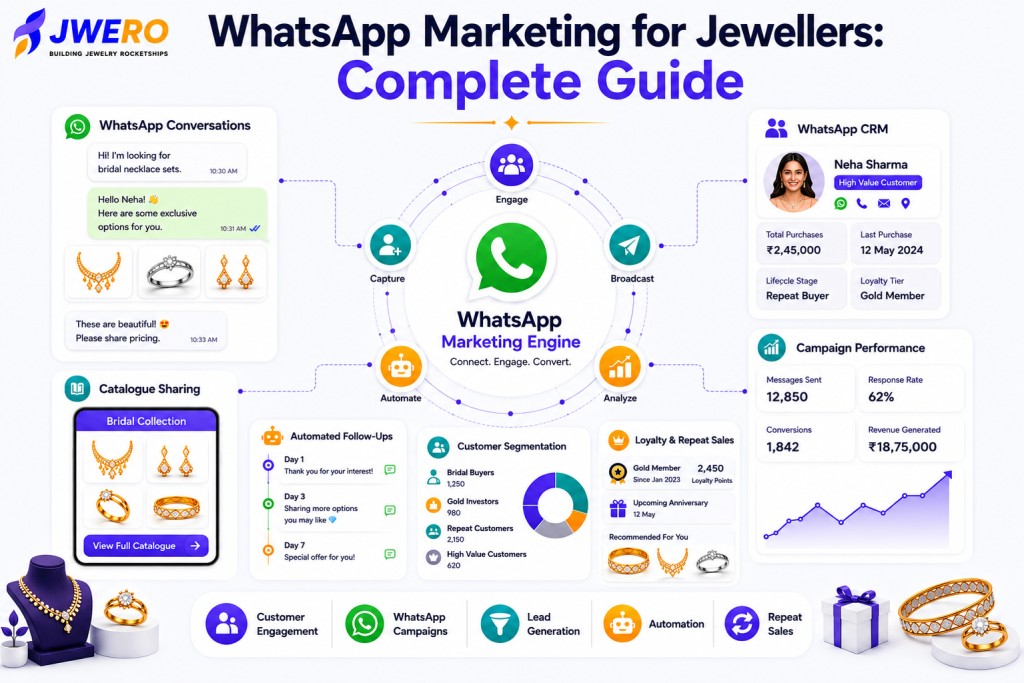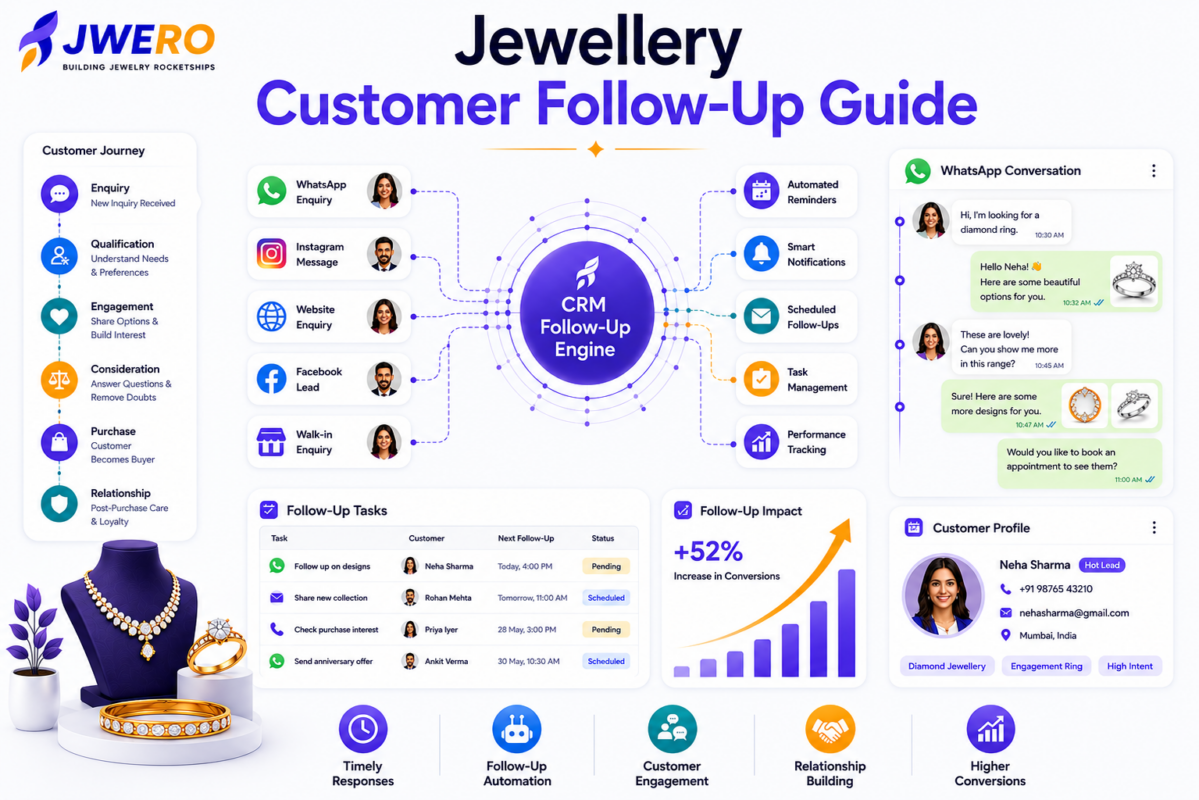


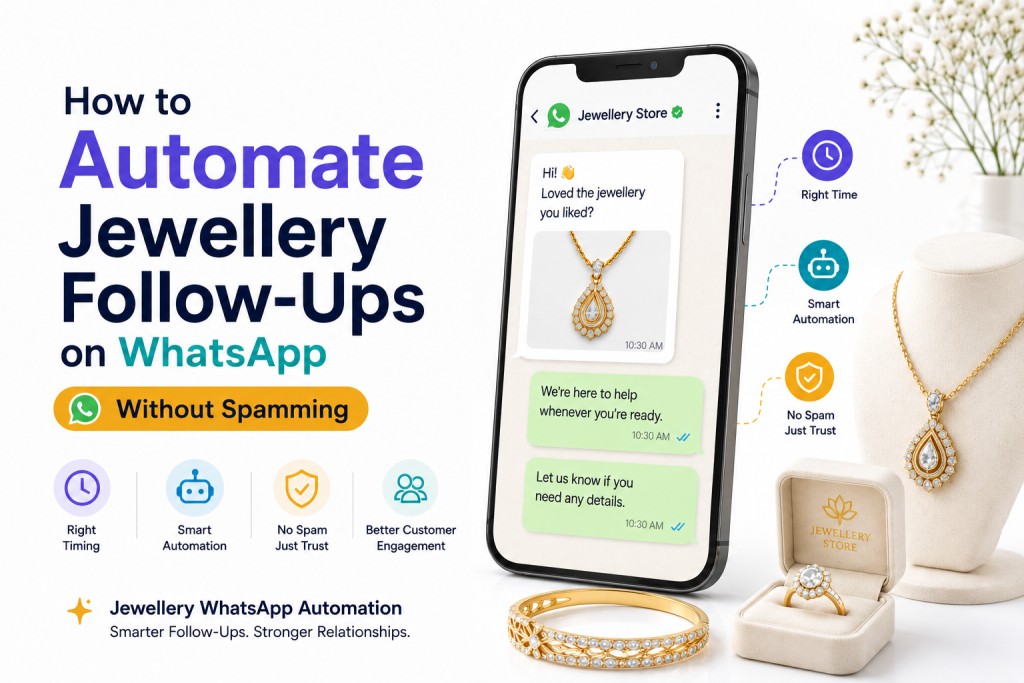
Most jewellery brands hesitate to automate WhatsApp follow-ups for one reason.
They fear becoming annoying.
They worry customers will mute the chat, ignore messages, or lose trust in the brand.
But in reality, most spam does not come from automation.
It comes from random manual follow-ups.
Messages sent too early.
Messages sent too often.
Messages sent without understanding where the customer actually is in the buying journey.
The real issue is not automation itself.
It is poor timing.
Today, the best jewellery brands use automation differently.
They use it quietly.
With restraint.
With context.
And with patience.
That is what makes the experience feel helpful instead of intrusive.
1. Why Jewellery Follow-Ups Feel Spammy
Most spammy follow-ups share the same patterns.
They are:
- repetitive
- sales-heavy
- disconnected from customer behaviour
- based only on time gaps
Many stores still follow rigid sequences like:
- Day 1 message
- Day 3 reminder
- Day 7 follow-up
The problem is simple.
Customers do not make jewellery decisions on a fixed timeline.
Some buyers need two days.
Others need three weeks.
A bridal customer may involve family discussions.
A gifting customer may wait for salary cycles.
A high-ticket buyer may simply need reassurance.
Yet many teams continue messaging because silence creates internal pressure.
That pressure usually leads to over-following.
Not better conversions.
2. Customers Usually Need Time, Not Pressure
Jewellery buying is emotional.
People rarely purchase instantly.
They compare designs.
Revisit options.
Discuss budgets.
Think privately.
Silence does not always mean disinterest.
Very often, it means consideration.
That changes how follow-ups should work.
A message sent too early feels pushy.
The same message sent after renewed customer activity can feel thoughtful and relevant.
This is where intelligent workflows matter.
Brands using centralised systems like Jwero Chats often gain better context before sending another message.
That context changes everything.
3. Why Behaviour Matters More Than Timing
The strongest follow-up systems react to customer behaviour.
Not calendar dates.
Good triggers include:
- Repeat website visits
- wishlist activity
- WhatsApp catalogue clicks
- store locator visits
- image requests
- voice note exchanges
- cart activity
These signals show active interest.
Time alone does not.
A customer ignoring WhatsApp for five days may still be deeply interested.
But many businesses see silence as rejection and send unnecessary follow-up messages.
Modern jewellery CRM systems like Jwero.ai help teams understand behaviour before responding blindly.
That reduces noise significantly.
4. Manual Follow-Ups Often Create More Noise
Many jewellery stores assume manual follow-ups feel more personal.
Sometimes they do.
But manual systems also create problems:
- duplicate follow-ups
- inconsistent timing
- repeated questions
- advisor overlap
- rushed messaging
This usually happens because advisors cannot see the full customer journey.
One salesperson sends a reminder.
Another follows up again.
A third message shares a discount too early.
The customer experiences pressure instead of care.
Good automation reduces this chaos.
It creates pauses.
Prevents duplicate outreach.
Maintains conversation history.
And helps teams know when not to message.
That restraint matters more than frequency.
5. A Smarter Jewellery Follow-Up Flow
Different customer actions require different responses.
Not every interaction deserves a sales pitch.
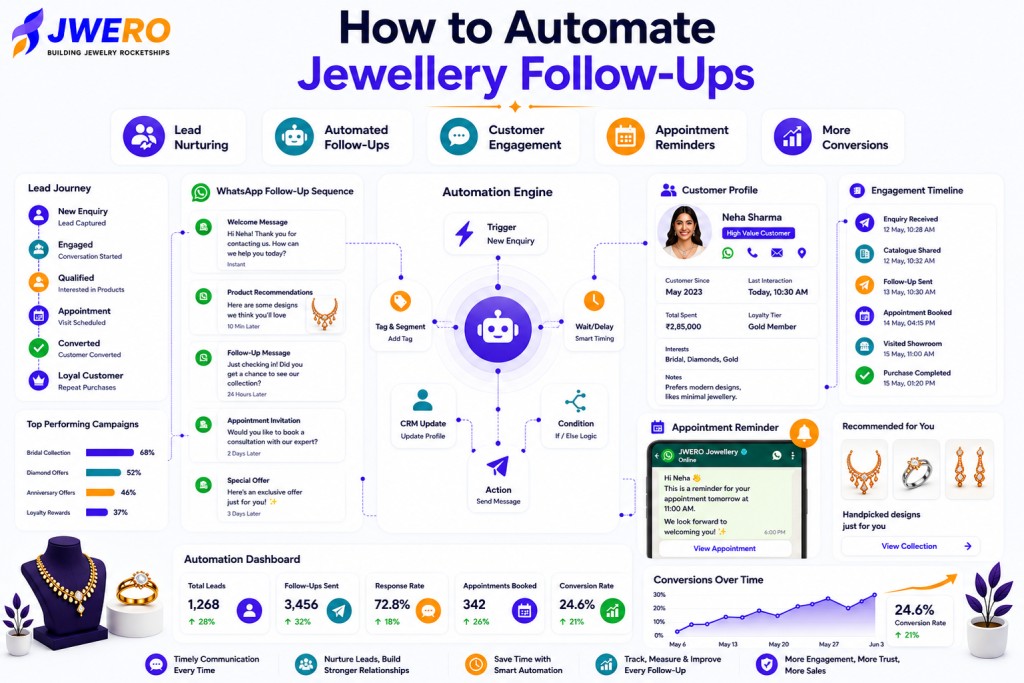
Customer Action → Better Follow-Up
- First website visit → Soft acknowledgement
- Wishlist save → Gentle reassurance
- Repeat product visits → Confidence-building support
- Product image request → Personal advisor assistance
- Store location visit → Visit coordination
- Voice note interaction → Human conversation
The goal is customer confidence.
That is a very different mindset.
6. What Good WhatsApp Automation Looks Like
Good automation is often invisible.
Customers should not feel “automated.”
The best systems usually:
- send fewer messages
- pause during low-interest periods
- continue only after fresh activity
- avoid excessive discounting
- preserve previous conversation context
This is where platforms like Jwero WhatsApp become useful for jewellery teams managing large customer volumes without losing personalisation.
Strong automation does not chase customers.
It keeps the relationship open without becoming overwhelming.
That difference is subtle.
But commercially, it is massive.
7. How AI Helps Reduce Unnecessary Messaging
Humans naturally feel pressure to act.
Especially sales teams.
If a customer goes silent, advisors often assume they must “do something.”
AI behaves differently.
It can:
- recognise slowing intent
- Identify hesitation periods
- Delay unnecessary follow-ups
- Restart communication after fresh signals
- suppress repetitive messaging
In jewellery retail, patience often converts better than urgency.
That is especially true for high-value purchases.
The stores seeing stronger conversions today are not always the loudest.
Many are simply more disciplined.
8. Why Fewer Messages Often Convert Better
Some jewellery brands now send dramatically fewer WhatsApp messages than before.
Yet conversions improve.
Why?
Because every message carries purpose.
Customers feel less pressure from follow-up messages.
Instead, conversations feel relevant and timely.
This often leads to:
- lower ghosting
- better trust
- higher response quality
- stronger repeat engagement
Relevance beats frequency in jewellery retail.
Almost every time.
9. Why Spam Is Usually a Process Problem
When WhatsApp communication feels spammy, the issue is rarely the platform itself.
The deeper problem is usually operational.
For example:
- no visibility into customer intent
- disconnected communication channels
- poor follow-up coordination
- lack of messaging rules
- no pause logic
Without structure, teams default to over-communication.
That creates customer fatigue.
Businesses using Jwero Instagram and Jwero Facebook can handle customer conversations from different channels in one place.
That helps businesses avoid sending too many follow-up messages.
Because the team finally has context.
10. From Follow-Ups to Follow-Through
This is the bigger strategic shift happening in jewellery retail.
The question is no longer:
“Did the team follow up?”
The smarter question is:
“Did the brand respond at the right moment?”
That changes how communication works.
It shifts the focus from pressure to readiness.
From persistence to reassurance.
From chasing to guiding.
The strongest jewellery brands today are not trying to accelerate every decision.
They are protecting customer confidence while staying available.
That balance builds trust.
And trust is what drives high-value jewellery sales.
Final Thought
Jewellery customers rarely need constant reminders.
What they need is reassurance.
At the right time.
In the right tone.
With the right context.
That is why thoughtful automation performs better than aggressive follow-ups.
The brands winning on WhatsApp today are not necessarily sending more messages.
They are simply sending smarter ones.
FAQs
How can jewellery stores automate WhatsApp follow-ups without sounding spammy?
Jewellery stores should automate follow-ups based on customer behaviour, not fixed schedules. Messages should feel relevant, timely, and connected to customer activity.
What is the best time to send jewellery follow-up messages?
The best timing depends on customer signals like repeat visits, wishlist activity, or catalogue engagement. Timing matters more than message frequency.
Why do customers ignore jewellery WhatsApp follow-ups?
Customers often ignore messages that feel repetitive, sales-heavy, or poorly timed. Many buyers simply need more decision time.
Does WhatsApp automation improve jewellery sales?
Yes. When used carefully, automation improves consistency, reduces missed opportunities, and helps maintain customer engagement without overwhelming buyers.
How do jewellery CRM systems help with follow-ups?
Jewellery CRM systems help stores understand customer activity and send better follow-up messages.
Build Smarter Jewellery Follow-Ups
Customer conversations should feel timely, personal, and calm.
Explore how modern jewellery brands use automation, WhatsApp workflows, and centralized communication to improve follow-ups without overwhelming customers.
Explore:
- Jwero.ai
- Jwero WhatsApp
- Jwero Chats
- How to automate jewellery follow-ups on WhatsApp
- How jewellery stores avoid WhatsApp spam
- Best WhatsApp follow-up strategy for jewellers
- Jewellery WhatsApp automation without spamming
- Jewellery conversion strategy
- jewellery crm
- jewellery crm strategy
- jewellery lead intelligence
- jewellery whatsapp crm
- social media
- customer service
- real time
- jewelry businesses
- marketing strategies
- customer base
- frequently asked questions
- social media platforms
- long term
- customer loyalty
- customer feedback
- customer data
- customer expects