

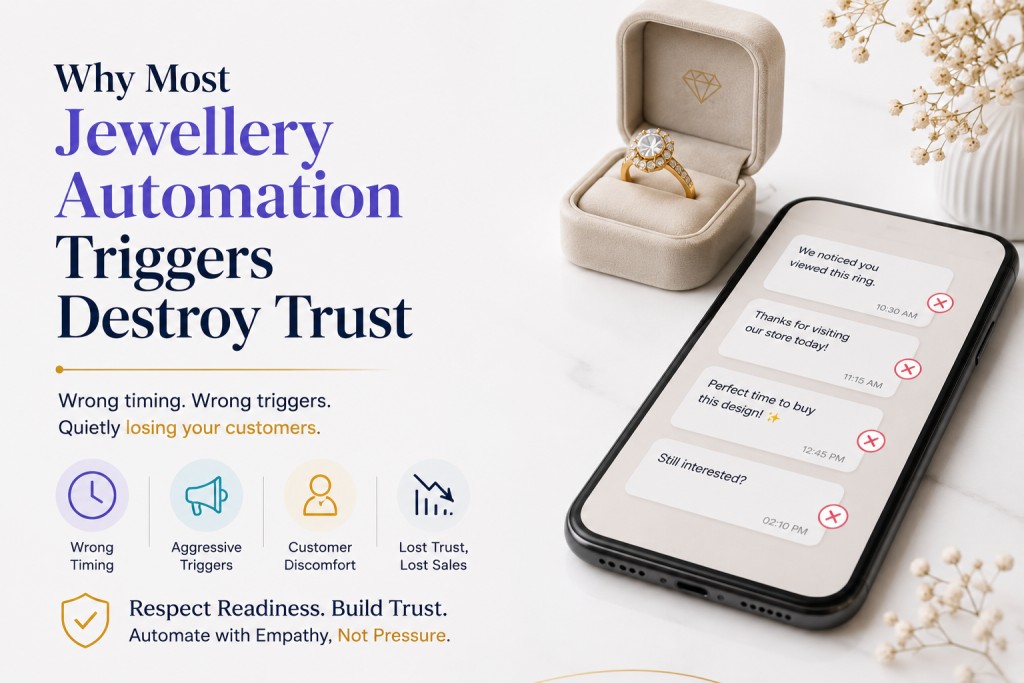
Most automation systems were designed for fast ecommerce.
Jewellery does not behave that way.
Most platforms optimise for:
- speed
- frequency
- urgency
- repeat nudges
Jewellery buying works differently.
People pause.
Reflect.
Compare.
Discuss privately.
Return later.
That difference matters more than most brands realise.
When automation pushes too early, customers rarely complain.
They simply pull away.
Quietly.
Table of Contents
- Jewellery Buying Does Not Follow E-commerce Logic
- Why Most Triggers Feel Uncomfortable
- The Hidden Costs of Bad Jewellery Automation
- Common Trigger Mistakes Jewellery Brands Make
- Why Customers Usually Disappear Instead of Complaining
- The Real Question Every Trigger Should Answer
- Why “Top of Mind” Often Backfires
- What Better Jewellery Automation Looks Like
1. Jewellery Buying Does Not Follow E-commerce Logic
Traditional e-commerce relies on momentum.
A customer visits.
Clicks.
Adds to cart.
Then receives reminders until they purchase.
That logic works for many products.
Not for jewellery.
In jewellery:
- Browsing often means imagination
- Comparisons reduce uncertainty
- Silence usually means consideration
- delays are emotionally normal
A customer viewing a necklace three times does not always want outreach.
Sometimes they simply want space.
Many brands misread this completely.
They interpret every action as buying intent.
That is where trust problems begin.
2. Why Most Triggers Feel Uncomfortable
Customers rarely describe automation as “bad automation.”
They describe it emotionally.
They feel:
- watched
- rushed
- pressured
- interrupted
That emotional reaction matters.
Especially in jewellery.
A jewellery purchase is rarely transactional.
It often connects to:
- weddings
- gifting
- anniversaries
- milestones
- family approval
- personal confidence
When automation interrupts those moments too aggressively, customers become cautious.
Not because the product is wrong.
Because the timing feels wrong.
3. The Hidden Costs of Bad Jewellery Automation
The biggest damage from poor triggers is rarely immediate.
That is why many brands miss it.
The customer does not always unsubscribe.
They simply become less responsive over time.
Confidence Starts Eroding
Over-messaging creates doubt.
Customers start questioning:
- whether they are being pushed
- whether they are taking too long
- whether the interaction is becoming sales-driven
In jewellery, confidence matters more than urgency.
A confident customer moves forward naturally.
A pressured customer delays decisions.
Social Moments Start Feeling Awkward
Jewellery decisions are often shared.
People discuss purchases with:
- partners
- parents
- friends
- family members
Imagine a customer casually browsing engagement rings.
Then, suddenly receiving multiple WhatsApp messages.
That interaction can feel intrusive very quickly.
Especially when the customer never initiated the conversation.
Customers Stop Giving Signals
This is the most dangerous effect.
Customers learn the system.
They realise:
“If I click, someone will follow up.”
So they stop interacting openly.
They avoid clicking.
Avoid asking questions.
Avoid exploring designs.
The automation system slowly loses real customer intent signals.
Ironically, excessive triggers make the system less intelligent over time.
4. Common Trigger Mistakes Jewellery Brands Make
Some automation flows damage trust almost immediately.
Not because the idea is wrong.
Because the timing lacks emotional awareness.
Browsing-Based WhatsApp Messages
Messages like:
“We noticed you viewed this ring.”
may sound personalised internally.
To customers, they often feel invasive.
Especially in luxury retail.
Good personalisation should feel helpful.
Not surveillance-driven.
Brands using tools like Jwero WhatsApp often perform better when they combine behaviour with consent and timing instead of reacting instantly to every click.
Store Visit Follow-Ups
Many jewellery stores automatically message after walk-ins.
That creates friction.
Most visits are exploratory.
Customers may still be:
- comparing stores
- discussing budgets
- understanding designs
- exploring styles casually
Immediate follow-ups can create social pressure before trust is established.
Festive & Price-Based Nudges
Not every jewellery purchase responds to discounts.
That assumption creates weak automation.
Messages like:
“Perfect time to buy.”
often ignore emotional timing completely.
Jewellery decisions rarely happen because a banner says “limited period.”
They happen when confidence aligns with intent.
Silence-Based Follow-Ups
This is one of the most common mistakes.
Messages like:
“Still interested?”
usually reduces response rates further.
Silence does not always mean rejection.
Sometimes customers simply need more time.
Strong customer engagement systems know when to pause instead of pushing repeatedly.
That is where centralised communication through platforms like Jwero Chats becomes valuable.
5. Why Customers Usually Disappear Instead of Complaining
Jewellery buyers rarely confront brands directly.
Most simply disengage quietly.
They stop replying.
Stop visiting.
Stop exploring.
Then one day, they purchase elsewhere.
This creates a dangerous illusion internally.
The team assumes:
“No complaints means the automation is working.”
That assumption causes long-term damage.
Trust loss in jewellery is subtle.
And usually irreversible.
6. The Real Question Every Trigger Should Answer
Most jewellery automation should pass one simple test:
“Did the customer clearly invite this interaction?”
If the answer is unclear, restraint is often safer.
This does not mean automation is bad.
It means jewellery automation requires emotional intelligence.
Not just technical logic.
The best systems today combine:
- customer behaviour
- timing
- consent
- channel history
- communication gaps
That creates calmer interactions.
Not louder ones.
Platforms like Jwero.ai help jewellery teams centralise these journeys instead of reacting randomly across disconnected channels.
7. Why “Top of Mind” Often Backfires
Many brands still believe constant messaging builds recall.
In jewellery, that can create the opposite effect.
Customers do not remember frequency positively.
They remember how communication made them feel.
If follow-ups feel respectful, customers return willingly.
If messages feel intrusive, brand perception drops silently.
Being remembered is not enough.
Being trusted matters more.
8. What Better Jewellery Automation Looks Like
Better automation usually feels quieter.
More patient.
More coordinated.
More intentional.
Good systems:
- trigger less frequently
- respect pauses
- avoid duplicate outreach
- coordinate across channels
- Prioritise customer comfort
This becomes even more important across Instagram, Facebook, WhatsApp, and ecommerce journeys.
Disconnected messaging creates pressure quickly.
That is why many jewellers now prefer connected systems like:
Not to send more messages.
But to make communication feel more natural and coordinated.
Final Thought
Automation itself is not the problem.
Poor timing is.
Most jewellery customers do not want aggressive follow-ups.
They want space.
Reassurance.
And respectful communication.
That requires a very different automation mindset.
The brands building stronger trust today are not reacting faster.
They are learning when to wait.
FAQs
Why do jewellery automation triggers hurt customer trust?
Poorly timed triggers can make customers feel pressured or watched before they are emotionally ready to engage.
What are bad WhatsApp automation triggers for jewellery stores?
Browsing-based messages, silence follow-ups, aggressive festive nudges, and instant store visit messages often reduce trust.
Why do jewellery customers stop responding on WhatsApp?
Many customers disengage when communication feels repetitive, intrusive, or emotionally mistimed.
How should jewellery brands use automation correctly?
Jewellery brands should combine customer behaviour, timing, consent, and communication history before triggering outreach.
Does omnichannel communication improve jewellery customer engagement?
Yes. Connected systems help brands avoid duplicate messaging and maintain smoother customer conversations across channels.
Build Jewellery Communication That Feels Respectful
Customer trust is fragile in jewellery retail.
The right systems help teams coordinate conversations, reduce unnecessary triggers, and create calmer customer experiences across WhatsApp, Instagram, Facebook, and ecommerce journeys.
Explore:
- Jwero.ai
- Jwero Chats
- Jwero WhatsApp
- Why jewellery automation feels spammy
- Bad WhatsApp triggers for jewellery stores
- How jewellery brands lose customer trust
- Jewellery automation mistakes that hurt conversions