

Inventory is one of the largest investments for any jewellery retailer.
Yet many businesses unknowingly lose revenue because of poor inventory practices.
Small inventory mistakes often lead to:
- Dead stock
- Lost sales
- Stock discrepancies
- Poor customer experience
- Reduced profitability
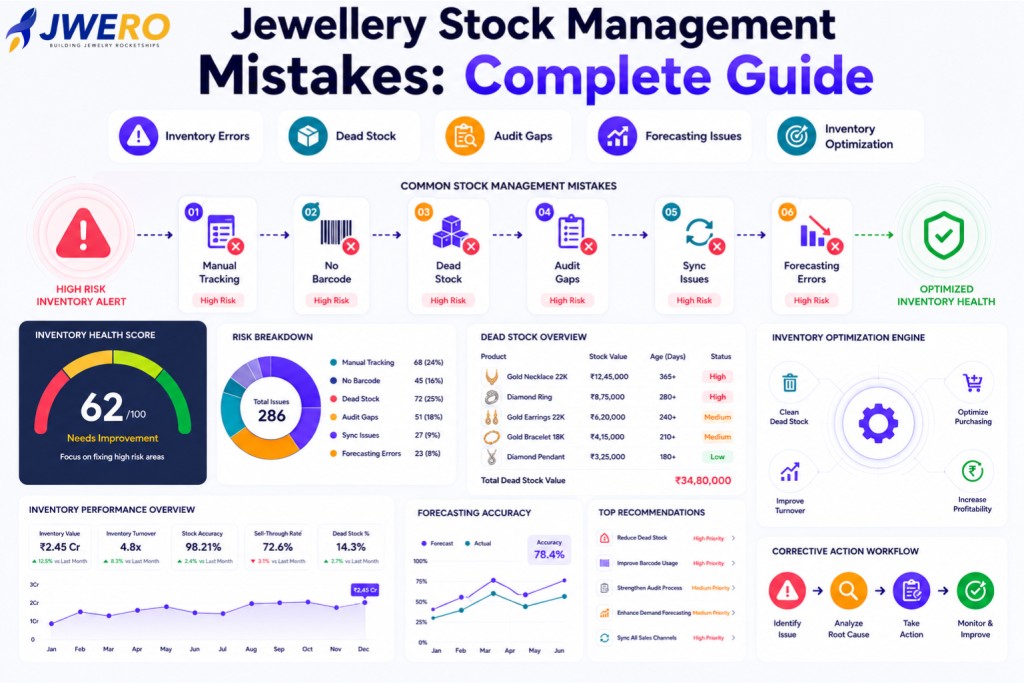
This guide covers the most common stock management mistakes and how jewellers can avoid them.
Why Stock Management Matters
Effective stock management helps retailers:
- Improve Inventory Accuracy
- Increase Inventory Turnover
- Improve Customer Experience
- Reduce Losses
- Improve Cash Flow
- Improve Profitability
Inventory performance directly impacts business growth.
Mistake 1: Manual Inventory Tracking
Many retailers still rely on:
- Excel Sheets
- Paper Records
- Manual Updates
Problems include:
- Human Errors
- Duplicate Entries
- Delayed Updates
- Missing Information
Modern inventory systems eliminate these issues.
Mistake 2: No Barcode System
Without barcode tracking:
- Billing Becomes Slower
- Audits Become Difficult
- Product Tracking Becomes Weak
- Inventory Errors Increase
Barcode systems improve visibility and accuracy.
Mistake 3: Poor Inventory Categorisation
Many retailers fail to categorise inventory correctly.
Inventory should be organised by:
- Product Type
- Metal Type
- Collection
- Price Range
- Demand Level
Proper categorisation improves analysis.
Mistake 4: No Inventory Audits
Without audits:
- Inventory Variances Increase
- Missing Inventory Goes Undetected
- Reporting Becomes Inaccurate
- Financial Risks Increase
Regular audits are essential.
Mistake 5: Dead Inventory Accumulation
Dead stock reduces cash flow.
Common causes:
- Poor Buying Decisions
- Weak Demand Analysis
- No Promotions
- Poor Forecasting
Dead inventory should be monitored continuously.
Mistake 6: Inventory Not Synced Across Channels
Customers shop through:
- Store
- Website
- Sales Teams
Without synchronization:
- Stock Mismatches Occur
- Overselling Happens
- Customer Trust Decreases
Omnichannel inventory is critical.
Mistake 7: Ignoring Inventory KPIs
Many businesses track sales but ignore inventory metrics.
Track:
- Inventory Turnover
- Stock Age
- Sell-Through Rate
- Dead Inventory
- Stock Availability
KPIs reveal inventory health.
Mistake 8: Weak Demand Forecasting
Retailers often buy inventory without forecasting.
Forecast:
- Wedding Season Demand
- Diwali Demand
- Akshaya Tritiya Demand
- Collection Trends
Forecasting improves purchasing decisions.
Mistake 9: Poor Multi-Store Visibility
For businesses with multiple locations:
- Store-Level Visibility Is Essential
- Transfers Must Be Tracked
- Centralised Reporting Is Required
Visibility improves operational control.
Mistake 10: No Inventory Analytics
Without analytics:
- Trends Are Missed
- Slow-Moving Inventory Grows
- Buying Decisions Become Risky
- Opportunities Are Lost
Data-driven inventory management performs better.
The Ideal Inventory Management Workflow
Inventory Entry
↓
Barcode Assignment
↓
Inventory Tracking
↓
Channel Synchronization
↓
Audits
↓
Analytics
↓
Forecasting
↓
Optimization
A structured workflow reduces errors.
Inventory KPIs Every Retailer Should Monitor
- Inventory Accuracy
- Inventory Turnover
- Dead Stock %
- Sell-Through Rate
- Inventory Value
- Demand Forecast Accuracy
KPIs improve decision-making.
How Technology Prevents Inventory Mistakes
Modern systems provide:
- Real-Time Inventory Tracking
- Barcode Management
- Audit Automation
- Omnichannel Inventory Sync
- Analytics Dashboards
- Demand Forecasting
Technology reduces operational risks.
How Jwero Supports Inventory Visibility
Jwero helps retailers connect inventory demand with:
- Customer Behaviour
- CRM
- Appointments
- Customer Analytics
- Sales Insights
- Omnichannel Engagement
This improves inventory planning and customer experience.
Final Thoughts
Most inventory problems are not caused by inventory itself.
They are caused by weak processes.
Avoiding common stock management mistakes helps jewellers:
- Improve accuracy
- Increase inventory turnover
- Reduce losses
- Improve customer experience
- Increase profitability
Inventory excellence creates competitive advantage.
Frequently Asked Questions
What is the biggest inventory management mistake?
Manual inventory tracking is one of the most common and costly mistakes.
Why is dead inventory dangerous?
Dead stock ties up capital and reduces profitability.
Why are inventory audits important?
Inventory audits are important because they improve accuracy and identify discrepancies.
What inventory KPI is most important?
Inventory Turnover and Inventory Accuracy are among the most important.
How can technology improve stock management?
Technology provides automation, visibility, analytics, and inventory control.