


Inventory is one of the most valuable assets in a jewellery business.
Even small inventory discrepancies can result in significant financial losses.
Regular stock audits help jewellery retailers:
- Verify inventory accuracy
- Identify stock variances
- Reduce shrinkage
- Improve accountability
- Improve inventory control
This guide provides a complete jewellery stock audit checklist.
What is a Jewellery Stock Audit?
A stock audit is the process of physically verifying inventory and comparing it against inventory records.
The goal is to ensure:
- Inventory Accuracy
- Stock Accountability
- Financial Accuracy
- Operational Control
Regular audits reduce inventory risks.
Why Stock Audits Matter
Stock audits help retailers:
- Identify Missing Inventory
- Detect Errors
- Reduce Losses
- Improve Compliance
- Improve Reporting
- Improve Inventory Accuracy
Inventory visibility improves profitability.
Types of Jewellery Stock Audits
- Daily Spot Audits
- Weekly Audits
- Monthly Audits
- Quarterly Audits
- Annual Audits
Most successful retailers use multiple audit cycles.
Pre-Audit Preparation Checklist
Before beginning:
- Freeze Inventory Movements
- Verify Inventory Records
- Print Inventory Reports
- Assign Audit Teams
- Prepare Barcode Scanners
- Define Audit Scope
Preparation improves accuracy.
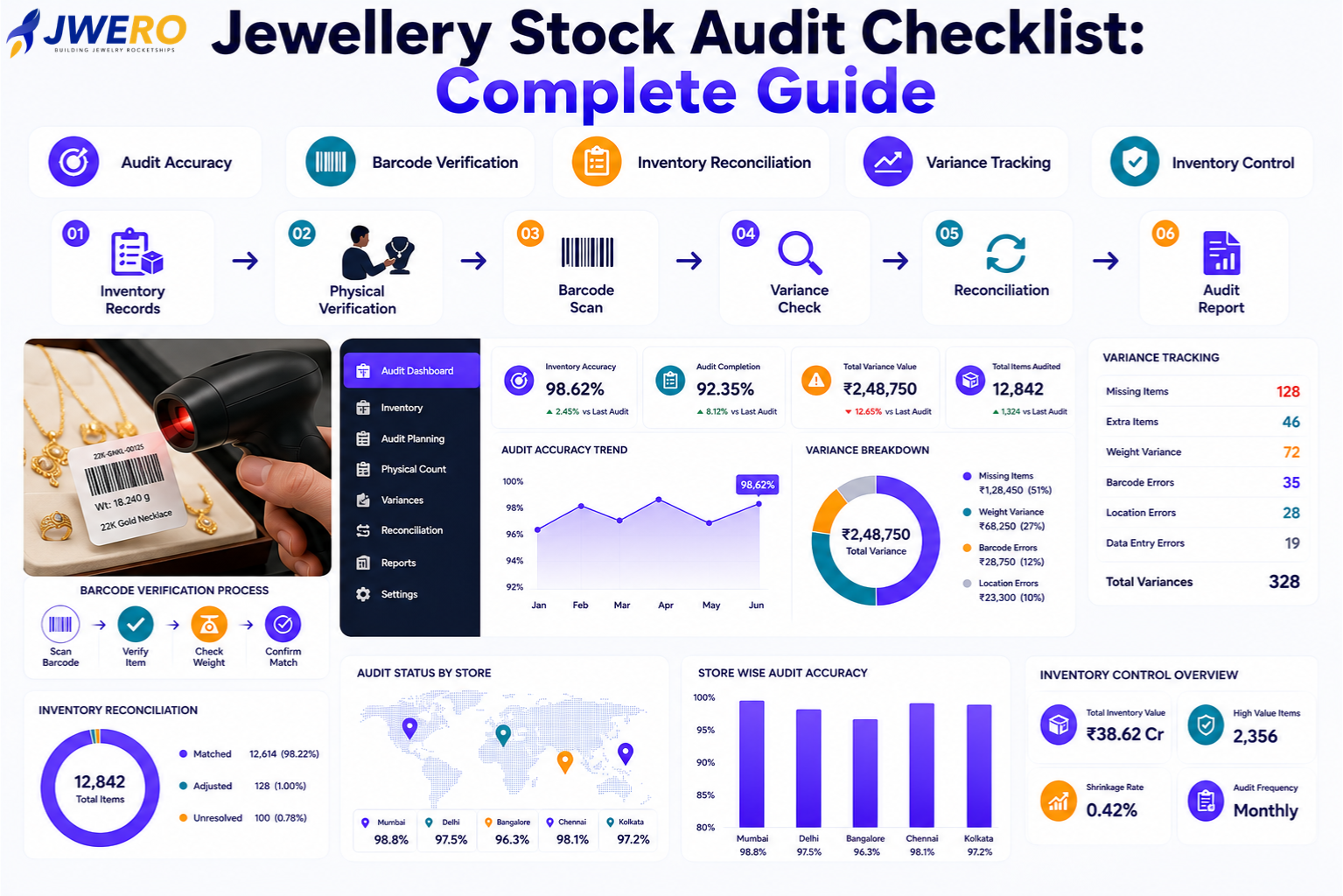
Jewellery Stock Audit Workflow
↓
Physical Verification
↓
Barcode Scanning
↓
Quantity Verification
↓
Variance Identification
↓
Reconciliation
↓
Audit Report
↓
Corrective Actions
This workflow should be standardised.
Physical Verification Checklist
Verify:
- Product SKU
- Product Description
- Weight
- Purity
- Stone Details
- Barcode
- Product Location
Every item should match system records.
Barcode Audit Process
Use barcode scanners to:
- Verify Products
- Reduce Manual Errors
- Speed Up Audits
- Improve Accuracy
Barcode audits are significantly faster.
Variance Analysis
Identify:
- Missing Items
- Extra Items
- Weight Variances
- Barcode Errors
- Location Errors
- Data Entry Errors
Understanding variances is critical.
Inventory Reconciliation
After verification:
- Investigate Variances
- Correct Records
- Update Inventory
- Document Findings
- Approve Adjustments
Reconciliation ensures accuracy.
Audit Dashboard Metrics
Track:
- Inventory Accuracy %
- Audit Completion %
- Variance Value
- Missing Inventory
- Reconciled Inventory
- Audit Frequency
These metrics improve control.
Common Audit Mistakes
- No Audit Schedule
- Manual Tracking
- No Barcode System
- Poor Documentation
- Delayed Reconciliation
- Incomplete Verification
Consistency matters.
Multi-Store Audit Management
For multiple locations:
- Store-Wise Audits
- Centralized Reporting
- Transfer Verification
- Inventory Reconciliation
- Regional Visibility
Centralised oversight improves accountability.
Technology and Audit Automation
Modern systems help with:
- Barcode Verification
- Audit Reporting
- Variance Tracking
- Inventory Reconciliation
- Audit Analytics
Technology improves efficiency.
Audit KPIs Every Retailer Should Track
- Inventory Accuracy Rate
- Variance Rate
- Audit Completion Rate
- Shrinkage Rate
- Audit Frequency
- Reconciliation Time
KPIs reveal inventory health.
How Jwero Supports Inventory Visibility
While inventory systems manage audits directly, Jwero helps retailers improve visibility through:
- Customer Demand Analytics
- Sales Tracking
- Appointment Analytics
- Lead Management
- Customer Insights
Together they improve operational planning.
Final Thoughts
Stock audits are not just compliance exercises.
They are essential for:
- Inventory accuracy
- Operational control
- Financial health
- Profitability
Retailers that audit consistently maintain stronger inventory visibility and control.
Frequently Asked Questions
Why are jewellery stock audits important?
Jewellery stock audits are important because they help verify inventory accuracy, reduce losses, and improve accountability.
How often should audits be conducted?
Daily spot audits, monthly audits, quarterly reviews, and annual audits are common.
Why are barcode audits recommended?
Barcode systems are recommended because they improve speed, accuracy, and audit efficiency.
What causes inventory variances?
Missing inventory, data entry errors, barcode issues, and process failures.
Which KPI is most important?
Inventory Accuracy Rate is one of the most critical audit KPIs.