


One of the biggest challenges in jewellery retail is knowing:
What inventory to buy, how much to buy, and when to buy it.
Poor forecasting often leads to:
- Overstocking
- Dead Inventory
- Stock Shortages
- Lost Sales
- Reduced Cash Flow
Demand forecasting helps retailers make smarter inventory decisions.
What is Jewellery Demand Forecasting?
Demand forecasting is the process of predicting future customer demand using historical data, sales trends, customer behaviour, and seasonal patterns.
The goal is to maintain the right inventory at the right time.
Why Demand Forecasting Matters
Forecasting helps retailers:
- Reduce Dead Stock
- Improve Inventory Turnover
- Improve Cash Flow
- Increase Sales
- Improve Inventory Availability
- Improve Profitability
Accurate forecasting reduces inventory risk.
Factors That Influence Jewellery Demand
Demand is influenced by:
- Wedding Seasons
- Akshaya Tritiya
- Diwali
- Festive Campaigns
- Gold Prices
- Fashion Trends
- Economic Conditions
Forecasting should account for these variables.
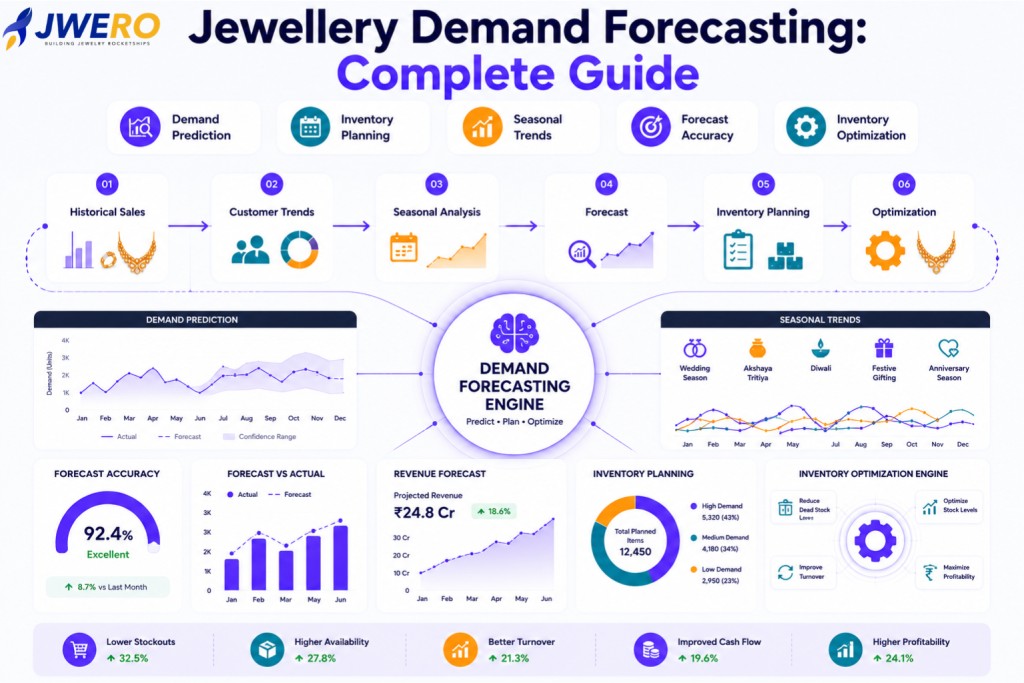
Demand Forecasting Workflow
Historical Sales Data
↓
Customer Trends
↓
Seasonal Analysis
↓
Demand Forecast
↓
↓
Purchasing Decisions
↓
Inventory Optimization
This creates a data-driven inventory strategy.
Historical Sales Analysis
Review:
- Product Sales History
- Collection Performance
- Category Trends
- Seasonal Performance
- Sales Velocity
Historical data provides forecasting insights.
Seasonal Demand Planning
Jewellery retailers should forecast separately for:
- Wedding Season
- Akshaya Tritiya
- Diwali
- Festive Gifting
- Anniversary Seasons
Seasonality significantly impacts demand.
Product Demand Forecasting
Forecast demand by:
- Product Category
- Collection
- Metal Type
- Price Range
- Customer Segment
Granular forecasting improves accuracy.
Inventory Planning Using Forecasts
Forecasts help determine:
- Purchase Quantities
- Inventory Allocation
- Store-Level Inventory
- Safety Stock
- Reorder Points
Better planning reduces waste.
Multi-Store Forecasting
Retailers with multiple locations should forecast:
- Store-Level Demand
- Regional Preferences
- Transfer Requirements
- Local Buying Patterns
Demand differs by location.
Forecasting Analytics Dashboard
Track:
- Forecast Accuracy
- Inventory Turnover
- Product Demand Trends
- Seasonal Demand
- Inventory Value
- Stock Availability
Analytics improve planning.
Common Forecasting Mistakes
- Relying on Guesswork
- Ignoring Seasonality
- Ignoring Customer Trends
- No Inventory Analytics
- No Historical Data Analysis
- Static Inventory Planning
Data-driven forecasting performs better.
Demand Forecasting KPIs
- Forecast Accuracy %
- Inventory Turnover
- Stock Availability
- Dead Stock %
- Inventory Value
- Reorder Accuracy
KPIs improve forecasting quality.
Benefits of Accurate Forecasting
- Better Inventory Control
- Improved Cash Flow
- Higher Inventory Turnover
- Better Product Availability
- Fewer Stockouts
- Higher Profitability
Forecasting improves operational efficiency.
Technology and Forecasting
Modern systems provide:
- Demand Prediction Models
- Historical Analysis
- Inventory Analytics
- Forecasting Dashboards
- Purchasing Recommendations
Technology improves accuracy.
How Jwero Supports Demand Planning
Jwero helps retailers understand demand through:
- Customer Analytics
- Lead Trends
- Appointment Analytics
- Product Interest Tracking
- Customer Segmentation
- Sales Insights
These insights help retailers make smarter inventory decisions.
Final Thoughts
Demand forecasting transforms inventory management from reactive to proactive.
Retailers that forecast effectively can:
- Reduce dead stock
- Improve inventory turnover
- Increase sales
- Improve cash flow
- Improve profitability
Forecasting is one of the most valuable capabilities in modern jewellery retail.
Frequently Asked Questions
Why is demand forecasting important?
It helps retailers predict demand and optimise inventory levels.
What data is used for forecasting?
Historical sales, customer trends, seasonality, product performance, and market conditions.
How does forecasting reduce dead stock?
It prevents over-purchasing and improves inventory planning.
Should forecasting be done store-wise?
Yes. Different locations often have different demand patterns.
What KPI is most important?
Forecast Accuracy % is one of the most important forecasting metrics.