


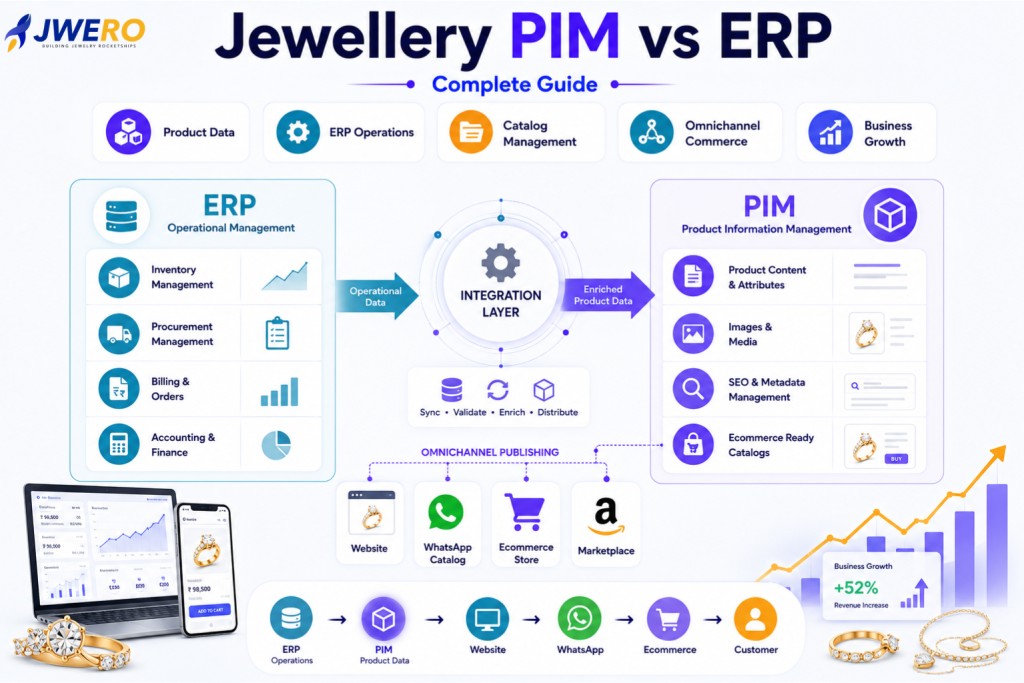
Many jewellery businesses invest heavily in ERP systems.
Over time, these businesses begin facing challenges with:
- Product catalogs
- Ecommerce product data
- WhatsApp catalogues
- Product images
- Product descriptions
- Omnichannel selling
The immediate question becomes:
Should our ERP manage product information?
Or:
Do we need a Jewellery PIM?
This is one of the most common questions asked by growing jewellery retailers.
The reality is simple:
ERP and PIM are not competitors.
They solve different problems.
Understanding the difference is critical for building a scalable jewellery commerce stack.
Understanding ERP in Jewellery Retail
ERP stands for Enterprise Resource Planning.
ERP systems were designed to manage business operations.
A jewellery ERP typically handles:
- Inventory
- Procurement
- Manufacturing
- Stock Transfers
- Accounting
- Billing
- Purchase Orders
- Vendor Management
- Financial Reporting
ERP systems are operational systems.
Their primary purpose is managing business processes.
Understanding Jewellery PIM
PIM stands for Product Information Management.
A Jewellery PIM focuses on managing product information.
This includes:
- Product Names
- Product Descriptions
- Product Images
- Product Videos
- Product Attributes
- Diamond Specifications
- Metal Details
- Certifications
- Product Categories
- Product Variants
- SEO Metadata
- Channel Distribution
PIM systems are product data systems.
Their purpose is to make product information accurate, complete, and consistent across every channel.
Why Many Jewellers Use ERP for Product Data
Historically, ERP systems were the only centralised business software available.
As a result, businesses began storing:
- Product Names
- Product Pricing
- Product Specifications
- Product Descriptions
- Product Images
inside ERP systems.
Initially, this worked.
However, as commerce evolved, ERP limitations became visible.
Why ERP Struggles With Modern Product Management
ERP systems are excellent at managing transactions.
They are not designed for:
- Rich Product Content
- Product Media
- Omnichannel Catalogs
- Ecommerce Content
- Product Storytelling
- SEO Optimization
- Marketplace Distribution
- WhatsApp Catalogues
This creates friction as businesses scale.
The Product Data Challenge
A modern jewellery product may include:
- 20+ Images
- Product Videos
- Diamond Certification
- Product Story
- Collection Information
- SEO Metadata
- Product Variants
- Lifestyle Photography
- Product Tags
- Marketing Content
Managing this inside an ERP becomes difficult.
ERP vs PIM: Core Difference
The easiest way to understand the difference is:
- ERP Manages Operations
- PIM Manages Product Experience
ERP answers:
- What is in stock?
- What is the cost?
- What was sold?
PIM answers:
- What should customers see?
- What product information should be published?
- Which channels should receive product updates?
What Should ERP Manage?
ERP should remain responsible for:
- Inventory
- Stock Availability
- Procurement
- Pricing Rules
- Manufacturing Data
- Financial Data
- Purchase Orders
- Billing
- Accounting
- Operational Reporting
ERP remains the operational backbone.
What Should PIM Manage?
PIM should manage:
- Product Content
- Product Attributes
- Product Images
- Product Videos
- Product Categories
- Product Variants
- SEO Information
- WhatsApp Catalogues
- Ecommerce Product Data
- Marketplace Listings
- Product Enrichment
- Product Distribution
PIM becomes the customer-facing product engine.
Why Jewellery ERP Product Management Often Creates Problems
Many jewellery businesses attempt to manage ecommerce catalogues directly from ERP systems.
This often leads to:
- Incomplete Product Pages
- Poor Product Images
- Missing Attributes
- Slow Product Updates
- Inconsistent Product Information
- Weak SEO Performance
The ERP was never designed for modern commerce.
Why Product Data Needs a Dedicated Home
As businesses expand across:
- Website
- Ecommerce
- Marketplaces
- Sales Teams
Product information becomes increasingly complex.
A dedicated system is needed to:
- Govern Product Data
- Improve Accuracy
- Maintain Consistency
- Manage Product Content
- Distribute Information
This is the role of PIM.
ERP and PIM Work Better Together
The best approach is not ERP or PIM.
It is ERP plus PIM.
The systems complement each other.
Typical workflow:
ERP
Manages:
- Inventory
- Pricing
- Operations
↓
PIM
Receives product information
↓
Product Enrichment
Images
Descriptions
Certifications
Attributes
↓
Distribution
Website
Ecommerce
Marketplace
↓
Customer
This creates a scalable architecture.
How Pricing Should Be Managed
One common question is:
Should pricing live in ERP or PIM?
The answer:
- ERP Owns Pricing Logic
- PIM Publishes Pricing Information
ERP should control:
- Base Price
- Cost Price
- Pricing Rules
- Inventory-Based Pricing
PIM should distribute approved pricing to channels.
How Product Catalogues Should Be Managed
Catalogue management is where PIM becomes essential.
PIM helps manage:
- Product Collections
- Product Categories
- Product Variants
- Product Relationships
- Product Media
- Product Metadata
- Product Publishing
ERP systems typically struggle with these requirements.
Why Jewellery Ecommerce Product Data Needs PIM
Modern ecommerce depends on:
- Rich Product Content
- Product Images
- Product Videos
- Product SEO
- Product Attributes
- Product Consistency
These are not ERP strengths.
They are PIM strengths.
Jewellery PIM vs ERP for WhatsApp Catalogues
WhatsApp catalogues require:
- Accurate Images
- Product Descriptions
- Pricing
- Product Availability
- Product Categories
- Product Attributes
Managing this manually from ERP systems becomes difficult.
PIM simplifies omnichannel publishing.
PIM and ERP for Jewellers: The Ideal Architecture
The future jewellery commerce stack looks like:
ERP
↓
PIM
↓
Website
↓
Ecommerce
↓
↓
Marketplace
↓
CRM
↓
Customer
ERP controls operations.
PIM controls product information.
Together, they create a connected commerce ecosystem.
Why This Matters for SEO
Search engines evaluate product quality.
PIM helps improve:
- Product Titles
- Product Descriptions
- Product Metadata
- Structured Product Data
- Product Completeness
This improves organic visibility.
Why This Matters for AI Search
AI-powered platforms such as:
- ChatGPT
- Gemini
- Google AI Overviews
- Perplexity
Prefer structured product information.
A PIM helps organise data for AI discoverability.
Signs Your ERP Is Doing Too Much
You may need a Jewellery PIM if:
- Product Updates Are Slow
- Catalogue Management Is Difficult
- Ecommerce Teams Depend on ERP
- Product Images Are Hard to Manage
- WhatsApp Catalogues Are Inconsistent
- Product Information Is Fragmented
- Product Publishing Takes Too Long
These are common signals.
How Jwero PIM Hub Complements ERP Systems
Jwero PIM Hub is designed to work alongside ERP platforms.
It helps jewellery businesses:
- Centralise Product Data
- Manage Rich Product Content
- Improve Product Accuracy
- Publish Across Channels
- Manage WhatsApp Catalogues
- Improve Ecommerce Performance
- Support Omnichannel Commerce
- Prepare Product Data for AI Search
Without replacing your ERP.
Final Thoughts
ERP and PIM solve different problems.
ERP is the operational backbone.
PIM is the product experience engine.
Trying to manage modern product catalogues entirely inside ERP systems often creates:
- Product inconsistencies
- Slow updates
- Ecommerce limitations
- Poor omnichannel experiences
The most successful jewellery retailers combine both systems.
ERP manages operations.
PIM manages product information.
Together, they create a scalable and future-ready commerce stack.
FAQs
What is the difference between Jewellery PIM and ERP?
ERP manages operations such as inventory, procurement, billing, and finance. PIM manages product information, images, descriptions, attributes, and omnichannel distribution.
Can ERP replace a Jewellery PIM?
ERP can store basic product information but is not designed for rich product content, ecommerce catalogues, SEO, or omnichannel product publishing.
Should pricing be managed in ERP or PIM?
Pricing logic should be managed in ERP, while PIM distributes approved pricing across customer-facing channels.
Why do jewellers need both ERP and PIM?
ERP handles business operations, while PIM ensures accurate and consistent product information across websites, WhatsApp, ecommerce stores, and marketplaces.
Does PIM improve ecommerce performance?
Yes. PIM improves product quality, catalogue consistency, SEO visibility, customer experience, and conversion rates.