


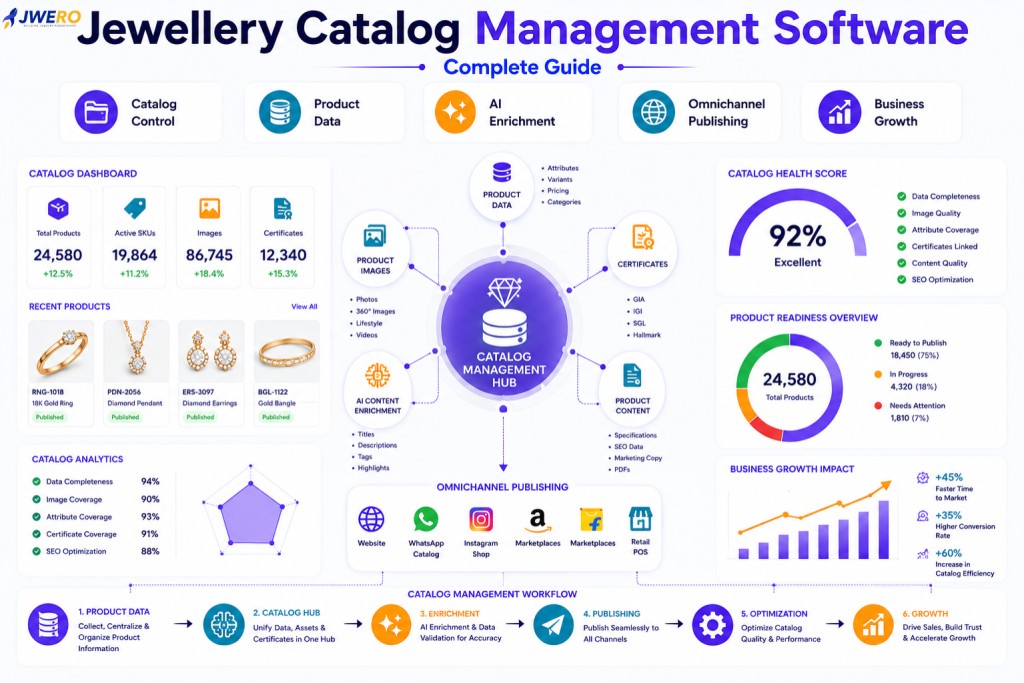
For modern jewellery businesses, a catalogue is no longer just a collection of products.
It is the foundation of:
- Ecommerce
- WhatsApp Selling
- Instagram Commerce
- Marketplace Listings
- Retail Sales
- Omnichannel Customer Experiences
As product ranges expand and customer expectations increase, traditional catalogue management methods begin to fail.
Many jewellers still manage catalogues using:
- Excel Sheets
- Shared Drives
- Ecommerce Platforms
- ERP Systems
- Manual Processes
This approach creates inefficiencies, data inconsistencies, and publishing challenges.
Modern jewellers need catalogue management software that centralises, enriches, and distributes product information across every sales channel.
What Is Jewellery Catalogue Management Software?
Jewellery catalogue management software is a platform that helps businesses organise, manage, enrich, and publish product information from a centralised system.
It manages:
- Product Information
- Product Attributes
- Product Images
- Product Videos
- Product Certificates
- Product Variants
- Product Content
- Product Categories
- Product Relationships
- Omnichannel Publishing
The goal is to create a single source of truth for the entire catalogue.
Why Traditional Catalogue Management Fails
Most catalogue challenges originate from fragmented data.
A product may exist in:
- ERP
- Website
- WhatsApp Catalogue
- Instagram Shop
- Marketplace
- Store POS
Each system contains slightly different information.
The result is:
- Product Data Errors
- Inconsistent Pricing
- Duplicate Products
- Outdated Images
- Missing Certificates
- Customer Confusion
What Modern Jewellers Should Expect from Catalogue Software
Today’s catalogue management platforms should do much more than store product information.
They should actively improve catalogue quality, operational efficiency, and omnichannel commerce.
Feature 1: Centralised Product Data Management
The platform should centralise:
- Product Names
- Product Descriptions
- Product Attributes
- Product Categories
- Product Collections
- Product Variants
- Product Relationships
Everything should be managed from one place.
Feature 2: Jewellery-Specific Attribute Management
Jewellery catalogues contain more complexity than most retail catalogues.
The software should support:
- Metal Type
- Purity
- Weight
- Diamond Details
- Gemstone Information
- Ring Size
- Certification Data
- Collection Information
Flexible attribute structures are essential.
Feature 3: Product DNA and Variant Management
Modern catalogue management requires:
- Parent Products
- Variant Products
- SKU Relationships
- Product DNA Structures
This prevents duplication while simplifying management.
Feature 4: Digital Asset Management
A jewellery catalogue relies heavily on media.
The software should manage:
- Product Images
- Product Videos
- Certificates
- Product PDFs
- Marketing Assets
- Social Media Content
Everything should remain linked to the correct product.
Feature 5: Certificate Management
Trust is critical in jewellery retail.
Modern platforms should support:
- GIA Certificates
- IGI Certificates
- SGL Certificates
- Hallmark Documents
- Product Compliance Records
Certificate management should be integrated directly into the catalogue.
Feature 6: Product Content Management
Every product requires content.
The platform should manage:
- Product Titles
- Product Descriptions
- Product Tags
- SEO Metadata
- Product Highlights
- Marketing Copy
Content should remain consistent across all channels.
Feature 7: AI-Powered Catalogue Enrichment
Modern jewellery catalogue software increasingly uses AI.
Capabilities should include:
- Product Description Generation
- Product Title Creation
- Product Tag Generation
- Product Categorization
- Attribute Suggestions
- Image Recognition
AI helps scale catalogue operations.
Feature 8: Product Readiness Scoring
A catalogue should not publish incomplete products.
The platform should calculate:
- Product Completeness
- Media Readiness
- Content Readiness
- Certification Readiness
- Ecommerce Readiness
This ensures quality before publication.
Feature 9: Omnichannel Publishing
Modern customers buy through multiple channels.
The software should publish to:
- Website
- Ecommerce Platforms
- Marketplaces
- POS Systems
One product record should power every channel.
Feature 10: Channel-Specific Product Content
Different channels require different content formats.
Website:
Detailed Descriptions
WhatsApp:
Product Summaries
Instagram:
Marketing Captions
Marketplace:
Structured Listings
The software should adapt content automatically.
Feature 11: Catalogue Governance
As catalogues grow, governance becomes essential.
The platform should support:
- Approval Workflows
- User Permissions
- Audit Trails
- Version Control
- Data Validation
This improves long-term catalogue quality.
Feature 12: Product Search and Discovery
Teams should be able to quickly find products using:
- SKU
- Product Name
- Collection
- Category
- Certificate Number
- Attributes
Searchability improves productivity.
Feature 13: Product Data Validation
Data quality should be continuously monitored.
Validation should identify:
- Missing Attributes
- Missing Images
- Duplicate Products
- Incorrect Categories
- Missing Certifications
- Data Inconsistencies
This reduces catalogue errors.
Feature 14: SEO Optimisation
A catalogue should support discoverability.
Features should include:
- SEO Titles
- Meta Descriptions
- Product URLs
- Structured Data
- Product Tags
- Category Metadata
SEO becomes easier when product information is structured.
Feature 15: AI Search Readiness
Modern search is evolving.
AI-powered search platforms evaluate:
- Product Structure
- Product Content
- Product Attributes
- Product Relationships
- Product Metadata
The best catalogue software prepares businesses for AI-driven discovery.
Feature 16: Integration with Business Systems
Catalogue software should integrate with:
- ERP
- CRM
- Ecommerce
- POS
- Marketing Platforms
- Analytics Tools
Integration eliminates duplicate work.
Why Catalogue Quality Directly Impacts Revenue
A stronger catalogue creates:
- Better Product Discovery
- Better Customer Trust
- Faster Product Launches
- Better Ecommerce Performance
- Better Omnichannel Experiences
- Higher Conversion Rates
Catalogue quality is directly linked to business growth.
Signs Your Current Catalogue System Is Holding You Back
You may need modern catalogue management software if:
- Product Data Is Stored in Multiple Systems
- Teams Cannot Find Product Information
- Publishing Is Slow
- Product Data Is Inconsistent
- Certificates Are Difficult to Manage
- Product Images Are Disorganised
- Omnichannel Publishing Is Difficult
These are common growth bottlenecks.
Why PIM Is Becoming the Foundation of Modern Catalogue Management
The most advanced jewellery catalogue management solutions are built on PIM architecture.
A Jewellery PIM provides:
- Centralised Product Data
- Product Governance
- Digital Asset Management
- Product Readiness
- AI Enrichment
- Omnichannel Publishing
- Catalog Analytics
This makes it the foundation of modern catalogue operations.
How Jwero Helps Modern Jewellers Manage Catalogues
Jwero helps jewellery businesses:
- Centralise Product Information
- Manage Product Attributes
- Manage Digital Assets
- Manage Certificates
- Generate AI Content
- Improve Product Readiness
- Publish Across Channels
- Improve Catalogue Quality
- Scale Omnichannel Commerce
All from a single platform.
Final Thoughts
The role of catalogue management has changed dramatically.
Modern jewellery businesses need software that does more than organise products.
They need a platform that helps:
- Improve Product Accuracy
- Improve Customer Experiences
- Support Omnichannel Commerce
- Accelerate Product Publishing
- Prepare for AI Search
- Drive Business Growth
The businesses that invest in better catalogue management today will be better positioned to compete tomorrow.
FAQs
What is jewellery catalogue management software?
Jewellery catalogue management software is software that helps jewellery businesses manage product information, media, certificates, and omnichannel publishing from one platform.
Why is catalogue management important for jewellers?
Catalogue management is important for jewellers because it improves product accuracy, customer experience, ecommerce performance, and operational efficiency.
What features should jewellery catalogue software include?
Product management, attribute management, DAM, certificates, AI content generation, readiness scoring, and omnichannel publishing.
Can catalogue software help ecommerce sales?
Yes. Better catalogue quality improves discoverability, customer trust, and conversions.
Is PIM software the same as catalogue software?
Modern jewellery catalogue management software is increasingly built on PIM platforms because they provide centralised product management and publishing capabilities.