

Product information is the foundation of every successful jewellery business.
Whether customers discover products through:
- Website
- Ecommerce Store
- Marketplace
- Retail Store
They expect complete and accurate product information.
However, managing jewellery product attributes becomes increasingly difficult as product catalogues grow.
A single jewellery product may contain dozens of attributes.
Without proper structure, businesses face:
- Product Data Errors
- Inconsistent Catalogs
- Customer Confusion
- Poor Search Visibility
- Inventory Issues
- Lost Sales
This is why attribute management is one of the most important aspects of modern jewellery commerce.
What Are Jewellery Product Attributes?
Product attributes are the characteristics that describe a jewellery product.
These attributes help customers understand exactly what they are purchasing.
Examples include:
- Metal Type
- Metal Purity
- Weight
- Stone Type
- Diamond Quality
- Ring Size
- Certification
- Collection
- Product Category
- Style
- Gender
- Occasion
Attributes create structure and consistency across the catalogue.
Why Jewellery Product Attributes Are More Complex Than Other Retail Products
Most retail products require basic information.
Jewellery products require significantly more detail.
For example, a diamond ring may contain:
- Product Name
- Collection
- Gold Purity
- Metal Weight
- Diamond Weight
- Diamond Color
- Diamond Clarity
- Stone Shape
- Certification Number
- Ring Size
- Product Images
- Videos
- Pricing
- Availability
The more attributes a product has, the more difficult it becomes to manage manually.
Why Attribute Management Matters
Well-structured attributes improve:
- Product Accuracy
- Customer Trust
- Product Discovery
- Search Visibility
- Catalog Consistency
- Inventory Visibility
- Omnichannel Selling
- AI Search Readiness
Poor attribute management affects every department in the business.
The Problem with Unstructured Product Attributes
Many jewellery businesses store product attributes in:
- Excel Sheets
- ERP Systems
- Ecommerce Platforms
- Shared Documents
- WhatsApp Catalogues
As information spreads across systems, consistency disappears.
Common issues include:
- Missing Attributes
- Duplicate Values
- Incorrect Purity Information
- Inconsistent Naming
- Incomplete Product Data
- Incorrect Certifications
These problems compound over time.
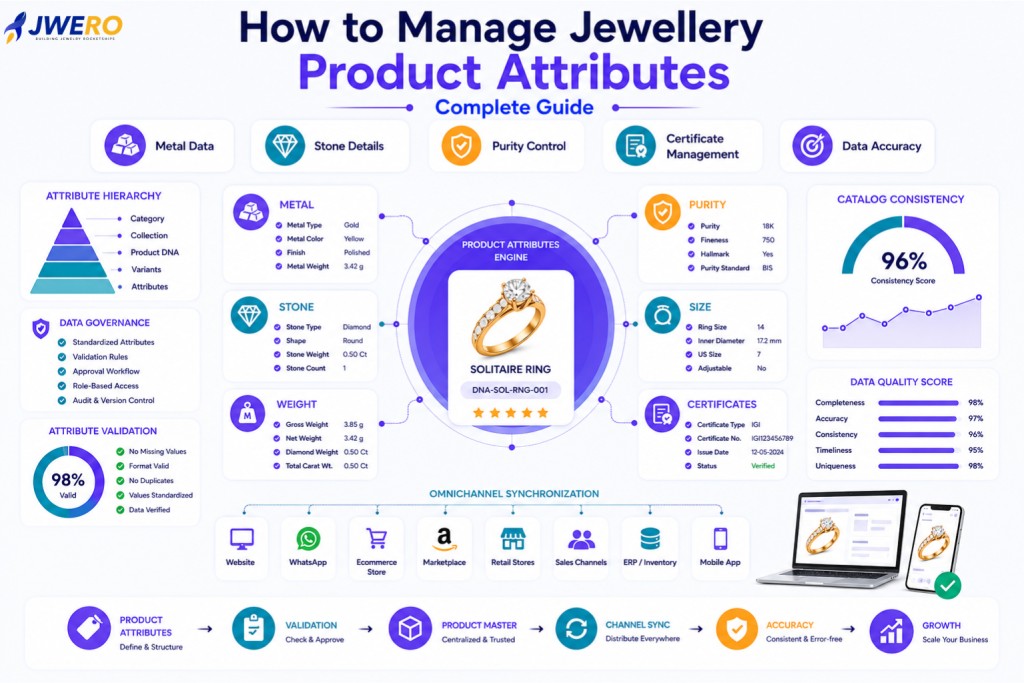
Managing Metal Attributes Correctly
Metal information is one of the most important jewellery attributes.
Customers frequently evaluate products based on metal type and purity.
Common metal attributes include:
- Gold
- Platinum
- Silver
- Rose Gold
- White Gold
- Yellow Gold
Additional fields may include:
- Gross Weight
- Net Weight
- Metal Purity
- Hallmark Information
- Metal Finish
Standardisation is critical.
Managing Jewellery Purity Data
Purity information influences customer trust and compliance.
Examples include:
- 14K Gold
- 18K Gold
- 22K Gold
- 24K Gold
Many retailers struggle with inconsistent purity naming.
For example:
- 18K
- 18 Karat
- 18Kt
- 750 Gold
These should be standardised.
Proper jewellery purity data management ensures consistency across all channels.
Managing Stone Attributes
Stone information is often the most detailed section of the product record.
Attributes may include:
- Stone Type
- Diamond Weight
- Stone Shape
- Stone Color
- Stone Clarity
- Stone Cut
- Stone Count
- Stone Origin
- Stone Certification
Accurate stone data improves customer confidence.
Jewellery Metal Stone Weight Management Best Practices
Weight is one of the most frequently searched jewellery specifications.
Common weight-related fields include:
- Gross Weight
- Net Weight
- Diamond Weight
- Stone Weight
- Total Carat Weight
- Metal Weight
Businesses should establish consistent measurement standards.
This improves reporting and catalogue accuracy.
Managing Size Attributes
Size attributes vary by product category.
Examples include:
- Ring Size
- Bracelet Size
- Necklace Length
- Chain Length
- Bangle Diameter
- Pendant Dimensions
Structured sizing improves customer experience and reduces returns.
Managing Jewellery Certificate Information
Customers increasingly expect certification transparency.
Certificate attributes may include:
- Certificate Number
- Certification Authority
- Certification Type
- Certification Date
- Certification Status
Examples of authorities include:
- IGI
- GIA
- SGL
- HRD
- Hallmark Certifications
Proper jewellery certificate management improves credibility.
Why Attribute Standardisation Matters
Attribute standardisation means every product follows the same structure.
For example:
Metal Type:
- Gold
instead of:
- Gold Metal
- Yellow Gold Metal
- Gold Jewellery
Consistency improves product quality.
Product Attributes and Ecommerce Performance
Product attributes directly impact ecommerce success.
They improve:
- Product Filters
- Product Search
- Product Comparisons
- Product Recommendations
- Customer Navigation
The better the attribute structure, the better the ecommerce experience.
Product Attributes and SEO
Search engines rely on structured product information.
Well-managed attributes improve:
- Product Relevance
- Search Rankings
- Rich Results
- Structured Data
- Product Discoverability
Attributes support stronger organic visibility.
Product Attributes and AI Search
AI-powered platforms evaluate product data differently from traditional search engines.
Platforms such as:
- ChatGPT
- Google AI Overviews
- Gemini
- Perplexity
Prefer structured and detailed product information.
Attribute quality improves AI discoverability.
Product Attributes and Omnichannel Commerce
Modern jewellery businesses publish products across:
- Website
- Ecommerce
- Marketplace
- Retail Store
- CRM
Attributes must remain consistent across every channel.
Without centralised management, inconsistencies emerge quickly.
Common Attribute Management Mistakes
Many jewellers struggle because they:
- Allow Free-Text Entries
- Use Different Naming Conventions
- Store Data in Multiple Systems
- Skip Validation Rules
- Ignore Governance
- Fail to Audit Data Quality
These mistakes create long-term catalogue issues.
Building an Attribute Governance Framework
A strong governance framework defines:
- Attribute Standards
- Required Fields
- Approval Processes
- Validation Rules
- Ownership Responsibilities
Governance ensures long-term consistency.
Why Jewellery Product Master Data Depends on Attributes
Attributes are the foundation of product master data.
Without structured attributes:
- Product Records Become Incomplete
- Product Relationships Break
- Reporting Becomes Difficult
- Product Accuracy Declines
Every product master depends on attribute quality.
How PIM Simplifies Attribute Management
A Product Information Management (PIM) platform helps businesses:
- Centralize Attributes
- Standardize Values
- Validate Product Data
- Manage Product Relationships
- Improve Catalogue Consistency
- Distribute Information Across Channels
- Improve Product Governance
This dramatically reduces errors.
How Jwero PIM Hub Helps Structure Jewellery Attributes
Jwero PIM Hub helps jewellery businesses:
- Manage Metal Attributes
- Manage Stone Attributes
- Manage Weight Data
- Manage Purity Information
- Manage Size Variants
- Manage Certificates
- Standardise Product Data
- Improve Catalogue Quality
- Support Omnichannel Commerce
All from a centralised platform.
Final Thoughts
Product attributes are the building blocks of every jewellery catalogue.
Without proper attribute management, businesses struggle with:
- Catalog inconsistency
- Product errors
- Poor customer experiences
- Weak search visibility
A structured approach to managing:
- Metal
- Stone
- Weight
- Purity
- Size
- Certificates
Creates the foundation for scalable growth.
The businesses that master attribute management will create better catalogues, better customer experiences, and better business outcomes.
FAQs
What are jewellery product attributes?
Jewellery product attributes are characteristics such as metal type, stone details, weight, purity, size, and certifications that describe a product.
Why are product attributes important?
Product attributes are important because they improve product accuracy, customer trust, catalogue consistency, SEO performance, and omnichannel selling.
What is jewellery purity data?
Purity data refers to information such as 14K, 18K, 22K, or 24K gold purity and related hallmark information.
How should jewellery certificates be managed?
Certificate numbers, authorities, dates, and statuses should be stored as structured attributes within a centralised product management system.
How can jewellers manage product attributes at scale?
By using a Jewellery PIM platform that centralises, standardises, validates, and distributes attribute data across channels.