


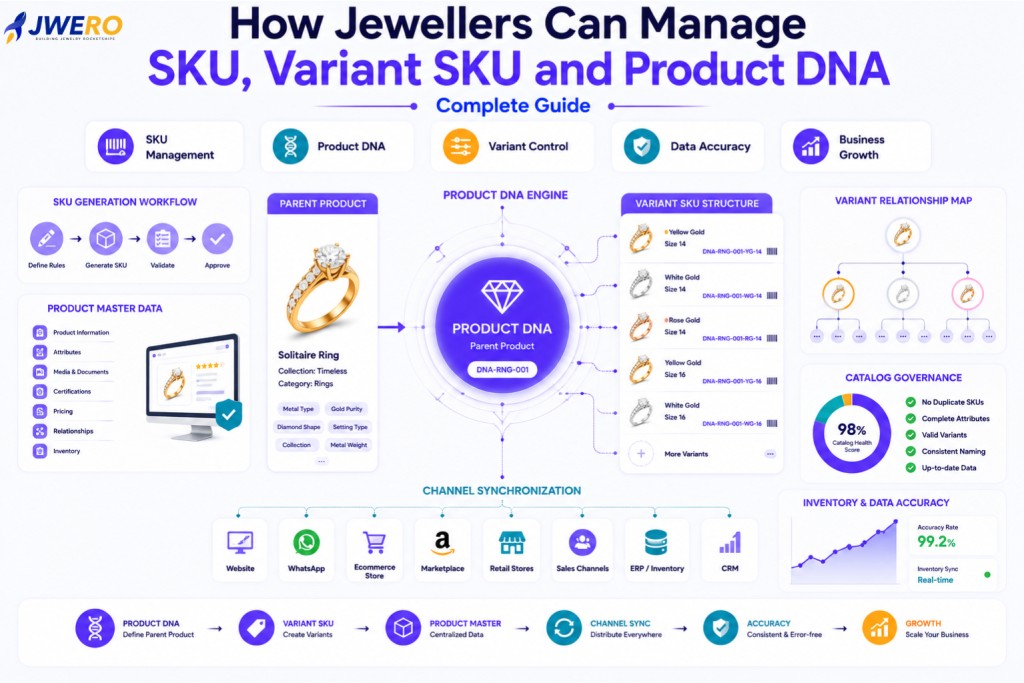
As jewellery businesses grow, managing products becomes increasingly complex.
A retailer with 100 products can often manage information manually.
A retailer with:
- 5,000 products
- Multiple collections
- Product variants
- Omnichannel sales channels
cannot.
Without a structured SKU strategy, businesses quickly face:
- Duplicate Products
- Inventory Confusion
- Incorrect Catalogs
- Product Data Errors
- Reporting Challenges
- Operational Inefficiencies
This is why successful jewellery businesses invest heavily in SKU management, variant SKU management, and product DNA structures.
Together, these systems create the foundation for scalable product operations.
What Is Jewellery SKU Management?
SKU stands for Stock Keeping Unit.
A SKU is a unique identifier assigned to every product.
It helps businesses:
- Track Products
- Manage Inventory
- Identify Variants
- Generate Reports
- Improve Accuracy
- Support Omnichannel Operations
Think of a SKU as a product’s unique identity within the business.
Why SKU Management Is Critical for Jewellery Businesses
Jewellery products are highly customizable.
A single ring may exist in:
- Yellow Gold
- White Gold
- Rose Gold
Different:
- Sizes
- Stone Types
- Diamond Qualities
- Collections
Without structured SKU management, products become difficult to track.
What Happens When SKU Management Fails?
Many jewellery businesses experience:
- Duplicate SKUs
- Missing SKUs
- Manual SKU Creation
- Inconsistent Naming
- Inventory Errors
- Reporting Issues
- Variant Confusion
The result is operational chaos.
Understanding Jewellery Product DNA
Before discussing variant SKUs, it is important to understand Product DNA.
Product DNA is the core identity of a product.
It remains consistent even when variations exist.
For example:
Product DNA:
- Solitaire Ring Collection
The DNA remains the same.
However, variations may include:
- Metal Type
- Ring Size
- Diamond Weight
- Stone Quality
- Color Option
The DNA represents the parent product.
Variants represent the children.
Why Product DNA Matters
Many jewellers manage every variation as a separate product.
This creates:
- Duplicate Catalogue Entries
- Product Data Repetition
- Catalog Complexity
- Reporting Difficulties
A Product DNA approach solves this.
What Is a Variant SKU?
A Variant SKU identifies a specific version of a product.
Example:
- Product DNA
SOL-RING
Variants:
- SOL-RING-YG-16
- SOL-RING-WG-16
- SOL-RING-RG-16
- SOL-RING-YG-18
- SOL-RING-WG-18
Each SKU represents a unique sellable product.
Product DNA vs Variant SKU
The easiest way to understand the difference:
Product DNA
Represents the master product.
Variant SKU
Represents a specific variation.
Product DNA answers:
What product is this?
Variant SKU answers:
Which exact version is this?
Why Variant SKU Jewellery Management Is Difficult
Jewellery businesses often manage:
- Metal Variants
- Size Variants
- Diamond Variants
- Gemstone Variants
- Weight Variants
- Custom Variants
Without structure, SKU counts grow rapidly.
A single product can generate dozens of variants.
Common SKU Mistakes Jewellers Make
1. Manual SKU Creation
Employees create SKUs differently.
Examples:
- RING001
- RING-001
- RNG001
Consistency disappears.
2. No Product DNA Structure
Every variation becomes a separate product.
Catalogues become bloated.
3. Duplicate SKUs
Different products accidentally receive the same SKU.
This creates inventory issues.
4. Overcomplicated SKUs
Some businesses create SKUs that are impossible to understand.
Complexity reduces usability.
5. No Governance Rules
Without standards, SKU quality declines over time.
Building a Jewellery SKU Framework
A scalable SKU framework should include:
- Collection Identifier
- Product Category
- Product Type
- Variant Information
- Version Control
Example:
COL-RNG-SOL-YG-16
This structure is:
- Consistent
- Searchable
- Scalable
- Easy to Understand
Creating Product DNA Structures
Every product should have:
Parent Product
↓
Product DNA
↓
Variant Structure
↓
Sellable SKUs
This hierarchy improves catalogue organisation.
Why Jewellery Product Master Data Matters
SKU management depends on accurate master data.
Product master data includes:
- Product Name
- SKU
- Product DNA
- Collection
- Category
- Attributes
- Certifications
- Pricing
- Images
- Inventory Data
- SEO Metadata
Master data becomes the foundation for every channel.
SKU Management and Omnichannel Commerce
Modern jewellery retailers sell through:
- Website
- Marketplace
- Ecommerce Store
- Retail Store
Every channel relies on SKU accuracy.
When SKU structures are inconsistent:
- Products Cannot Sync Properly
- Inventory Becomes Inaccurate
- Product Visibility Declines
- Customer Experience Suffers
SKU Management and Inventory Accuracy
Inventory visibility depends on SKU quality.
Accurate SKU structures improve:
- Stock Tracking
- Product Availability
- Warehouse Management
- Inventory Forecasting
- Multi-Store Operations
Better SKU management leads to better inventory control.
SKU Management and Product Discovery
Customers often search for products using:
- Collection
- Style
- Product Type
- Attributes
A structured SKU and product DNA system improves:
- Internal Search
- Product Filtering
- Catalog Navigation
- Customer Experience
Why Product DNA Supports Better Reporting
Without Product DNA:
Sales reports become fragmented.
Example:
Ten ring variants appear as ten different products.
With Product DNA:
All variants roll up into one parent product.
This improves:
- Sales Reporting
- Inventory Reporting
- Product Performance Analysis
- Collection Analytics
SKU Management and SEO
Structured product information improves:
- Product Organization
- Product Relationships
- Product Discoverability
- Category Management
- Internal Linking
All of which support SEO performance.
SKU Management and AI Search
AI systems increasingly rely on structured product data.
Platforms such as:
- ChatGPT
- Gemini
- Google AI Overviews
- Perplexity
Prefer organised product structures.
SKU governance improves AI discoverability.
Signs You Need Better SKU Management
You likely need a structured system if:
- Duplicate SKUs Exist
- Product Variants Are Difficult to Manage
- Inventory Reporting Is Inaccurate
- Catalogues Are Difficult to Maintain
- Product Data Is Inconsistent
- Omnichannel Synchronisation Is Challenging
These are common indicators.
Why PIM Is Ideal for SKU and Product DNA Management
A PIM provides:
- Centralised Product Data
- Product DNA Structures
- Variant Management
- SKU Governance
- Product Relationships
- Catalog Control
- Omnichannel Distribution
- Data Validation
This makes it ideal for jewellery product management.
How Jwero PIM Hub Helps Manage SKU and Product DNA
Jwero PIM Hub helps jewellery businesses:
- Create Product DNA Structures
- Generate Variant SKUs
- Manage Product Relationships
- Centralise Product Master Data
- Improve Product Accuracy
- Support Omnichannel Commerce
- Improve Reporting
- Scale Catalogue Operations
Without spreadsheet chaos.
Final Thoughts
As jewellery catalogues become more complex, SKU management becomes a strategic business function.
Businesses that rely on manual SKU creation often face:
- Product duplication
- Inventory confusion
- Catalog inconsistency
- Reporting challenges
A structured approach built around:
- Product DNA
- Variant SKU Management
- Product Master Data
Creates the foundation for scalable growth.
The businesses that master product structure will be able to scale faster, operate more efficiently, and deliver better customer experiences.
FAQs
What is jewellery SKU management?
Jewellery SKU management is the process of creating, organising, and governing product identifiers to improve inventory, catalogue, and product management.
What is a variant SKU in jewellery?
A variant SKU represents a specific version of a product, such as a different size, metal type, or stone quality.
What is jewellery product DNA?
Product DNA is the parent identity of a product that groups all related variants.
Why is product DNA important?
It improves catalogue organisation, reporting, inventory management, and product consistency.
How can jewellers automate SKU management?
Using a Jewellery PIM platform that supports SKU generation, product DNA structures, and variant management.