


Many jewellery retailers believe that once they have an ecommerce platform, product management is solved.
After all, platforms like:
- Shopify
- WooCommerce
- Magento
- BigCommerce
allow businesses to create products, upload images, manage collections, and publish online.
For a small catalog, that may be enough.
However, as jewellery businesses grow, many discover a critical problem:
Ecommerce platforms are designed to sell products, not manage product information at scale.
This is where the distinction between a Jewellery PIM and an ecommerce backend becomes important.
Understanding Ecommerce Backends
An ecommerce backend is the engine behind an online store.
Platforms such as Shopify, WooCommerce, and Magento help businesses:
- Create Product Listings
- Process Orders
- Manage Checkouts
- Handle Payments
- Manage Customers
- Run Promotions
- Manage Storefronts
Their primary goal is enabling online transactions.
What Is a Jewellery PIM?
A Jewellery Product Information Management (PIM) platform is designed specifically for managing product information.
Instead of focusing on transactions, a PIM focuses on:
- Product Data
- Product Attributes
- Product Images
- Product Videos
- Product Variants
- Product Categories
- Certifications
- SEO Metadata
- Omnichannel Distribution
- Catalog Governance
A PIM becomes the single source of truth for product information.
Why This Difference Matters
Many jewellers initially upload products directly into Shopify, WooCommerce, or Magento.
As the business grows, product management becomes increasingly difficult.
The ecommerce platform starts carrying responsibilities it was never designed for.
The result is:
- Product Data Chaos
- Catalog Inconsistencies
- Duplicate Work
- Slow Product Updates
- Poor Omnichannel Control
The Modern Jewellery Product Is Complex
A jewellery product is much more than:
- Product Name
- Price
- Image
A single product may include:
- Gold Purity
- Metal Weight
- Diamond Weight
- Diamond Clarity
- Diamond Color
- Certification Information
- Collection Data
- Product Videos
- Lifestyle Images
- SEO Metadata
- Product Variants
- Marketing Descriptions
Managing all of this directly inside an ecommerce backend becomes difficult.
Why Shopify Is Not a Product Information System
Shopify is an excellent ecommerce platform.
It helps businesses:
- Build Online Stores
- Process Orders
- Manage Customers
- Sell Products
However, Shopify was not designed to become a master product information repository.
As catalogs grow, Shopify jewellery product management becomes increasingly challenging.
Common issues include:
- Product Duplication
- Attribute Inconsistency
- Variant Complexity
- Content Management Challenges
- Multi-Channel Publishing Limitations
Why WooCommerce Catalog Management Becomes Difficult
WooCommerce offers flexibility.
However, jewellery retailers often struggle when managing:
- Large Product Catalogs
- Multiple Collections
- Product Variants
- Product Media
- Omnichannel Publishing
- Product Governance
As product volume increases, WooCommerce jewellery catalog management becomes increasingly complex.
Magento Solves Scale, But Not Product Governance
Magento provides enterprise-level ecommerce capabilities.
However, even Magento is not a replacement for PIM.
Magento helps with:
- Storefront Management
- Customer Experiences
- Promotions
- Commerce Operations
But product governance remains a separate challenge.
The Biggest Problem: Product Information Lives Everywhere
Many jewellers store product information across:
- ERP
- Shopify
- WooCommerce
- Shared Drives
- Excel Files
- WhatsApp Catalogues
- Sales Team Documents
This creates multiple versions of the same product.
Soon nobody knows which version is correct.
Ecommerce Platforms Were Built to Publish Products
Ecommerce systems answer:
What products should customers buy?
PIM systems answer:
What product information should be published?
This distinction is important.
Publishing and managing are different responsibilities.
The Product Data Lifecycle
A jewellery product typically follows this journey:
Product Creation
↓
Product Enrichment
↓
↓
Product Approval
↓
Product Distribution
↓
Ecommerce Publishing
↓
Customer Purchase
Most ecommerce platforms focus on the final stage.
PIM focuses on everything before publication.
Why Product Data Quality Matters
Poor product information affects:
- Conversion Rates
- Customer Trust
- Product Discoverability
- SEO Performance
- AI Visibility
- Omnichannel Consistency
The better the product data, the better the business performs.
Ecommerce Product Data for Jewellers Is Becoming More Complex
Modern jewellery businesses publish products across:
- Ecommerce Website
- WhatsApp Catalogue
- Marketplaces
- Retail Stores
- Sales Teams
Maintaining consistency manually becomes impossible.
Why Omnichannel Commerce Requires PIM
Omnichannel customers expect:
- Same Product Information
- Same Images
- Same Pricing
- Same Specifications
- Same Availability
Across every channel.
A PIM ensures consistency.
An ecommerce platform alone cannot.
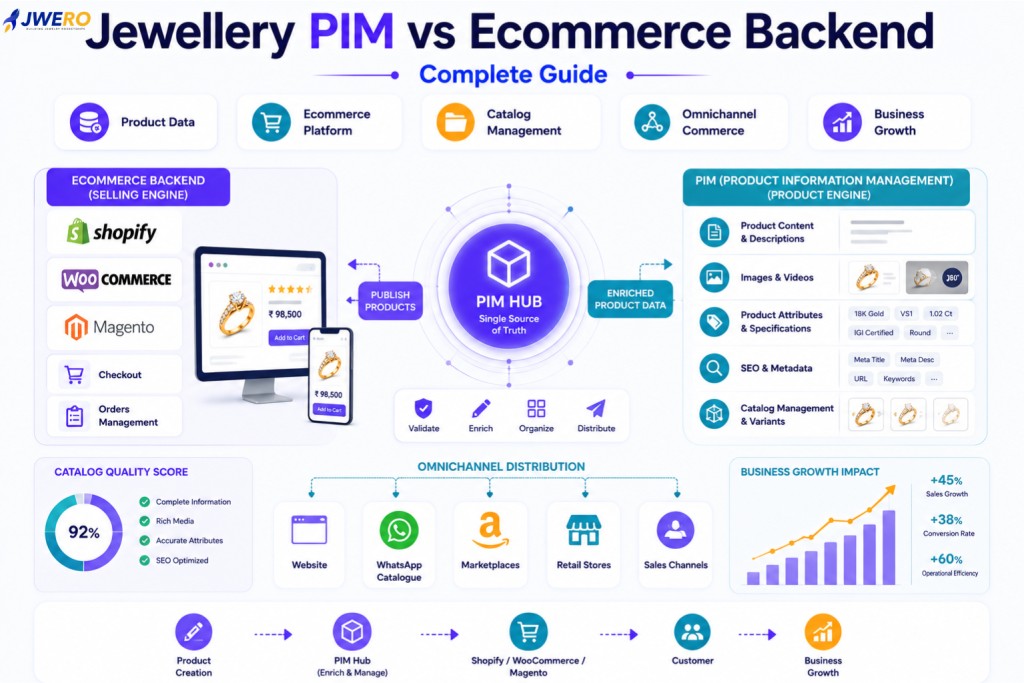
PIM vs Ecommerce Backend: Core Difference
The easiest way to understand the distinction:
Ecommerce Backend = Selling Engine
PIM = Product Information Engine
The ecommerce platform processes transactions.
The PIM manages information.
Together they create a scalable architecture.
What Should Be Managed in a PIM?
PIM should manage:
- Product Attributes
- Product Descriptions
- Product Images
- Product Videos
- Product Variants
- Certifications
- SEO Metadata
- Product Categories
- Collection Information
- Product Relationships
- Omnichannel Distribution
What Should Be Managed in Ecommerce?
The ecommerce backend should manage:
- Storefront
- Shopping Cart
- Checkout
- Orders
- Payments
- Promotions
- Customer Accounts
- Commerce Operations
Why Product Publishing Should Start in PIM
The ideal workflow looks like:
Product Creation
↓
↓
Product Validation
↓
PIM
↓
Shopify
WooCommerce
Magento
↓
Customer
The ecommerce platform receives clean, validated product information.
SEO Benefits of PIM
A PIM helps improve:
- Product Titles
- Product Descriptions
- Product Metadata
- Structured Data
- Catalog Consistency
- Internal Search
Better product information improves organic visibility.
AI Search Benefits of PIM
Platforms such as:
- ChatGPT
- Google AI Overviews
- Gemini
- Perplexity
favor structured and consistent product information.
PIM helps prepare product data for AI discovery.
Signs You Need a Jewellery PIM
You likely need a PIM if:
- Product Updates Take Too Long
- Product Information Exists in Multiple Systems
- Catalog Consistency Is Poor
- Ecommerce Teams Struggle with Data
- Product Images Are Difficult to Manage
- WhatsApp Catalogues Are Inconsistent
- Omnichannel Publishing Is Manual
These are strong indicators.
Why Jwero PIM Hub Complements Ecommerce Platforms
Jwero PIM Hub works alongside:
- Shopify
- WooCommerce
- Magento
- Custom Ecommerce Platforms
It helps jewellery businesses:
- Centralize Product Data
- Improve Product Accuracy
- Manage Rich Product Content
- Synchronize Across Channels
- Improve Catalog Governance
- Prepare Product Data for AI Search
- Scale Omnichannel Commerce
Without replacing existing ecommerce infrastructure.
Final Thoughts
Shopify, WooCommerce, and Magento are excellent ecommerce platforms.
But they are not product information management systems.
As jewellery businesses grow, managing product information directly inside ecommerce platforms creates:
- Product inconsistencies
- Catalog management challenges
- Omnichannel difficulties
- Scaling limitations
The future is not PIM or Ecommerce.
It is:
PIM + Ecommerce
Together they provide a scalable foundation for modern jewellery commerce.
FAQs
What is the difference between a Jewellery PIM and Shopify?
Shopify manages ecommerce transactions, while a Jewellery PIM manages product information, attributes, images, descriptions, and omnichannel distribution.
Can WooCommerce replace a PIM?
WooCommerce can manage basic products, but it is not designed for large-scale product governance, enrichment, and omnichannel catalog management.
Do jewellers need both PIM and ecommerce software?
Yes. Ecommerce platforms handle selling, while PIM platforms manage product information and distribution.
Why is a PIM important for omnichannel commerce?
A PIM ensures consistent product information across websites, WhatsApp, marketplaces, and other sales channels.
Does a PIM improve SEO?
Yes. Better product data improves product quality, search visibility, AI discoverability, and customer experience.