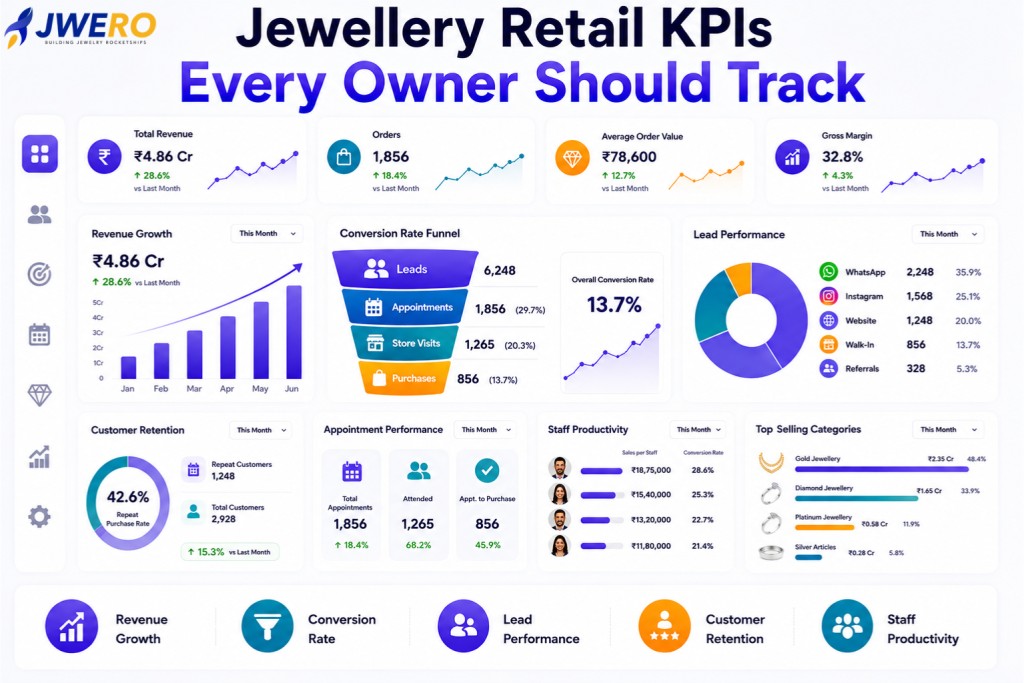


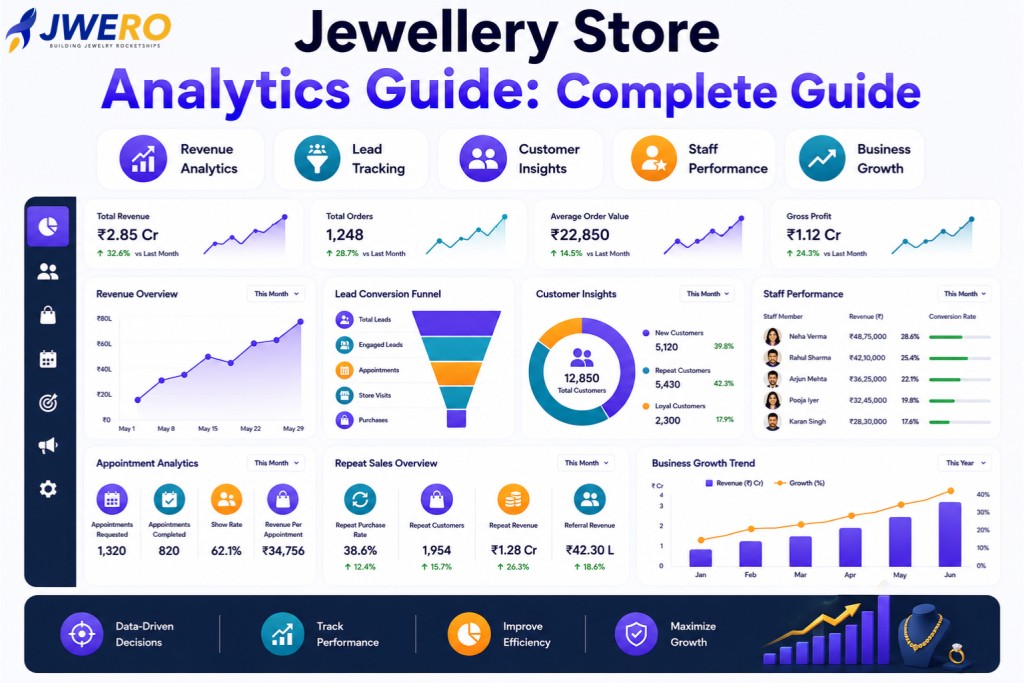
Modern jewellery retail is driven by data.
The most successful retailers do not rely on assumptions. They use analytics to understand:
- Sales performance
- Customer behaviour
- Lead conversion
- Staff productivity
- Repeat purchases
- Revenue growth
Analytics helps jewellery retailers make smarter business decisions and identify growth opportunities faster.
What Are Jewellery Store Analytics?
Jewellery store analytics refers to the process of measuring and analysing business performance using data.
Analytics helps answer questions such as:
- Which products sell best?
- Which marketing channels generate leads?
- Which staff members perform best?
- Which customers generate the most revenue?
- Where are sales opportunities being lost?
The goal is visibility.
Why Analytics Matter
Analytics helps jewellery retailers:
- Increase Revenue
- Improve Conversion Rates
- Improve Staff Productivity
- Optimise Marketing Spend
- Increase Customer Retention
- Improve Decision-Making
Businesses that measure performance consistently outperform competitors.
Core Analytics Areas
1. Sales Analytics
Track:
- Daily Revenue
- Weekly Revenue
- Monthly Revenue
- Average Order Value
- Revenue Growth
Sales analytics reveal overall business performance.
2. Lead Analytics
Track:
- Total Leads
- Lead Sources
- Lead Conversion Rate
- Lead Response Time
- Appointment Rate
Lead visibility improves conversion.
3. Customer Analytics
Understand:
- Purchase Behaviour
- Customer Lifetime Value
- Repeat Purchase Rate
- Retention Rate
- Product Preferences
Customer insights improve personalisation.
4. Staff Analytics
Track:
- Leads Assigned
- Appointments Booked
- Revenue Generated
- Conversion Rate
- Follow-Up Completion
Performance visibility improves accountability.
5. Appointment Analytics
Measure:
- Appointment Requests
- Attendance Rate
- Conversion Rate
- Revenue Per Appointment
Appointments often indicate purchase intent.
6. Repeat Sales Analytics
Track:
- Repeat Customers
- Loyalty Program Participation
- Repeat Purchase Revenue
- Referral Rate
Retention metrics reveal long-term growth.
The Jewellery Analytics Funnel
Leads
↓
Engagement
↓
↓
Store Visits
↓
Purchases
↓
Repeat Purchases
↓
Referrals
Analytics should track every stage.
Essential Dashboard Components
A jewellery retailer should monitor:
- Revenue Dashboard
- Lead Dashboard
- Customer Dashboard
- Staff Dashboard
- Appointment Dashboard
- Repeat Sales Dashboard
Together, they create a complete business view.
Customer Intelligence Analytics
Understand:
- Customer Segments
- Buying Patterns
- Purchase History
- Preferred Categories
- Spending Behaviour
Customer intelligence improves marketing and sales.
Marketing Analytics
Track performance across:
- Google Ads
- Facebook Ads
- WhatsApp Campaigns
- Referral Programs
Understanding ROI improves investment decisions.
Common Analytics Mistakes
- Tracking Too Many Metrics
- No CRM Integration
- Ignoring Customer Data
- No Staff Visibility
- No Follow-Up Reporting
- Inconsistent Reviews
Focus on actionable metrics.
How CRM Improves Analytics
CRM centralises:
- Customer Data
- Lead Data
- Sales Data
- Appointment Data
- Follow-Up Data
This creates real-time visibility.
How Jwero Helps Store Analytics
Jwero enables:
- Revenue Tracking
- Lead Analytics
- Customer Intelligence
- Staff Performance Dashboards
- Appointment Reporting
- Repeat Sales Analytics
- Customer Lifetime Value Tracking
- Executive Business Dashboards
This helps jewellery retailers make data-driven decisions.
Final Thoughts
Analytics transforms jewellery retail from reactive decision-making to proactive growth management.
By measuring:
- Sales
- Customers
- Leads
- Staff
- Appointments
- Repeat purchases
Retailers gain the visibility needed to scale profitably.
Frequently Asked Questions
Why are analytics important for jewellery retailers?
Analytics are important for jewellery retailers because they provide visibility into performance, helping retailers improve sales and profitability.
What metrics should jewellers track?
Metrics like Revenue, conversion rate, lead performance, repeat sales, customer lifetime value, and staff productivity should be tracked by jewellers.
How does CRM improve analytics?
CRM centralises data and creates dashboards for reporting and decision-making.
What is customer lifetime value?
The total revenue generated by a customer throughout their relationship with the business is called Customer lifetime value.
How often should analytics be reviewed?
Operational metrics should be reviewed daily, while strategic metrics should be reviewed monthly.