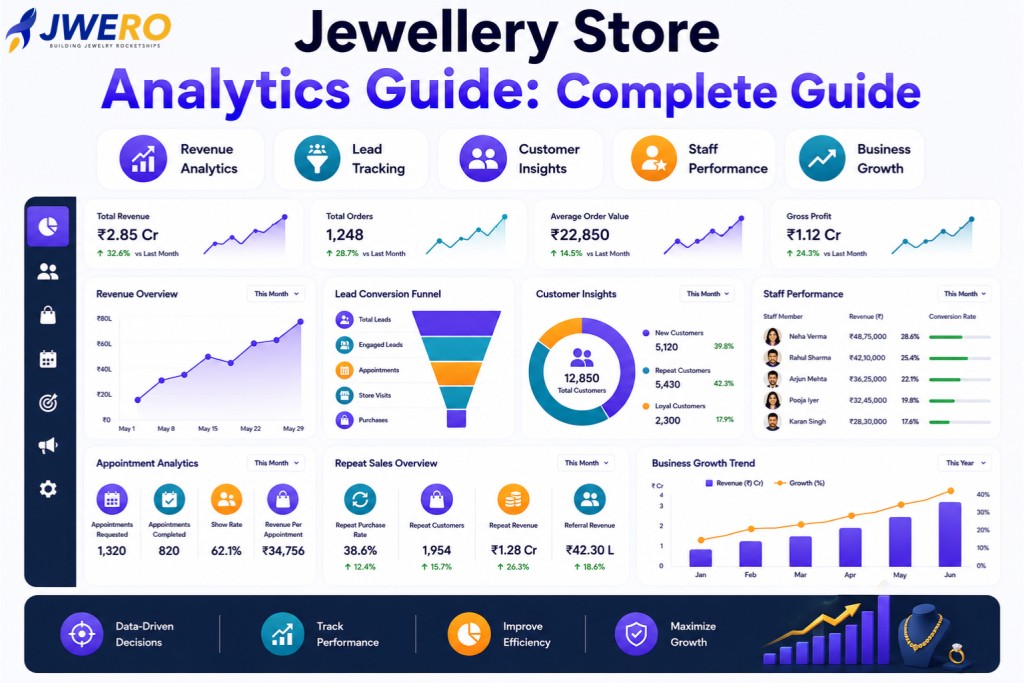


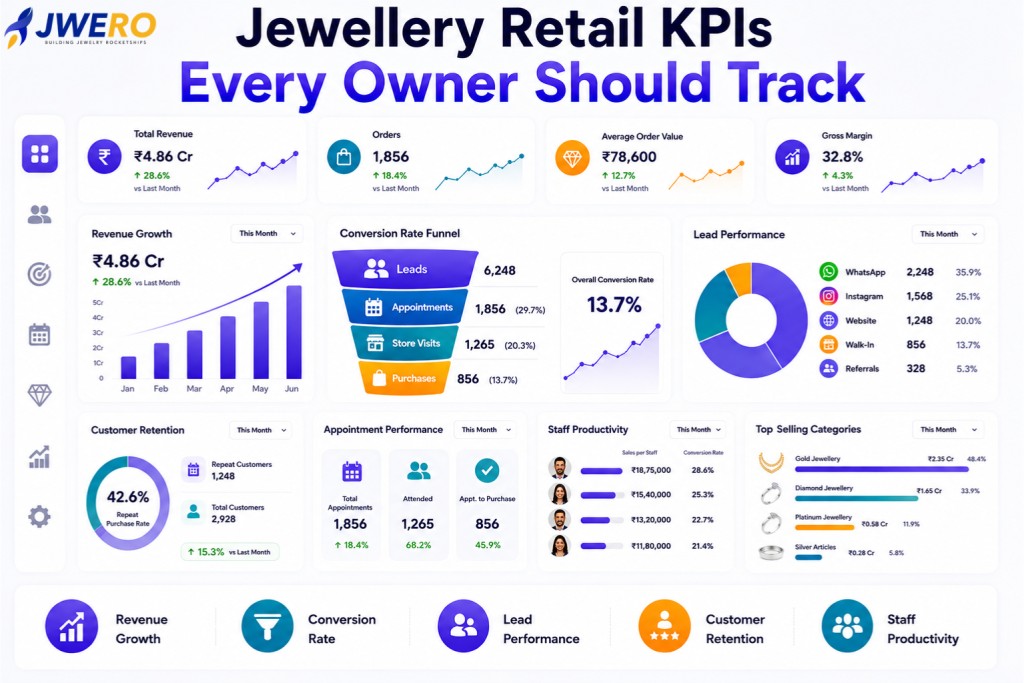
Successful jewellery businesses are built on data-driven decisions.
Many retailers focus only on revenue, but revenue alone does not reveal the full picture.
To improve performance, jewellery store owners must track key performance indicators (KPIs) that measure sales, customer behaviour, operational efficiency, and profitability.
This guide covers the most important KPIs every jewellery retailer should monitor.
What Are KPIs?
KPIs (Key Performance Indicators) are measurable metrics that help businesses evaluate performance.
They answer questions such as:
- Are sales improving?
- Are leads converting?
- Are customers returning?
- Is the team performing effectively?
- Are marketing campaigns working?
KPIs provide visibility into business health.
Why KPI Tracking Matters
Tracking KPIs helps jewellery retailers:
- Improve Sales Performance
- Increase Conversion Rates
- Identify Bottlenecks
- Improve Customer Retention
- Measure Team Productivity
- Increase Profitability
Businesses that measure performance consistently make better decisions.
Revenue KPIs
Total Revenue
The most basic performance metric.
Measures:
- Daily revenue
- Weekly revenue
- Monthly revenue
- Annual revenue
Revenue trends help identify growth opportunities.
Revenue Growth Rate
Formula:
Revenue Growth % = (Current Revenue – Previous Revenue) ÷ Previous Revenue × 100
Measures business growth over time.
Average Order Value (AOV)
Formula:
Total Revenue ÷ Number of Orders
Higher AOV increases profitability.
Sales Performance KPIs
Conversion Rate
Formula:
Purchases ÷ Leads × 100
Measures how effectively enquiries become customers.
Appointment Conversion Rate
Formula:
Purchases ÷ Appointments × 100
Shows the effectiveness of consultations and showroom visits.
Walk-In Conversion Rate
Formula:
Purchases ÷ Walk-In Visitors × 100
Measures in-store sales performance.
Lead Management KPIs
Total Leads Generated
Track leads from:
- Google Ads
- Facebook Ads
- Referrals
Lead volume drives future sales.
Lead Response Time
Measures how quickly staff respond to enquiries.
Faster responses improve conversion rates.
Lead-to-Appointment Rate
Formula:
Appointments ÷ Leads × 100
Shows the effectiveness of lead nurturing.
Customer KPIs
Repeat Purchase Rate
Formula:
Repeat Customers ÷ Total Customers × 100
Measures customer retention.
Customer Lifetime Value (CLV)
Measures total revenue generated by a customer over time.
Higher CLV indicates stronger customer relationships.
Customer Retention Rate
Measures how effectively customers return.
Retention drives long-term profitability.
Appointment KPIs
Total Appointments Booked
Tracks appointment volume.
Appointment Attendance Rate
Formula:
Attended Appointments ÷ Booked Appointments × 100
Shows appointment quality.
Appointment-to-Purchase Rate
Measures the effectiveness of consultations.
Marketing KPIs
Cost Per Lead (CPL)
Formula:
Marketing Spend ÷ Leads Generated
Measures campaign efficiency.
Return on Ad Spend (ROAS)
Formula:
Revenue Generated ÷ Advertising Spend
Measures advertising profitability.
Campaign Conversion Rate
Tracks performance of individual campaigns.
Staff Performance KPIs
Sales Per Staff Member
Measures productivity.
Conversion Rate by Staff Member
Identifies top performers.
Revenue Generated Per Employee
Measures contribution to sales.
Follow-Up Completion Rate
Tracks operational discipline.
Inventory & Product KPIs
Best-Selling Categories
Examples:
- Gold jewellery
- Diamond jewellery
- Bridal collections
Inventory Turnover
Measures how quickly stock is sold.
Product Performance
Tracks sales by category and collection.
KPI Dashboard Example
A jewellery retailer should ideally monitor:
- Revenue
- Conversion Rate
- Lead Response Time
- Appointment Rate
- Repeat Purchase Rate
- Customer Lifetime Value
- Staff Performance
- Marketing ROI
These KPIs provide a complete business view.
Common KPI Tracking Mistakes
- Tracking Too Many Metrics
- Ignoring Customer KPIs
- No Lead Tracking
- No Staff Accountability
- Inconsistent Reporting
- No CRM Integration
Focus on metrics that directly impact growth.
How CRM Improves KPI Visibility
CRM helps retailers:
- Track leads
- Monitor conversions
- Measure follow-ups
- Analyse customer behaviour
- Generate performance reports
This creates operational visibility.
How Jwero Helps with KPI Tracking
Jwero enables jewellers to monitor:
- Revenue
- Lead Conversion
- Appointment Performance
- Customer Retention
- Staff Productivity
- Repeat Sales
- Marketing ROI
- Customer Lifetime Value
Through real-time dashboards and analytics.
Final Thoughts
Jewellery retailers cannot improve what they do not measure.
By tracking the right KPIs consistently, businesses can:
- Increase sales
- Improve conversions
- Retain more customers
- Improve operational efficiency
- Grow profitability
Data-driven retailers consistently outperform competitors.
Frequently Asked Questions (FAQs)
What is the most important KPI for jewellery retailers?
Conversion rate is one of the most important metrics because it directly impacts revenue.
Why is lead response time important?
Faster responses typically result in higher conversion rates.
What KPI measures customer loyalty?
Repeat Purchase Rate and Customer Lifetime Value.
How often should KPIs be reviewed?
Daily for operational KPIs and monthly for strategic KPIs.
How can CRM help with KPI tracking?
CRM centralises customer, lead, appointment, and sales data for reporting.
What KPIs should small jewellery stores track first?
Revenue, conversion rate, lead response time, appointment rate, and repeat purchase rate.