


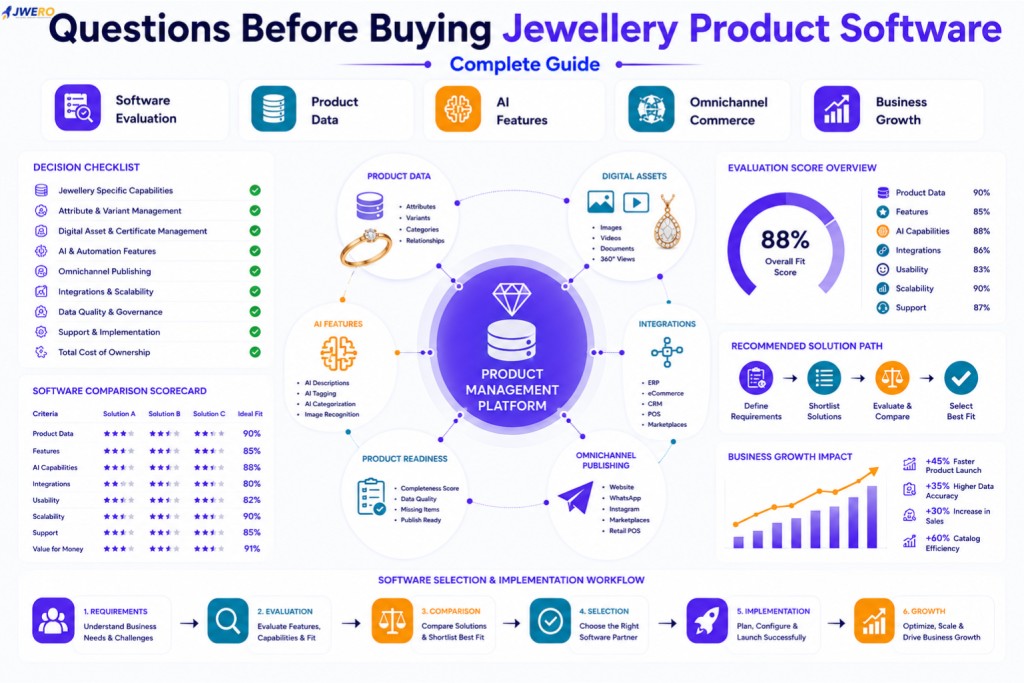
Choosing product management software is one of the most important technology decisions a jewellery business can make.
The right platform can help you:
- Centralise product data
- Improve catalog quality
- Manage product images and certificates
- Publish across multiple channels
- Improve customer experiences
- Scale your business
The wrong platform can create years of operational challenges.
Unfortunately, many jewellers focus on software features alone and fail to ask the right questions before making a purchase.
This guide provides the key questions every jewellery retailer, wholesaler, manufacturer, and D2C brand should ask before investing in product management software.
Why This Decision Matters More Than Ever
Modern jewellery businesses sell through:
- Ecommerce Websites
- Marketplaces
- Retail Stores
- CRM Platforms
- Sales Teams
As product catalogues and sales channels grow, managing information manually becomes impossible.
Your product management platform becomes the foundation of your commerce ecosystem.
Question 1: Is the Software Built for Jewellery Businesses?
Not all product management systems are designed for jewellery.
Ask:
- Can it manage metadata?
- Can it manage purity data?
- Can it manage stone attributes?
- Can it manage certifications?
- Can it handle product variants?
- Can it support jewellery-specific workflows?
Jewellery catalogues are far more complex than standard retail catalogues.
Question 2: Can It Become a Single Source of Truth?
One of the biggest product management challenges is fragmented data.
Ask:
- Can all product information be managed from one platform?
- Can it centralise product data?
- Can it centralise product media?
- Can it centralise certifications?
- Can it centralise product content?
A modern platform should eliminate duplicate systems.
Question 3: How Does It Handle Product Attributes?
Product attributes are critical for jewellery businesses.
Ask:
- Can attributes be customised?
- Can it support metal types?
- Can it support purity grades?
- Can it support stone details?
- Can it support certifications?
- Can it support category-specific attributes?
Flexible attribute management is essential.
Question 4: Does It Support Product DNA and Variants?
Most jewellery products have multiple variants.
Ask:
- Can it manage parent products?
- Can it manage variant SKUs?
- Can it manage product DNA?
- Can it manage product relationships?
- Can it support scalable catalogue structures?
Without variant management, catalogues quickly become difficult to maintain.
Question 5: How Does It Manage Product Images and Certificates?
Media management is just as important as product data.
Ask:
- Does it include digital asset management?
- Can it store product images?
- Can it store videos?
- Can it manage certificates?
- Can assets be linked to products?
- Can teams search and retrieve assets quickly?
A strong media management framework improves efficiency.
Question 6: Can It Improve Product Data Quality?
Catalogue quality directly affects sales performance.
Ask:
- Does it validate product information?
- Does it identify missing attributes?
- Does it identify missing images?
- Does it identify missing certificates?
- Does it prevent incomplete products from being published?
Quality control is essential.
Question 7: Does It Offer Product Readiness Scoring?
A readiness score helps determine whether products are ready for publication.
Ask:
- Does the platform calculate completeness scores?
- Can readiness rules be customised?
- Can products be scored automatically?
- Can incomplete products be flagged?
Readiness scoring improves catalogue governance.
Question 8: How Does It Support Omnichannel Commerce?
Most jewellery businesses now sell across multiple channels.
Ask:
- Can it publish to websites?
- Can it support WhatsApp catalogues?
- Can it support Instagram Shops?
- Can it support marketplaces?
- Can it support POS systems?
- Can one product record power on all channels?
Omnichannel readiness is a major differentiator.
Question 9: Does It Support AI?
AI is becoming increasingly important in product management.
Ask:
- Can AI generate product descriptions?
- Can AI generate product titles?
- Can AI generate tags?
- Can AI classify products?
- Can AI enrich catalogues?
- Can AI analyse images?
AI capabilities reduce manual work.
Question 10: Can It Automate Catalog Enrichment?
Catalogue enrichment often consumes significant resources.
Ask:
- Can product attributes be suggested automatically?
- Can images be analysed?
- Can categories be recommended?
- Can content be generated?
Automation improves scalability.
Question 11: How Easy Is Data Migration?
Most businesses already have product information spread across multiple systems.
Ask:
- How will product data be migrated?
- How will product images be migrated?
- How will certificates be migrated?
- What support is provided?
- How long will migration take?
Migration planning is critical.
Question 12: What Integrations Are Available?
No software operates in isolation.
Ask:
- Does it integrate with ERP?
- Does it integrate with CRM?
- Does it integrate with ecommerce platforms?
- Does it integrate with POS?
- Does it integrate with marketing tools?
Integration reduces duplication.
Question 13: How Does It Handle Governance?
As catalogues grow, governance becomes essential.
Ask:
- Are approval workflows available?
- Are user permissions configurable?
- Is version history maintained?
- Can audit trails be tracked?
Governance protects catalogue quality.
Question 14: Can Teams Find Information Quickly?
Product discovery is often overlooked.
Ask:
- Is SKU search available?
- Is certificate search available?
- Is attribute search available?
- Is media search available?
- Can products be filtered effectively?
Searchability improves productivity.
Question 15: Will It Scale with the Business?
The software you buy today should support future growth.
Ask:
- Can it handle large catalogues?
- Can it support thousands of products?
- Can it support multiple brands?
- Can it support multiple channels?
- Can it support international expansion?
Scalability matters.
Question 16: How Does It Support Ecommerce?
Ecommerce requirements continue to grow.
Ask:
- Does it support SEO?
- Does it support product metadata?
- Does it support product content?
- Does it support category structures?
- Does it support marketplace publishing?
Strong ecommerce capabilities drive growth.
Question 17: What Analytics Are Available?
Visibility helps improve catalogue performance.
Ask:
- Can we measure product completeness?
- Can we measure readiness?
- Can we track catalogue health?
- Can we identify missing information?
Analytics improve decision-making.
Question 18: What Does Success Look Like?
Before buying any platform, define success metrics.
Examples:
- Faster Product Launches
- Better Catalogue Quality
- Better Product Accuracy
- Better Omnichannel Consistency
- Reduced Manual Work
- Increased Revenue
This helps evaluate ROI.
Product Management Software Evaluation Checklist
Before making a decision, confirm that the platform supports:
- Jewellery Product Attributes
- Product DNA
- Variant Management
- Digital Asset Management
- Certificate Management
- Product Readiness Scoring
- AI Content Generation
- Omnichannel Publishing
- Data Validation
- Governance Workflows
- Ecommerce Support
- Business Integrations
- Scalability
- Analytics
- Product Search
Why Jwero Is Designed for Jewellery Businesses
Jwero helps jewellery businesses:
- Centralise Product Data
- Manage Product Attributes
- Manage Product Media
- Manage Certificates
- Support Product DNA
- Improve Product Readiness
- Enable Omnichannel Commerce
- Generate AI Content
- Improve Catalogue Quality
- Scale Product Operations
All from a platform built specifically for jewellery businesses.
Final Thoughts
The best product management software is not necessarily the one with the longest feature list.
It is the one that aligns with your:
- Product Complexity
- Business Model
- Sales Channels
- Growth Strategy
- Operational Requirements
Asking the right questions before purchasing software helps ensure long-term success.
FAQs
What is product management software for jewellery businesses?
Product Management software for jewellery businesses is software that helps jewellery businesses manage product information, media, attributes, certificates, and omnichannel publishing.
Why is a jewellery-specific platform important?
Jewellery products require specialised attributes, certifications, variants, and product structures that generic systems often struggle to support.
What should I evaluate before buying a PIM?
Evaluate attribute management, product DNA, media management, AI capabilities, integrations, governance, and omnichannel support.
Can product management software improve ecommerce performance?
Yes. Better product data and catalogue quality improve discoverability, customer trust, and conversion rates.
Is Jwero suitable for retailers, wholesalers, and D2C brands?
Yes. Jwero is designed to support jewellery businesses across multiple business models and sales channels.