


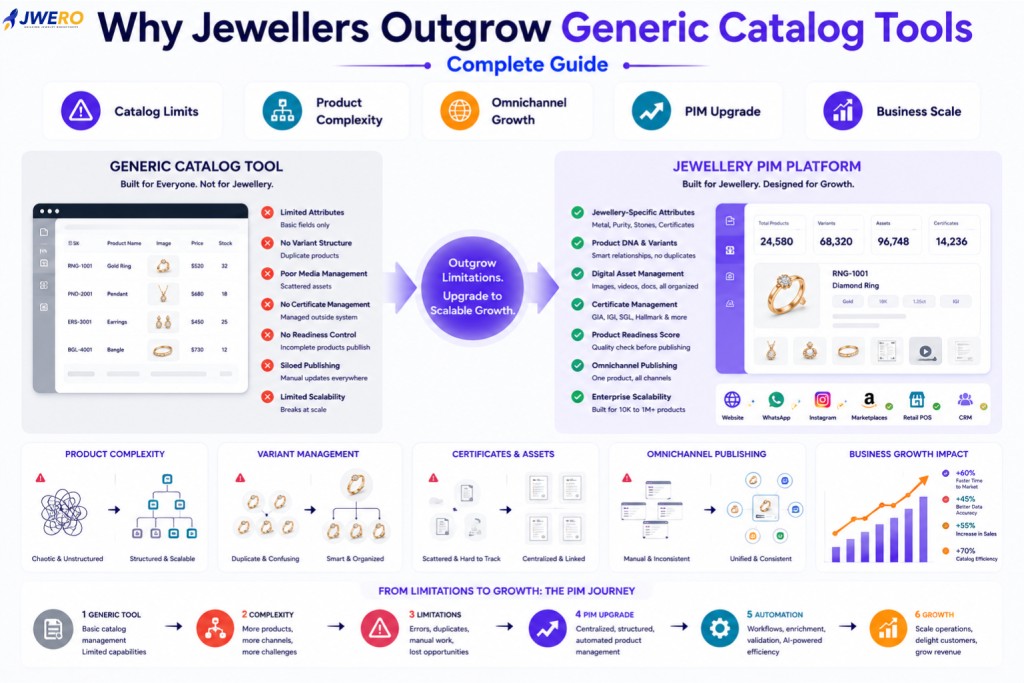
When jewellery businesses first begin selling online, generic catalogue tools often seem sufficient.
Many retailers start with:
- Excel Sheets
- Google Sheets
- Ecommerce Product Managers
- Basic Inventory Systems
- Generic Product Databases
Initially, these tools appear to solve the problem.
The catalogue is small.
The team is small.
The number of channels is limited.
However, as the business grows, cracks begin to appear.
What once felt simple becomes increasingly difficult to manage.
This is why many growing jewellery businesses eventually outgrow generic catalogue tools and move toward jewellery-specific Product Information Management (PIM) platforms.
What Are Generic Catalogue Tools?
Generic catalogue tools are systems designed to manage product information across multiple industries.
Examples include:
- Spreadsheets
- Ecommerce Product Managers
- Generic Inventory Systems
- Basic Product Databases
- General Catalogue Platforms
These systems are not specifically built for jewellery retail.
Why Generic Catalogue Tools Work Initially
For very small catalogues, generic systems may be enough.
A retailer with:
- 100 Products
- One Store
- One Website
- One Sales Channel
Can often manage operations without major issues.
But growth changes everything.
The Turning Point: When Growth Creates Complexity
As jewellery businesses expand, they introduce:
- More Products
- More Variants
- More Collections
- More Channels
- More Images
- More Certificates
- More Customer Touchpoints
Catalogue complexity increases exponentially.
This is where generic tools begin to struggle.
Problem 1: Jewellery Products Have Complex Attributes
Most generic catalogue systems were not designed for jewellery-specific information.
Jewellers need to manage:
- Metal Type
- Purity
- Weight
- Diamond Specifications
- Gemstone Details
- Certification Information
- Ring Sizes
- Product DNA
Generic tools often treat these as simple text fields.
This creates inconsistency.
Problem 2: Product Variants Become Unmanageable
A single jewellery product may exist in multiple versions.
Examples include:
- Different Sizes
- Different Metals
- Different Stones
- Different Weights
- Different Purities
Generic tools often create separate products for every variation.
This causes:
- Duplicate Records
- Data Redundancy
- Reporting Challenges
- Catalog Bloat
A jewellery-specific PIM handles variant relationships more effectively.
Problem 3: Product Images Multiply Rapidly
Jewellery products require extensive media assets.
Examples include:
- Primary Images
- Alternate Angles
- Lifestyle Images
- Videos
- Certificates
- Product PDFs
As catalogues grow, managing media becomes difficult.
Generic catalogue systems often lack proper digital asset management.
Problem 4: Certificate Management Becomes a Challenge
Trust is essential in jewellery retail.
Products often require:
- GIA Certificates
- IGI Certificates
- SGL Certificates
- Hallmark Documents
Generic tools rarely include certificate management capabilities.
This forces businesses to manage certificates separately.
Problem 5: Omnichannel Commerce Creates Data Silos
Today’s jewellery customers shop through:
- Websites
- Marketplaces
- Retail Stores
- Sales Consultants
Generic catalogue tools are not designed for omnichannel publishing.
Teams often duplicate work across systems.
Problem 6: Product Information Becomes Inconsistent
As catalogues grow, inconsistencies appear.
Common examples:
- Different Product Titles
- Different Product Images
- Different Prices
- Different Product Descriptions
- Missing Attributes
- Missing Certifications
This impacts customer trust.
Problem 7: Catalogue Updates Take Too Long
Without centralised product management:
Updating one product may require changes in:
- Website
- Ecommerce Store
- WhatsApp Catalogue
- Marketplace
- CRM
- POS
The process becomes inefficient.
Problem 8: Teams Lose Confidence in Product Data
When product information exists in multiple systems:
Teams start asking:
- Which Version Is Correct?
- Which Image Is Current?
- Which Price Is Accurate?
- Which Description Should We Use?
The catalog stops being trusted.
Problem 9: Generic Tools Lack Product Readiness Controls
Many businesses publish products without realizing they are incomplete.
Missing:
- Images
- Descriptions
- Attributes
- Certificates
- SEO Metadata
Generic tools rarely provide readiness scoring.
As a result, incomplete products reach customers.
Problem 10: AI and Automation Become Difficult
Modern commerce increasingly relies on:
- AI Content Generation
- Product Classification
- Product Enrichment
- Product Recommendations
- Image Recognition
Generic catalog tools often lack AI-ready data structures.
This limits future growth.
The Hidden Cost of Generic Catalog Tools
The biggest issue is not software cost.
It is operational cost.
Businesses spend time:
- Fixing Data Errors
- Updating Multiple Systems
- Managing Duplicate Records
- Searching for Assets
- Resolving Customer Confusion
- Correcting Publishing Mistakes
The hidden cost grows every year.
What Happens as the Business Scales?
A business may grow from:
500 Products
to
50,000 Products
The systems that worked initially often become major bottlenecks.
Catalog complexity eventually exceeds the capabilities of generic tools.
What Modern Jewellers Actually Need
Growing jewellery businesses need:
- Centralized Product Data
- Product DNA Management
- Variant Management
- Digital Asset Management
- Certificate Management
- Product Governance
- Product Readiness Scoring
- Omnichannel Publishing
- AI Enrichment
These capabilities are rarely available in generic systems.
Why Jewellery-Specific PIM Platforms Exist
A jewellery-specific PIM is designed around industry requirements.
It supports:
- Jewellery Attributes
- Product Variants
- Product DNA
- Certificates
- Product Media
- Omnichannel Publishing
- Product Readiness
- AI Product Enrichment
This creates a scalable foundation.
Generic Catalog Tool vs Jewellery PIM
| Capability | Generic Tool | Jewellery PIM |
|---|---|---|
| Product Attributes | Basic | Advanced |
| Product DNA | Limited | Built-In |
| Variant Management | Limited | Advanced |
| Certificate Management | No | Yes |
| Digital Asset Management | Limited | Yes |
| Product Readiness Score | No | Yes |
| Omnichannel Publishing | Limited | Yes |
| AI Enrichment | Rare | Yes |
| Scalability | Moderate | High |
Signs You Have Outgrown Generic Catalog Tools
You likely need a jewellery-specific PIM if:
- Product Information Exists in Multiple Systems
- Teams Struggle to Find Correct Information
- Product Updates Take Too Long
- Catalog Errors Are Increasing
- Product Variants Are Difficult to Manage
- Certificates Are Managed Separately
- Omnichannel Publishing Is Difficult
- Catalog Growth Is Slowing Operations
These are common indicators.
How Jwero Solves These Challenges
Jwero helps jewellery businesses:
- Centralize Product Information
- Manage Product Attributes
- Manage Product DNA
- Manage Certificates
- Manage Product Media
- Improve Product Readiness
- Support Omnichannel Publishing
- Enable AI-Powered Catalog Enrichment
- Improve Catalog Governance
All from one platform built specifically for jewellery businesses.
Final Thoughts
Generic catalog tools often work during the early stages of growth.
However, as jewellery businesses expand, product complexity increases dramatically.
At some point, spreadsheets, ecommerce product managers, and generic catalog systems become operational bottlenecks.
A jewellery-specific PIM provides the structure, governance, automation, and scalability required for long-term growth.
The question is no longer whether your business needs better catalog management.
The question is whether your current tools can support where your business is going next.
FAQs
What are generic catalog tools?
Generic catalog tools are product management systems designed for multiple industries rather than jewellery-specific requirements.
Why do jewellery businesses outgrow generic catalog tools?
As catalogs grow, businesses need advanced attribute management, variants, certificates, digital assets, omnichannel publishing, and governance.
What are the limitations of generic catalog tools?
They often struggle with jewellery attributes, product variants, certificates, product readiness, and omnichannel commerce.
What is a jewellery-specific PIM?
A jewellery-specific PIM is a product information management platform designed specifically for jewellery product structures, workflows, and catalog requirements.
How does Jwero help jewellery businesses?
Jwero centralizes product information, manages digital assets and certificates, supports omnichannel publishing, and improves catalog quality.