

Managing jewellery products is becoming increasingly difficult.
Today’s jewellery businesses sell across:
- Retail Stores
- Ecommerce Websites
- WhatsApp Catalogues
- Marketplaces
- Sales Teams
Each channel requires accurate product information.
Without a centralised system, managing product data becomes chaotic.
This is where Jewellery PIM becomes essential.
What Is Jewellery PIM?
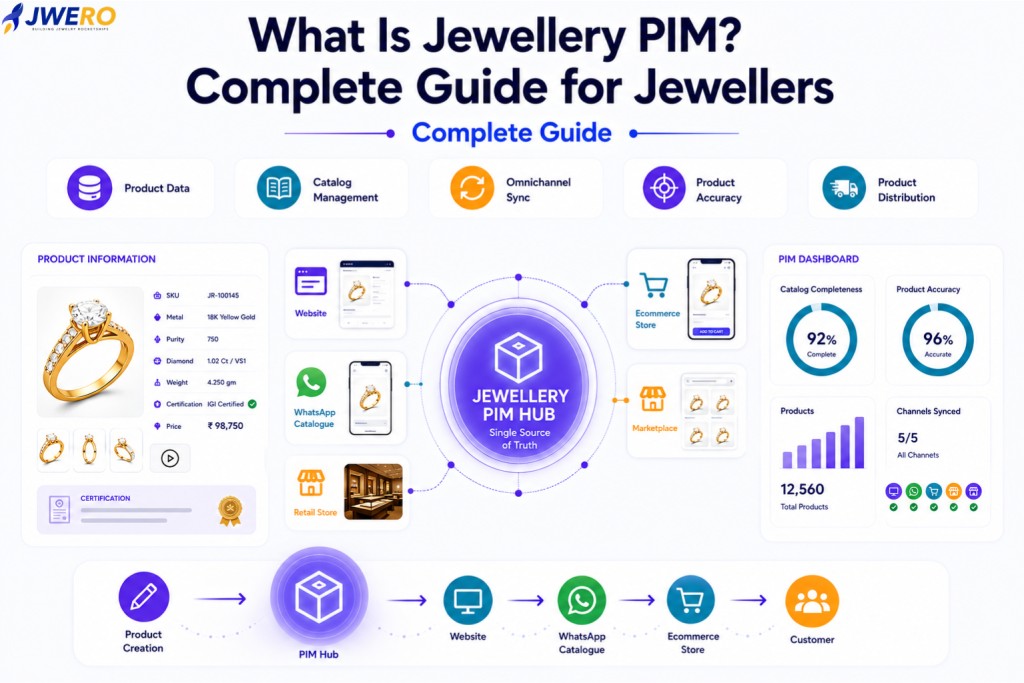
Jewellery PIM (Product Information Management) is a centralised platform that helps jewellery businesses manage, organise, enrich, and distribute product information across multiple sales channels.
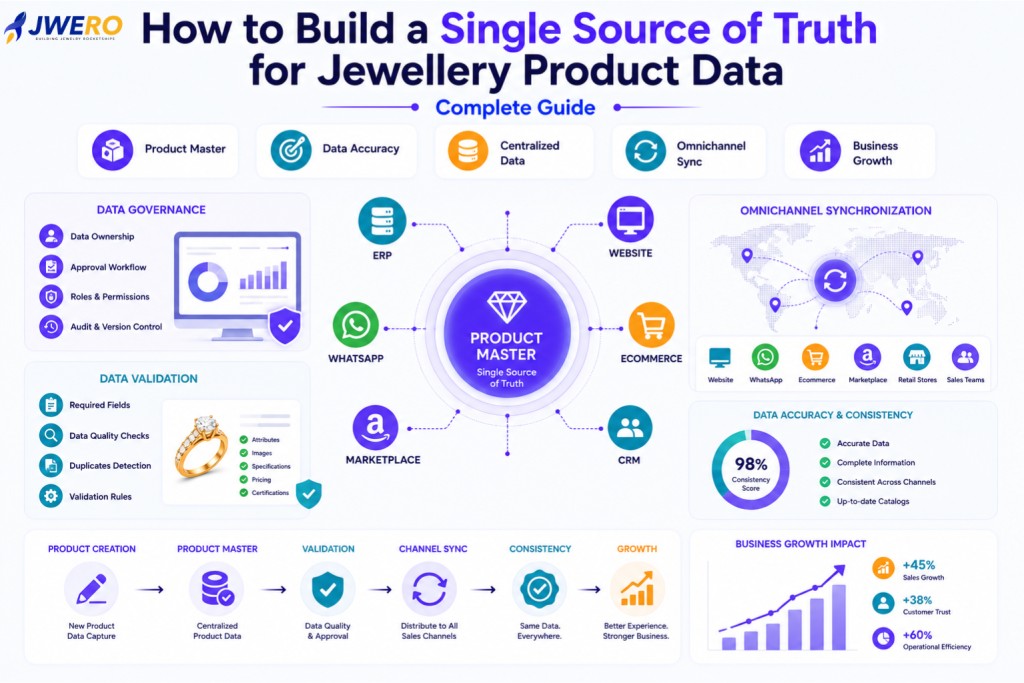
A Jewellery PIM becomes the single source of truth for all product-related information.
This includes:
- Product Names
- Product Descriptions
- Images
- Videos
- SKU Data
- Pricing
- Inventory Attributes
- Metal Specifications
- Diamond Details
- Certifications
- SEO Information
Instead of storing product information in multiple places, everything is managed from one platform.
Why Jewellery Businesses Need a PIM
Jewellery products contain significantly more information than standard retail products.
A single product may include:
- Gold Purity
- Diamond Weight
- Gemstone Details
- Certification Information
- Product Variants
- Multiple Images
- Videos
- Pricing Rules
- Collection Information
Managing this data manually is inefficient.
Common Product Management Challenges
Many jewellers still rely on:
- Excel Sheets
- ERP Databases
- Shared Drives
- Manual Uploads
- Separate Catalogue Files
This creates:
- Data Inconsistency
- Duplicate Work
- Catalog Errors
- Missing Information
- Poor Customer Experiences
- Slow Product Launches
A PIM solves these issues.
How a Jewellery PIM Works
The workflow is simple:
Product Creation
↓
Product Enrichment
↓
↓
Quality Review
↓
Channel Distribution
↓
Product Updates
↓
Customer Experience
Every channel receives consistent product information.
What Information Does a Jewellery PIM Manage?
A jewellery-specific PIM manages:
- Product Titles
- Product Categories
- Collections
- Metal Types
- Metal Purity
- Diamond Specifications
- Gemstone Information
- Product Images
- Videos
- Certifications
- Pricing
- SEO Metadata
- Marketing Content
Everything is stored centrally.
Jewellery PIM vs Spreadsheet Management
| Spreadsheet | Jewellery PIM |
|---|---|
| Manual Updates | Automated Updates |
| Multiple Versions | Single Source of Truth |
| Error-Prone | Controlled Data |
| Limited Scalability | Built for Growth |
| Channel-Specific Data | Omnichannel Distribution |
PIM becomes essential as product catalogues grow.
Jewellery PIM for Retailers
Retail jewellers use PIM software to:
- Manage Product Catalogues
- Improve Product Accuracy
- Sync Product Data
- Improve Ecommerce Performance
- Reduce Manual Work
Retail teams gain better visibility.
Jewellery PIM for Wholesalers
Wholesalers often manage thousands of SKUs.
A PIM helps:
- Organise Large Catalogues
- Manage Product Variants
- Share Product Data with Dealers
- Maintain Consistency
- Launch Products Faster
PIM improves operational efficiency.
Jewellery PIM for Omnichannel Businesses
Modern jewellers sell across multiple channels.
A Jewellery PIM synchronises data across:
- Website
- Ecommerce Store
- WhatsApp Catalogue
- Marketplaces
- CRM
- Sales Teams
- Retail Locations
Every channel receives accurate information.
Why Omnichannel Jewellery Product Data Matters
Customers expect consistency.
They should see:
- The Same Product Images
- The Same Pricing
- The Same Product Specifications
- The Same Certifications
- The Same Availability Information
Across every channel.
PIM ensures this consistency.
Jewellery Catalogue Software vs Jewellery PIM
Many retailers confuse catalogue software with PIM software.
Catalog Software
Focuses on displaying products.
Jewellery PIM
Focuses on managing and distributing product information.
A PIM powers the catalogue.
Benefits of Jewellery Product Information Management
- Better Product Accuracy
- Faster Product Launches
- Better Customer Experience
- Improved Team Productivity
- Better SEO Performance
- Omnichannel Consistency
- Improved Product Discovery
- Reduced Operational Costs
- Better Ecommerce Conversion Rates
- Business Scalability
Jewellery PIM and Ecommerce Growth
Successful ecommerce requires:
- Complete Product Information
- High-Quality Images
- Detailed Specifications
- Consistent Data
- SEO Optimization
A PIM provides the foundation.
Jewellery PIM and SEO
Product information directly affects search visibility.
A Jewellery PIM helps standardise:
- Product Titles
- Product Descriptions
- Meta Titles
- Meta Descriptions
- Structured Product Data
- Internal Linking
This improves organic traffic.
Jewellery PIM and AI Search
AI-powered search engines rely on structured product information.
Platforms like:
- Google AI Overviews
- ChatGPT
- Gemini
- Perplexity
Favour brands with organised product data.
A Jewellery PIM prepares product information for AI-powered discovery.
Jewellery PIM and GEO (Generative Engine Optimisation)
Generative search engines require:
- Structured Product Attributes
- Product Relationships
- Consistent Data
- Rich Product Context
PIM improves AI visibility.
Jewellery PIM and AEO (Answer Engine Optimisation)
Customers increasingly ask:
- What is the purity of this ring?
- Does this diamond have certification?
- What gemstone options are available?
- What is the exact product weight?
A PIM ensures accurate answers across channels.
Signs You Need a Jewellery PIM
You likely need a PIM if:
- Product Information Exists in Multiple Systems
- Product Updates Take Too Long
- Catalogue Errors Are Frequent
- Ecommerce Data Is Inconsistent
- WhatsApp Catalogues Are Outdated
- Product Launches Are Slow
- Teams Use Different Product Versions
The Future of Jewellery Product Management
The future includes:
- Centralised Product Data
- Omnichannel Commerce
- AI-Ready Catalogues
- Automated Product Distribution
- Real-Time Product Updates
- Connected Commerce Ecosystems
PIM becomes a core business platform.
Why Jwero PIM Hub Is Built for Jewellery Businesses
Jwero PIM Hub helps jewellers:
- Centralise Product Information
- Manage Product Attributes
- Organise Images and Videos
- Synchronize Across Channels
- Improve Product Accuracy
- Power Ecommerce Growth
- Support Omnichannel Commerce
- Prepare for AI Search
It is designed specifically for jewellery businesses.
Final Thoughts
Jewellery PIM is no longer optional for growing retailers and wholesalers.
As product catalogues expand and sales channels increase, centralised product management becomes critical.
A Jewellery PIM helps businesses:
- Improve product accuracy
- Increase operational efficiency
- Support ecommerce growth
- Enable omnichannel selling
- Improve SEO and AI visibility
The businesses that manage product information effectively will have a significant competitive advantage.
Frequently Asked Questions
What is Jewellery PIM?
Jewellery PIM is a Product Information Management platform that centralises and manages product data across multiple sales channels.
Why do jewellery retailers need a PIM?
Jewellery retailers manage large amounts of product information across multiple channels. A PIM ensures consistency, accuracy, and faster product updates.
Is Jewellery PIM different from ERP?
Yes. ERP manages operations and inventory, while PIM manages product information, media assets, catalogue data, and omnichannel distribution.
Does Jewellery PIM help ecommerce businesses?
Yes. It improves product quality, consistency, SEO performance, and customer experience across ecommerce channels.
Is Jewellery PIM important for AI search?
Absolutely. Structured product data managed through a PIM improves visibility in AI-powered search engines and answer engines.
Explore Jwero PIM Hub
Discover how Jwero PIM Hub helps jewellery retailers, wholesalers, and omnichannel businesses centralize product data and scale faster across every sales channel.