

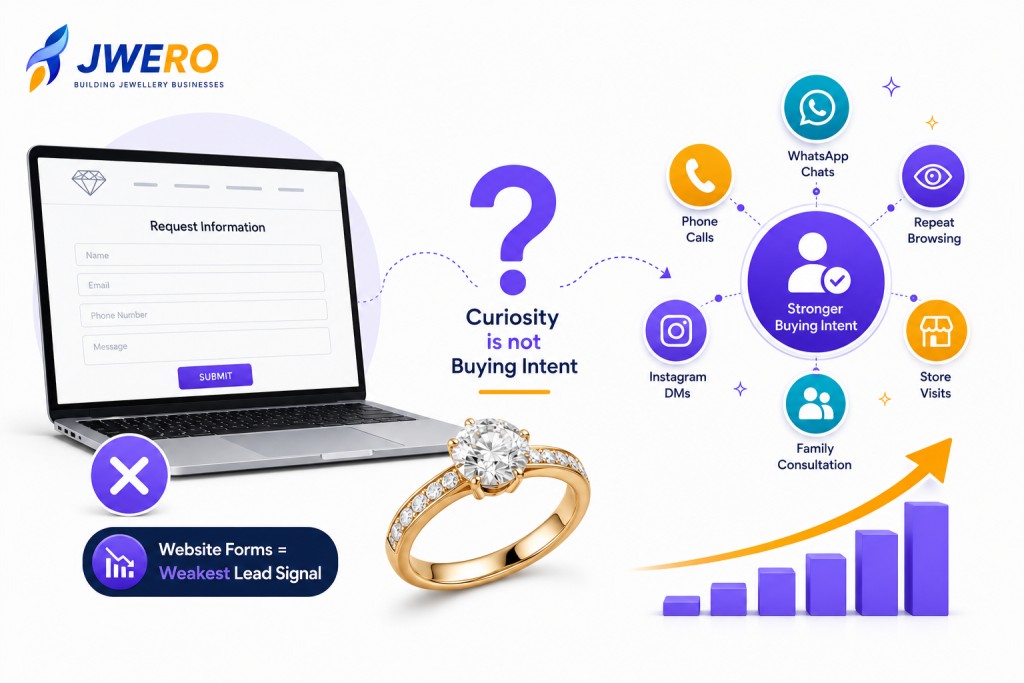
Jewellery brands often celebrate website form submissions.
The CRM captures a lead.
Dashboards look healthy.
Sales teams receive contact details.
Everything appears positive.
But in jewellery retail, website forms are often one of the weakest indicators of actual buying readiness.
Not because customers lack interest.
But because jewellery intent develops slowly.
And forms capture customers far earlier than most brands realise.
That creates a dangerous assumption:
“They filled the form, so they must be ready.”
Usually, they are not.
Table of Contents
- Why Website Forms Feel Valuable
- Why Jewellery Buying Behaviour Weakens Form Quality
- What Jewellery Website Forms Actually Capture
- Why Form Leads Disappear So Often
- Comparing Jewellery Intent Signals Properly
- How Website Forms Distort CRM Performance
- Why Forms Work Better in Other Industries
- The Smarter Role of Website Forms in Jewellery
- Why Silent Behaviour Often Matters More
1. Why Website Forms Feel Valuable
Website forms create visible activity.
That is why businesses trust them so easily.
Forms provide:
- names
- phone numbers
- email addresses
- measurable lead counts
From an operational perspective, this feels reassuring.
Because visibility creates a sense of control.
But jewellery buying rarely behaves like short-cycle ecommerce.
A form submission usually means:
“I’m interested enough to explore further.”
Not:
“I’m ready to purchase.”
That difference changes everything operationally.
2. Why Jewellery Buying Behaviour Weakens Form Quality
Jewellery purchases involve emotional complexity.
Customers often need:
- reassurance
- family discussions
- financial comfort
- timing alignment
- design confidence
The decision cycle is naturally longer.
But website forms were originally designed for fast-response industries.
Industries where customers often expect:
- quick calls
- immediate qualification
- rapid sales conversations
Jewellery customers usually behave differently.
Many are still exploring emotionally when they fill out forms.
That creates a mismatch immediately after lead capture.
3. What Jewellery Website Forms Actually Capture
Most jewellery website forms capture very early-stage intent.
Usually things like:
- curiosity
- inspiration
- comparison behaviour
- design exploration
- future consideration
Customers may simply want to:
- Save the brand mentally
- request light information
- Keep the option available
Forms rarely capture:
- purchase timing
- emotional certainty
- buying urgency
- final decision readiness
The lead becomes visible.
But the decision process is still incomplete.
4. Why Form Leads Disappear So Often
This is where many jewellery businesses create pressure unintentionally.
The customer fills out a form.
Then immediately receives:
- repeated calls
- aggressive WhatsApp messages
- discount pushes
- appointment requests
From the business perspective, this seems logical.
But from the customer perspective, it often feels premature.
The customer may think:
“I was just exploring.”
Not:
“I wanted immediate sales follow-up.”
This is why many jewellery forms lead suddenly disappear.
The follow-up timing breaks emotional comfort before trust fully develops.
5. Comparing Jewellery Intent Signals Properly
Not all customer signals carry equal intent strength.
That distinction matters enormously.
| Signal Type | Intent Strength |
|---|---|
| Website form fill | Low |
| Instagram DM | Medium |
| WhatsApp conversation | Medium–High |
| Repeat website visits | Medium–High |
| Google Business call | High |
| Store visit after browsing | Very High |
Website forms are not useless.
But they are often over-trusted.
Meanwhile, stronger behavioural signals remain ignored because they are less visible inside traditional CRM systems.
That creates misleading lead prioritisation.
6. How Website Forms Distort CRM Performance
Over-reliance on forms creates several operational problems.
Sales teams begin chasing visible leads instead of meaningful intent.
This usually leads to:
- inflated lead counts
- low-quality follow-ups
- wasted advisor time
- poor attribution understanding
- unnecessary customer pressure
Internally, dashboards may still appear healthy.
But conversion quality weakens quietly underneath.
This is why many jewellery businesses increasingly combine behavioural systems with platforms like Jwero.ai and Jwero Chats to understand customer journeys beyond simple form submissions.
Because visibility alone is not intelligence.
7. Why Forms Work Better in Other Industries
Website forms perform better when buying cycles are short.
For example:
- service bookings
- standard ecommerce
- low-emotion purchases
- individual decision-making
Jewellery behaves differently.
The category involves:
- emotional hesitation
- social influence
- financial caution
- long evaluation cycles
That means borrowing lead-generation logic from other industries often creates friction in jewellery retail.
Especially when aggressive follow-up systems get applied too early.
8. The Smarter Role of Website Forms in Jewellery
Strong jewellery brands do not eliminate forms.
They reposition them.
Instead of treating forms like “hot leads,” they treat them as:
- early intent indicators
- long-term nurturing opportunities
- behavioural starting points
This creates calmer customer journeys.
The smarter approach is to:
- Combine forms with browsing behaviour
- reduce immediate pressure
- preserve continuity across channels
- wait for stronger confidence signals
That is where systems like Jwero Ecommerce and Jwero WhatsApp become operationally useful.
Because they help connect behaviour over time instead of forcing premature conversion attempts.
9. Why Silent Behaviour Often Matters More
Some of the strongest jewellery intent signals are almost invisible.
For example:
- Repeated website visits
- returning to the same product
- Google searches after Instagram exposure
- WhatsApp re-engagement
- showroom visits after long gaps
These behaviours often predict readiness more accurately than form submissions.
But traditional reporting systems frequently ignore them because they are harder to measure.
That creates a dangerous bias toward visible activity.
Instead of a valuable activity.
Final Thought
Jewellery website forms rarely represent immediate buying intent.
More often, they represent permission to stay connected.
That is a very different thing.
The strongest jewellery brands today understand this clearly.
They no longer ask:
“Why didn’t this form convert?”
They ask:
“What behaviours tell us this customer is becoming ready?”
That shift changes everything.
Because jewellery conversion improves dramatically when businesses stop chasing visibility and start understanding intent progression instead.
FAQs
Why are jewellery website forms weak lead signals?
They often capture early curiosity rather than true buying readiness or emotional confidence.
Why do jewellery form leads stop responding?
Many customers fill forms while exploring casually and feel pressured when immediate follow-ups begin too aggressively.
Are website forms useless for jewellery brands?
No. Forms still help identify early-stage interest, but they should support nurturing instead of aggressive selling.
What signals are stronger than website forms in jewellery?
Repeat browsing, WhatsApp conversations, Google calls, and showroom visits usually indicate much stronger intent.
How can jewellery brands improve lead quality?
By combining form submissions with behavioural tracking, customer journey context, and calmer engagement timing.
Move Beyond Basic Jewellery Lead Capture
Jewellery customers rarely convert through forms alone.
The right systems help brands understand browsing behaviour, preserve customer context, and identify stronger buying signals across WhatsApp, ecommerce, and showroom journeys.
Explore:
- Jwero.ai
- Jwero Chats
- Jwero Ecommerce