

Order processing errors are one of the most expensive problems in jewellery retail.
A single mistake can lead to customer dissatisfaction, delayed deliveries, costly rework, inventory discrepancies, and even loss of trust.
Unlike many retail products, jewellery orders often involve high-value items, customizations, certificates, size requirements, stone specifications, and customer approvals.
This makes accuracy critical.
Unfortunately, many jewellery businesses still rely on manual workflows that increase the likelihood of errors.
As order volumes grow and businesses expand across multiple channels, maintaining accuracy becomes even more challenging.
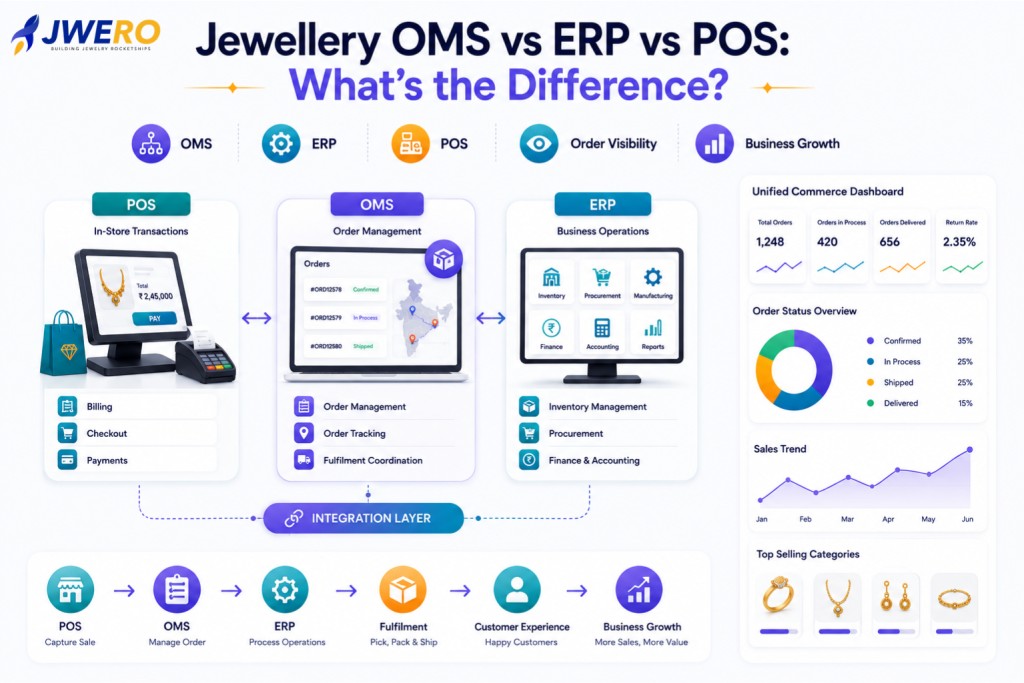
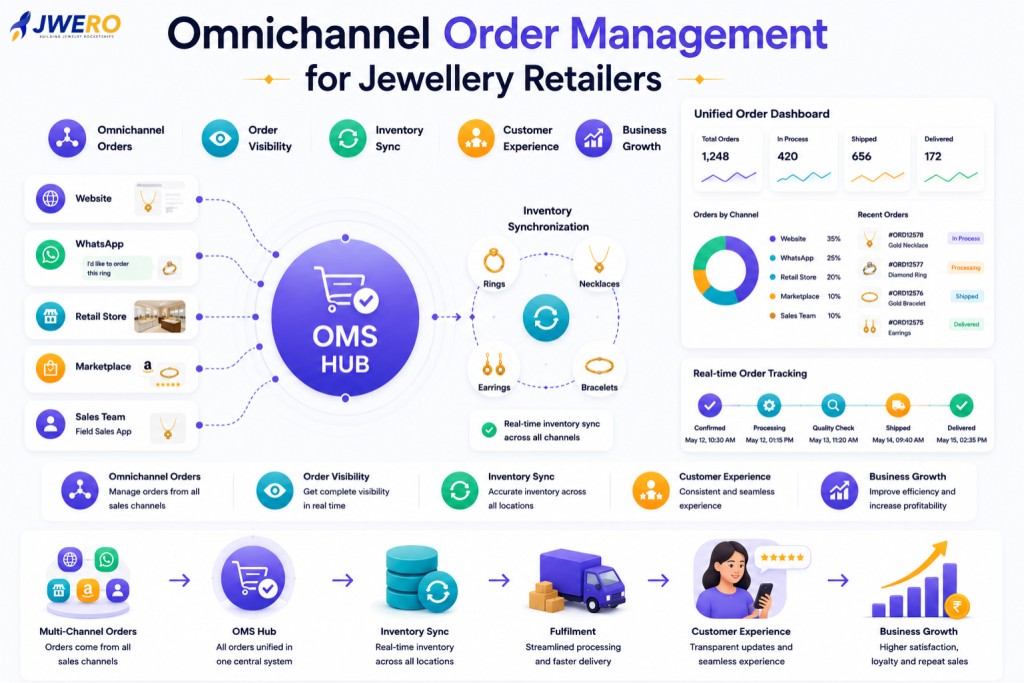
This is where a modern Order Management System (OMS) can make a significant difference.
In this guide, we’ll explore the most common causes of jewellery order processing errors and how businesses can reduce them through better processes and technology.
Why Order Processing Errors Matter
Order mistakes are not just operational issues.
They directly impact customer experience and profitability.
Common consequences include:
- Customer Complaints
- Delayed Deliveries
- Product Returns
- Rework Costs
- Revenue Loss
- Brand Reputation Damage
For jewellery businesses, even a small error can have significant financial implications.
This is why reducing errors should be a priority.
Common Jewellery Order Processing Errors
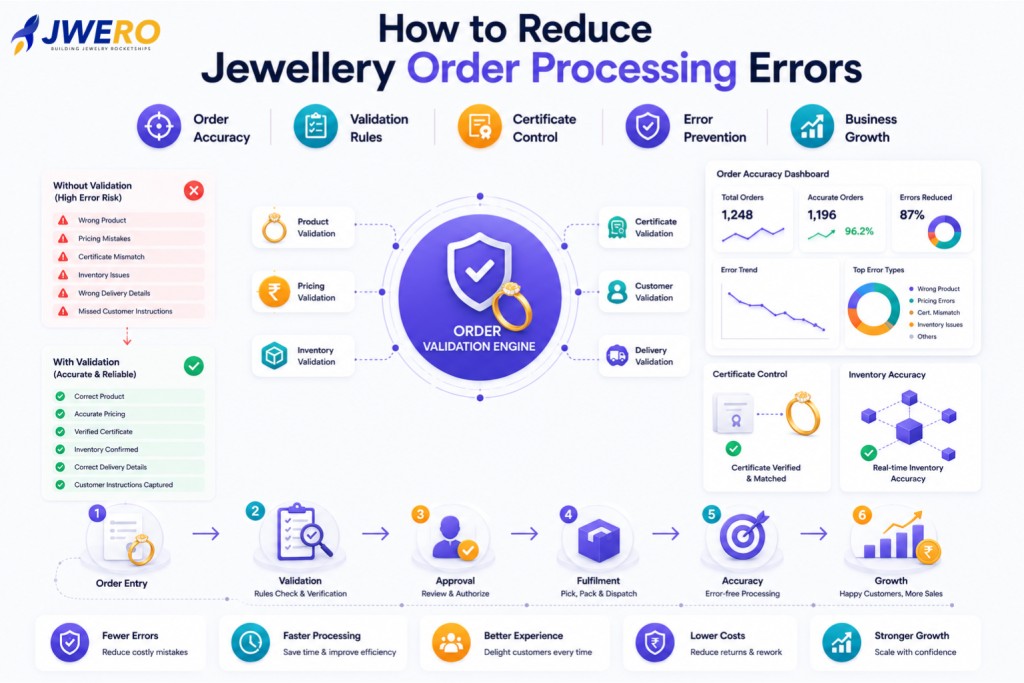
Jewellery businesses frequently encounter errors such as:
Incorrect Product Selection
Wrong design or product SKU selected.
Pricing Errors
Incorrect pricing or discount application.
Certificate Mismatches
Wrong certificate attached to a product.
Size and Specification Errors
Incorrect ring size, chain length, stone details, or customization requirements.
Inventory Allocation Issues
Products allocated incorrectly or oversold.
Delivery Errors
Incorrect delivery address or shipment details.
Missed Customer Instructions
Special requirements not communicated properly.
Why Errors Increase as Businesses Grow
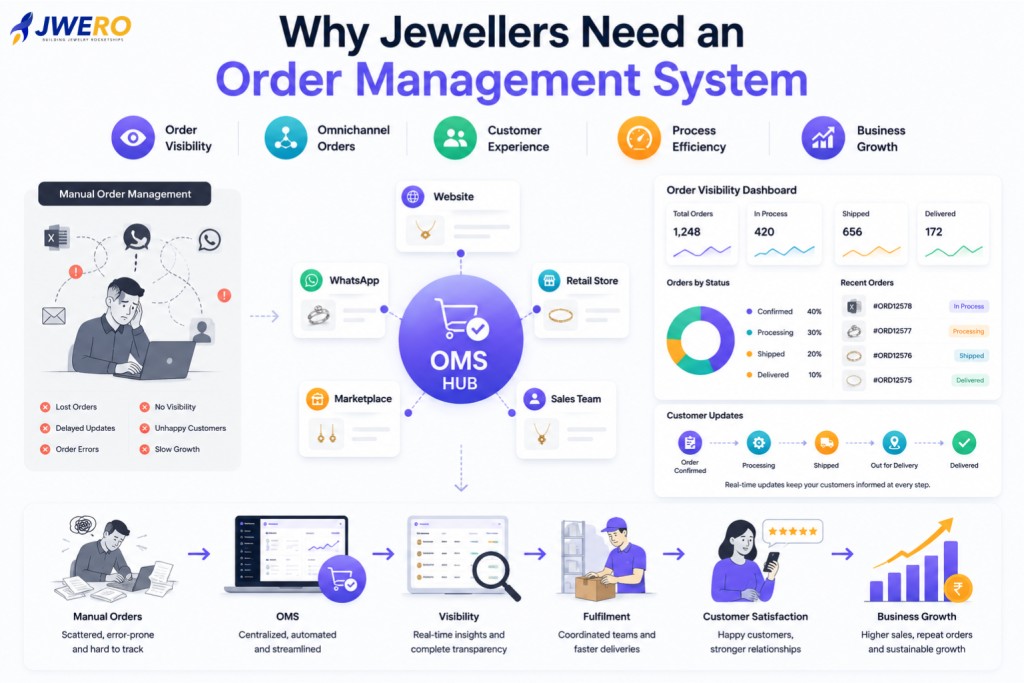
Many jewellers begin with manual processes.
Orders may be managed through:
- Excel Sheets
- WhatsApp Messages
- Emails
- Shared Documents
- Individual Staff Knowledge
These processes often work initially.
However, as businesses grow, they face:
- More Orders
- More Products
- More Sales Channels
- More Team Members
- More Custom Orders
Complexity increases rapidly.
Without structured workflows, errors become inevitable.
The Hidden Cost of Manual Order Processing
Many businesses underestimate the cost of manual errors.
A single mistake can trigger:
Order Error
      ↓
Customer Complaint
      ↓
Investigation
      ↓
Correction
      ↓
Delay
      ↓
Additional Costs
The operational impact often extends far beyond the original mistake.
Centralizing Order Information
One of the biggest causes of errors is fragmented information.
Businesses often store:
- Orders in Spreadsheets
- Customer Conversations in WhatsApp
- Inventory in Another System
- Certificates Elsewhere
When information is scattered, mistakes become more likely.
A centralized OMS creates a single source of truth for every order.
This improves visibility and accuracy.
Standardizing Order Workflows
Inconsistent processes create inconsistency in outcomes.
A structured order workflow helps ensure every order follows the same path.
Example:
Order Created
      ↓
Validation
      ↓
Approval
      ↓
Inventory Check
      ↓
Fulfilment
      ↓
Dispatch
Structured workflows reduce human error and improve accountability.
Using Validation Rules
Validation is one of the most effective ways to reduce errors.
An OMS can verify:
- Product Information
- Pricing Rules
- Inventory Availability
- Customer Details
- Certificate Mapping
- Delivery Information
Validation prevents errors before they occur.
Managing Custom Jewellery Orders More Effectively
Custom orders are particularly vulnerable to mistakes.
Examples include:
- Personalized Jewellery
- Bespoke Designs
- Bridal Jewellery
- Stone Changes
- Size Modifications
These projects often involve multiple approvals and revisions.
An OMS helps track requirements, approvals, and updates throughout the process.
This reduces misunderstandings and costly mistakes.
Improving Team Collaboration
Order fulfilment typically involves:
- Sales Team
- Customer Service
- Inventory Team
- Production Team
- Logistics Team
When teams work from different information sources, errors increase.
A centralized OMS ensures everyone has access to the same data.
This improves coordination and accuracy.
Reducing Pricing and Discount Errors
Pricing mistakes can significantly impact profitability.
Common issues include:
- Incorrect Discounts
- Outdated Pricing
- Unauthorized Price Changes
- Manual Calculation Errors
An OMS helps enforce pricing rules and approval workflows.
This improves pricing consistency and margin protection.
Preventing Certificate Mismatches
Certificates play an important role in jewellery sales.
Customers expect certificates to match:
- Product Specifications
- Stone Details
- Purity Information
Manual processes often create mismatches.
A structured OMS helps ensure certificates remain linked to the correct products and orders.
Improving Inventory Accuracy
Inventory-related errors often lead to:
- Overselling
- Duplicate Allocation
- Fulfilment Delays
A connected OMS synchronizes inventory and order activity.
This reduces allocation mistakes and improves fulfilment accuracy.
Better Visibility Leads to Better Accuracy
Many errors occur because businesses lack visibility.
When teams cannot see:
- Order Status
- Inventory Availability
- Approval Progress
- Customer Requirements
mistakes become more likely.
An OMS provides real-time visibility throughout the order lifecycle.
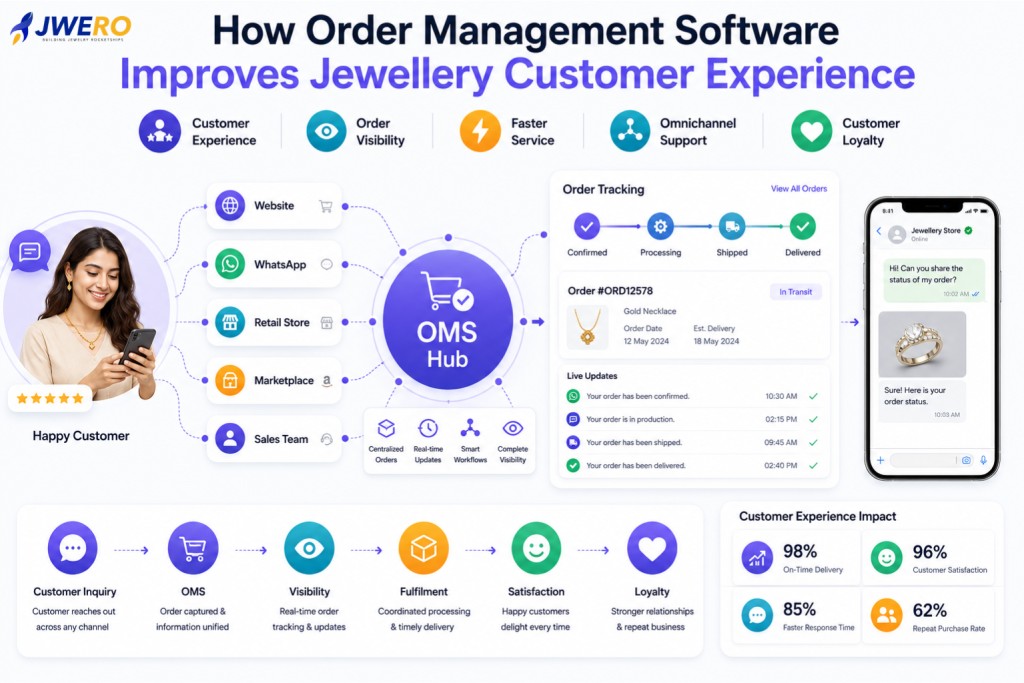
The Customer Experience Impact
Customers may never see the internal workflow.
However, they always experience the outcome.
Accurate orders lead to:
- Faster Deliveries
- Better Communication
- Higher Satisfaction
- Increased Trust
- More Referrals
Reducing errors directly improves customer experience.
The Future of Order Accuracy
Modern OMS platforms increasingly include:
- Automated Validation
- AI-Powered Error Detection
- Approval Workflows
- Inventory Synchronization
- Real-Time Visibility
- Predictive Risk Alerts
The future of order management is proactive rather than reactive.
How Jwero OMS Helps Reduce Order Errors
Jwero OMS helps jewellery businesses improve accuracy through:
- Centralized Order Management
- Validation Workflows
- Pricing Controls
- Certificate Management
- Inventory Synchronization
- Custom Order Tracking
- Approval Processes
- Real-Time Visibility
Rather than relying on spreadsheets and disconnected systems, businesses can manage every order through a structured workflow.
The result is fewer mistakes, better customer experiences, and improved operational efficiency.
Final Thoughts
Order processing errors can significantly impact profitability, customer trust, and business growth.
As jewellery businesses scale across products, teams, and channels, maintaining accuracy becomes increasingly challenging.
A modern Order Management System helps reduce errors by creating structure, visibility, validation, and accountability throughout the order lifecycle.
Businesses that invest in order accuracy today are better positioned to deliver exceptional customer experiences tomorrow.
Frequently Asked Questions
What causes jewellery order processing errors?
Common causes include manual data entry, fragmented systems, poor communication, inventory issues, and lack of validation workflows.
How can OMS reduce order errors?
OMS platforms improve accuracy through centralized information, validation rules, approval workflows, and real-time visibility.
Can OMS prevent certificate mismatches?
Yes. Modern OMS platforms help maintain proper certificate-to-product mapping throughout the order lifecycle.
How do pricing controls reduce errors?
Pricing controls prevent unauthorized discounts, outdated pricing, and manual calculation mistakes.
Why are custom jewellery orders more error-prone?
Custom orders involve multiple approvals, specifications, and revisions, increasing complexity and risk.