

Most jewellery brands already market across multiple channels.
Instagram creates discovery.
Google builds trust.
WhatsApp handles conversations.
Stores close the sale.
Yet internally, attribution still breaks.
Instagram gets blamed for weak conversion.
Google gets over-credited.
WhatsApp becomes impossible to measure properly.
Then budgets move emotionally instead of strategically.
The real issue is not missing data.
It is using the wrong attribution logic for jewellery buying behaviour.
Because jewellery customers rarely convert through one touchpoint alone.
Table of Contents
- Why Jewellery Attribution Usually Fails
- Why Single-Touch Attribution Breaks in Jewellery
- What Instagram Actually Contributes
- What Google Actually Contributes
- Why WhatsApp Matters Most Near Conversion
- The Biggest Attribution Mistake Jewellery Brands Make
- A Better Attribution Model for Jewellery Retail
- Why Platform Dashboards Mislead Jewellery Brands
- What CXOs Should Actually Measure
- Why Jewellery Channels Should Work Together
1. Why Jewellery Attribution Usually Fails
Most jewellery buying journeys are layered.
A customer may:
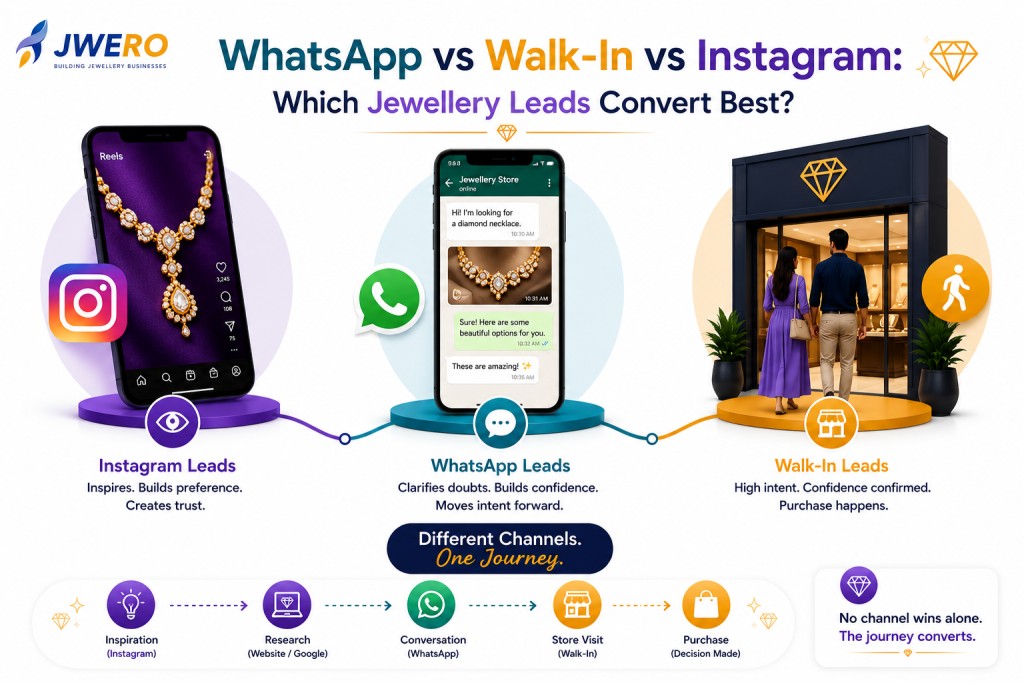
- discover a design on Instagram
- search the brand on Google later
- continue on WhatsApp
- finally visit the store weeks afterward
But internally, only the last step gets credit.
That creates distorted reporting.
And distorted reporting creates poor budget decisions.
Jewellery buying is rarely linear.
Which means attribution cannot behave like ecommerce attribution.
2. Why Single-Touch Attribution Breaks in Jewellery
Single-touch attribution assumes one interaction created the sale.
That logic fails badly in jewellery retail.
Because jewellery customers usually need:
- emotional confidence
- repeated exposure
- reassurance
- social validation
- timing alignment
A purchase often develops across weeks or months.
For example:
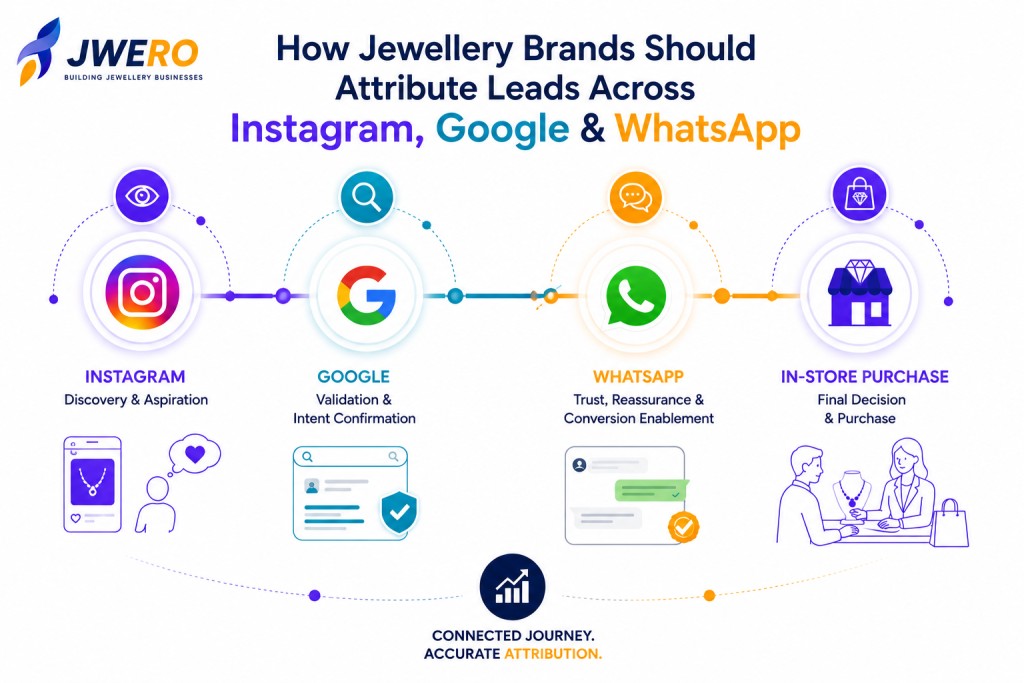
- Instagram sparks interest
- Google builds credibility
- WhatsApp reduces uncertainty
- Store visit finalizes trust
Which channel caused the conversion?
The honest answer is:
All of them contributed differently.
That is why last-click attribution creates misleading conclusions in jewellery marketing.
3. What Instagram Actually Contributes
Instagram rarely closes jewellery sales directly.
But that does not make it weak.
Instagram helps customers:
- discover designs
- build aspiration
- recognize the brand
- emotionally shortlist jewellers
It answers:
“Do I feel connected to this brand?”
That is an important stage in jewellery buying psychology.
Especially for bridal and high-ticket purchases.
Brands using platforms like Jwero Instagram increasingly focus on continuity instead of immediate conversion pressure.
Because jewellery intent usually starts emotionally before becoming transactional.
4. What Google Actually Contributes
Google plays a very different role.
Customers search Google when they want reassurance.
Usually around:
- pricing
- reviews
- store locations
- trust validation
- scheme information
Google answers:
“Can I trust this business seriously?”
That is why Google traffic often looks “high intent.”
But Google usually captures existing demand.
It rarely creates the original desire itself.
This distinction matters enormously for budget planning.
5. Why WhatsApp Matters Most Near Conversion
WhatsApp sits closest to decision-making.
It helps customers:
- ask questions
- clarify concerns
- involve family
- coordinate store visits
- continue conversations comfortably
In jewellery retail, WhatsApp often becomes the bridge between digital interest and physical purchase.
But WhatsApp usually does not create the initial demand.
It converts confidence that already exists.
That is why jewellery brands increasingly rely on platforms like Jwero WhatsApp and Jwero Chats to preserve customer continuity across long buying journeys.
Because context matters heavily during high-consideration purchases.
6. The Biggest Attribution Mistake Jewellery Brands Make
Most businesses ask:
“Which channel converted the sale?”
That is the wrong question.
The better question is:
“Which channel moved customer confidence forward?”
That changes attribution completely.
Because jewellery conversion depends on:
- discovery
- validation
- reassurance
- trust-building
- timing
Not simply the final click.
Every channel plays a psychological role.
Strong attribution recognizes those roles individually.
7. A Better Attribution Model for Jewellery Retail
Jewellery brands need role-based attribution.
Not equal attribution.
A better model looks like this:
| Channel | Core Role | Attribution Logic |
|---|---|---|
| Discovery | Demand creation | |
| Validation | Intent reinforcement | |
| Confidence building | Conversion enablement | |
| Store visit | Purchase completion | Final trust stage |
This creates much smarter reporting.
Because channels stop competing internally.
And begin supporting one another strategically.
8. Why Platform Dashboards Mislead Jewellery Brands
Platform dashboards optimize for themselves.
Meta wants Instagram credit.
Google wants Google credit.
Neither platform understands full jewellery buying behaviour.
Especially:
- offline visits
- family discussions
- delayed conversions
- WhatsApp conversations
- long decision cycles
This is why jewellery brands should build business-level attribution systems instead of relying entirely on advertising dashboards.
Otherwise, decision-making becomes algorithm-driven instead of customer-driven.
9. What CXOs Should Actually Measure
Jewellery leadership teams often track the wrong metrics.
Instead of focusing only on:
- cost per lead
- click-through rates
- platform conversions
They should track:
- source-to-purchase linkage
- store visits after digital engagement
- WhatsApp involvement rate
- conversion timing by channel
- repeat purchase origin
These metrics reveal actual customer behaviour more accurately.
Especially across multi-touch journeys.
10. Why Jewellery Channels Should Work Together
Instagram, Google, WhatsApp, and stores are not competitors.
They are sequential trust-builders.
Each channel prepares the customer emotionally for the next stage.
When brands misunderstand this:
- channels get blamed unfairly
- budgets swing aggressively
- teams operate in silos
But when journeys stay connected:
- conversion becomes smoother
- attribution becomes clearer
- scaling becomes calmer
That is where platforms like Jwero.ai and Jwero Ecommerce become strategically useful.
Because they help unify fragmented customer journeys across channels and stores.
Final Thought
Jewellery customers rarely convert because of one interaction.
They convert because trust builds gradually across multiple moments.
Instagram creates emotional interest.
Google validates credibility.
WhatsApp reduces hesitation.
Stores finalize confidence.
Attribution in jewellery is not about finding one winning channel.
It is about understanding how channels work together to move customers toward belief and purchase readiness.
The brands that understand this stop arguing about lead quality.
And start building connected journeys that convert more consistently over time.
FAQs
Why does jewellery attribution fail so often?
Because most jewellery purchases involve multiple channels, long timelines, and offline decision-making that traditional attribution models miss.
Is Instagram important for jewellery conversion?
Yes. Instagram strongly influences discovery, aspiration, and brand preference even when direct conversion appears low.
Why is WhatsApp important in jewellery retail?
WhatsApp helps reduce uncertainty, preserve customer continuity, and support high-consideration buying conversations.
Should jewellery brands use last-click attribution?
No. Last-click attribution ignores earlier trust-building stages that heavily influence jewellery purchases.
What is the best attribution model for jewellery brands?
A role-based, multi-touch attribution model works best because it measures contribution across the full customer journey.
Build Smarter Jewellery Customer Journeys
Jewellery attribution works best when every customer interaction stays connected across Instagram, Google, WhatsApp, and showroom visits.
Explore how connected engagement systems help jewellery brands improve attribution clarity and conversion continuity:
- Jwero.ai
- Jwero Chats
- Jwero WhatsApp
- how jewellery brands should attribute leads
- jewellery Instagram Google WhatsApp attribution
- how jewellery customers convert across channels
- jewellery multi-touch attribution explained