


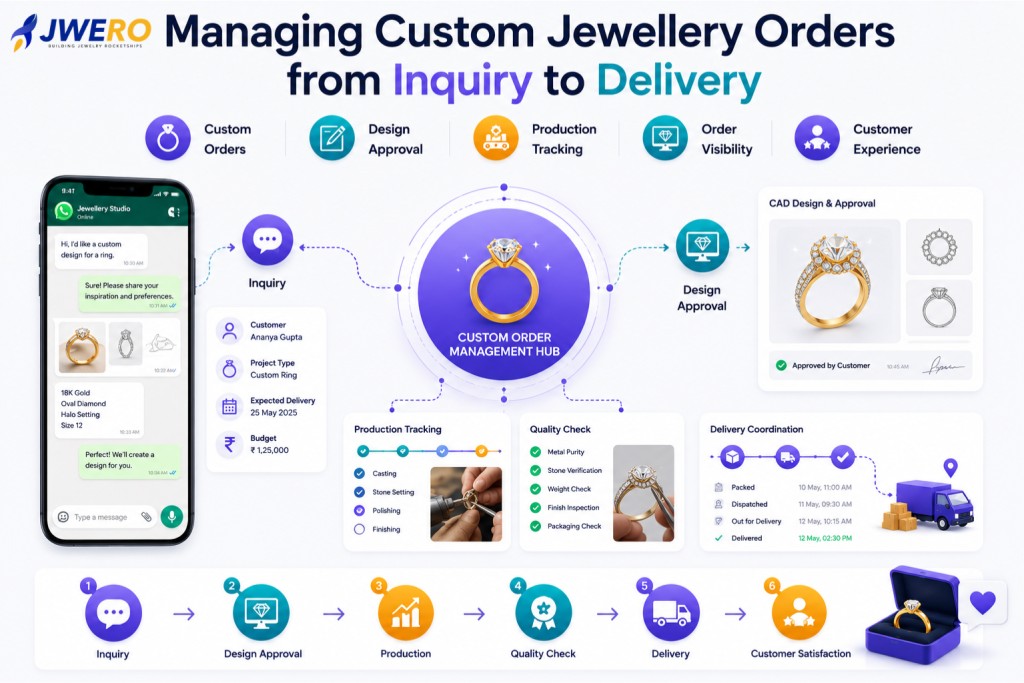
Custom jewellery orders are among the most valuable and complex transactions in the jewellery industry.
Unlike standard products, custom orders involve multiple stages, customer approvals, design discussions, production milestones, and delivery commitments.
A simple ring customization or a fully bespoke bridal jewellery project can involve weeks or even months of collaboration.
Without a structured process, businesses often face delays, miscommunication, missed approvals, and customer dissatisfaction.
This is why many jewellers are adopting Order Management Systems (OMS) to manage custom jewellery projects more effectively.
In this guide, we’ll explore how jewellers can manage custom orders from the first enquiry through final delivery.
Why Custom Jewellery Orders Are Different
Standard jewellery orders follow a predictable process.
Custom orders are more complex because every project is unique.
They often involve:
- Design Consultations
- Stone Selection
- Metal Selection
- CAD Approval
- Customer Feedback
- Production Milestones
- Quality Checks
- Delivery Coordination
Each stage must be tracked carefully.
A single missed step can delay the entire project.
The Typical Custom Jewellery Order Journey
Most custom jewellery projects follow a workflow similar to this:
Customer Inquiry
        ↓
Requirement Discussion
        ↓
Design Proposal
        ↓
Quotation Approval
        ↓
CAD Design
        ↓
Customer Approval
        ↓
Production
        ↓
Quality Check
        ↓
Delivery
The challenge is maintaining visibility throughout this journey.
Stage 1: Customer Inquiry
Every custom project begins with an enquiry.
Customers may contact the business through:
- Website
- Retail Store
- Sales Consultant
During this stage, businesses gather information about:
- Design Preferences
- Budget
- Timeline
- Metal Choice
- Stone Requirements
Capturing these details accurately is critical.
Stage 2: Requirement Gathering
This stage focuses on understanding customer expectations.
Discussions often include:
- Design Inspiration
- Stone Selection
- Purity Requirements
- Ring Size
- Engraving Requests
- Delivery Timelines
Poor documentation at this stage often creates problems later.
A structured OMS helps record all customer requirements in one place.
Stage 3: Quotation and Approval
Once requirements are defined, businesses prepare quotations.
These may include:
- Material Costs
- Stone Costs
- Labour Charges
- Design Charges
- Delivery Costs
Customers often request revisions before approval.
An OMS helps track quotation versions and customer approvals.
Stage 4: CAD Design and Visualization
Many jewellers create CAD designs before production begins.
This allows customers to review:
- Design Structure
- Stone Placement
- Dimensions
- Overall Appearance
Approvals at this stage are critical.
Production should not begin until designs are approved.
An OMS ensures approvals are documented properly.
Stage 5: Production Management
Once approvals are complete, production begins.
Typical production stages include:
- Casting
- Stone Setting
- Polishing
- Finishing
- Quality Inspection
Each milestone should be tracked.
This improves internal coordination and customer communication.
Stage 6: Customer Updates
One of the biggest customer concerns is visibility.
Customers often ask:
- Has production started?
- Is the design approved?
- When will it be completed?
- Is delivery on schedule?
Without a structured workflow, answering these questions becomes difficult.
An OMS provides real-time visibility throughout the project.
Stage 7: Quality Control
Before delivery, every custom jewellery piece should undergo quality checks.
This may include:
- Stone Verification
- Weight Validation
- Design Verification
- Finish Inspection
- Certificate Matching
Quality control reduces the risk of costly corrections after delivery.
Stage 8: Delivery and Handover
The final stage involves delivering the completed order.
This may include:
- Store Pickup
- Home Delivery
- Courier Shipment
Businesses should also provide:
- Certificates
- Care Instructions
- Warranty Information
A smooth delivery experience leaves a lasting impression.
Common Challenges in Custom Jewellery Orders
Many jewellers struggle with:
- Missed Approvals
- Design Revisions
- Production Delays
- Communication Gaps
- Lost Customer Requirements
- Delivery Delays
- Certificate Errors
As project volumes increase, these challenges become more difficult to manage.
Why Spreadsheets and WhatsApp Are Not Enough
Many businesses manage custom projects through:
- WhatsApp Chats
- Excel Sheets
- Emails
- Paper Notes
While this may work for a small number of projects, it becomes risky as complexity grows.
Information becomes fragmented and difficult to track.
An OMS creates a centralized project view.
Benefits of Custom Order Management Software
A structured OMS helps jewellers:
- Track Every Project Stage
- Manage Approvals
- Improve Customer Communication
- Reduce Errors
- Increase Visibility
- Improve Delivery Performance
- Enhance Customer Experience
The result is better operational control and happier customers.
Managing Multiple Custom Orders Simultaneously
As businesses grow, managing multiple projects becomes challenging.
Teams must track:
- Deadlines
- Approvals
- Production Status
- Customer Updates
- Delivery Commitments
An OMS helps prioritize and organize work efficiently.
The Customer Experience Impact
Custom jewellery purchases are highly emotional.
Customers invest significant time, money, and trust into these projects.
A well-managed process creates:
- Greater Confidence
- Better Communication
- Higher Satisfaction
- Stronger Loyalty
- More Referrals
Customer experience often becomes the biggest differentiator.
The Future of Custom Jewellery Order Management
Modern OMS platforms increasingly include:
- Digital Approvals
- Automated Updates
- Production Tracking
- AI-Powered Notifications
- Customer Portals
- Real-Time Visibility
The goal is creating a transparent and efficient customer journey.
How Jwero OMS Helps Manage Custom Jewellery Orders
Jwero OMS helps jewellery businesses manage custom projects from enquiry to delivery through a structured workflow.
Capabilities include:
- Custom Order Tracking
- Design Approval Management
- Production Milestone Tracking
- Customer Communication
- WhatsApp Integration
- Certificate Management
- Delivery Coordination
- Real-Time Visibility
Rather than relying on spreadsheets and disconnected conversations, businesses can manage every custom order through one centralized platform.
The result is better control, faster execution, and improved customer satisfaction.
Final Thoughts
Custom jewellery orders are among the most valuable opportunities for jewellery businesses.
However, they also introduce significant complexity.
Without structured workflows, businesses risk delays, errors, and customer dissatisfaction.
A modern Order Management System helps jewellers manage every stage of the custom order journey while improving visibility, communication, and operational efficiency.
As customer expectations continue to rise, effective custom order management will become an increasingly important competitive advantage.
Frequently Asked Questions
What is custom jewellery order management?
Custom jewellery order management is the process of tracking and managing bespoke jewellery projects from enquiry through delivery.
Why are custom jewellery orders difficult to manage?
They involve multiple approvals, design revisions, production stages, and customer interactions.
How can OMS help manage custom jewellery projects?
OMS platforms provide centralized tracking, approvals, communication, and visibility throughout the order lifecycle.
Can OMS track CAD approvals?
Yes. Modern OMS platforms can manage design reviews, approvals, and revision workflows.
Does custom order management improve customer experience?
Yes. Better communication and visibility significantly improve customer confidence and satisfaction.