


WhatsApp has become one of the most important sales channels in the jewellery industry.
Customers increasingly prefer WhatsApp because it feels personal, convenient, and fast.
Instead of visiting a store or browsing a website, customers often send a message, request product details, ask for pricing, receive catalogues, and even place orders directly through WhatsApp.
For jewellers, this creates significant opportunities.
However, it also introduces operational challenges.
As enquiry volumes grow, managing WhatsApp orders manually becomes difficult.
Messages get missed, follow-ups are delayed, order information becomes scattered, and teams struggle to maintain visibility.
This is why many jewellery businesses are implementing structured WhatsApp order management workflows through modern Order Management Systems (OMS).
In this guide, we’ll explore how jewellers can effectively manage WhatsApp orders while delivering better customer experiences.
Why WhatsApp Has Become a Major Jewellery Sales Channel
Jewellery purchases often involve conversations.
Customers typically want to:
- Ask Questions
- Compare Designs
- Request Pricing
- Discuss Customization
- Share References
- Seek Recommendations
WhatsApp supports all of these interactions naturally.
Unlike traditional ecommerce experiences, WhatsApp allows customers to communicate directly with a business.
This makes it especially valuable for jewellery retail.
The Challenges of Managing WhatsApp Orders Manually
Many jewellery businesses start by managing WhatsApp orders manually.
Initially, this works well.
However, as enquiry volumes increase, businesses often face:
- Missed Messages
- Delayed Responses
- Lost Order Information
- Duplicate Conversations
- Poor Team Coordination
- Lack of Order Visibility
- Difficult Follow-Ups
These issues can negatively impact both customer experience and sales performance.
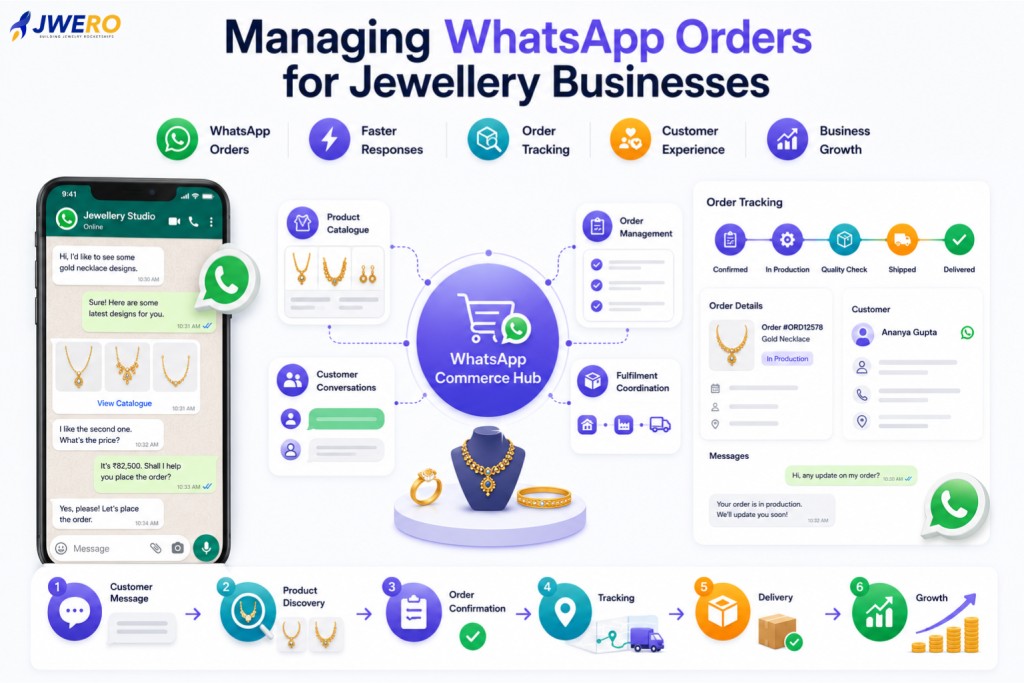
A Typical WhatsApp Jewellery Order Journey
A customer journey may look like this:
Customer Enquiry
        ↓
Product Discovery
        ↓
Catalogue Sharing
        ↓
Pricing Discussion
        ↓
Order Confirmation
        ↓
Payment Processing
        ↓
Order Fulfilment
        ↓
Delivery Updates
Every stage creates information that needs to be tracked.
Without a structured workflow, businesses often lose visibility.
WhatsApp Is More Than Just Messaging
Many businesses treat WhatsApp as a communication tool.
In reality, it has become a commerce channel.
Customers frequently use WhatsApp to:
- Browse Products
- Request Catalogues
- Place Orders
- Track Deliveries
- Request Modifications
- Ask Support Questions
This means WhatsApp activity must be connected to operational workflows.
Why Order Visibility Matters
Once a customer places an order, expectations change.
Customers want updates such as:
- Order Confirmed
- Production Started
- Quality Check Completed
- Ready for Dispatch
- Delivered
Without visibility, customers repeatedly contact staff for updates.
This creates unnecessary workload.
A structured OMS provides real-time order visibility.
Managing Catalogue Sharing Efficiently
One of the most common WhatsApp activities in jewellery retail is catalogue sharing.
Sales teams frequently send:
- Product Images
- Videos
- Pricing Information
- Certificates
- Product Specifications
When catalogues are managed manually, inconsistencies often occur.
Customers may receive outdated information.
A connected OMS ensures product information remains accurate and consistent.
Tracking WhatsApp Orders in One Place
A major challenge is connecting conversations with order workflows.
Businesses often store:
- Conversations in WhatsApp
- Orders in Spreadsheets
- Inventory in Another System
- Customer Information Elsewhere
This creates fragmentation.
A modern OMS connects these processes into a single workflow.
Teams gain complete visibility throughout the order lifecycle.
Managing Custom Jewellery Orders Through WhatsApp
Many custom jewellery projects begin on WhatsApp.
Examples include:
- Bridal Jewellery
- Bespoke Designs
- Personalized Pieces
- Stone Modifications
- Size Adjustments
Customers frequently share inspiration images and requirements through chat.
An OMS helps businesses convert these conversations into structured order workflows.
This improves tracking and communication.
Faster Responses Improve Conversion Rates
Response speed has a significant impact on sales.
Customers often compare multiple jewellers simultaneously.
Businesses that respond quickly are more likely to win the opportunity.
An OMS helps teams:
- Access Product Information Quickly
- Track Customer Conversations
- View Order Status
- Share Accurate Updates
The result is a more responsive customer experience.
WhatsApp Order Tracking
Customers increasingly expect order tracking directly within conversations.
Common questions include:
- Has my order been confirmed?
- Is production complete?
- When will delivery happen?
- Has my order shipped?
A connected OMS allows teams to provide accurate answers immediately.
This improves trust and customer satisfaction.
Team Collaboration Becomes Easier
Managing WhatsApp orders often involves multiple departments.
Examples include:
- Sales Team
- Customer Service
- Inventory Team
- Production Team
- Logistics Team
Without a centralized system, collaboration becomes difficult.
An OMS ensures every team works from the same information.
Business Benefits of Structured WhatsApp Order Management
Implementing structured workflows provides significant benefits.
- Faster Responses
- Better Customer Experience
- Improved Order Visibility
- Reduced Errors
- Better Team Coordination
- Higher Conversion Rates
- Increased Customer Satisfaction
As WhatsApp continues to grow as a commerce channel, these benefits become increasingly valuable.
The Future of WhatsApp Commerce in Jewellery Retail
WhatsApp is evolving from a messaging platform into a complete commerce channel.
Future capabilities will include:
- Automated Order Updates
- AI-Powered Recommendations
- Integrated Payments
- Intelligent Customer Journeys
- Omnichannel Commerce Integration
Jewellery businesses that prepare now will be better positioned for future growth.
How Jwero OMS Helps Manage WhatsApp Orders
Jwero OMS helps jewellery businesses manage WhatsApp orders through a connected order management platform.
Capabilities include:
- WhatsApp Order Capture
- Order Tracking
- Customer Communication
- Product Catalogue Management
- Custom Order Workflows
- Fulfilment Coordination
- Inventory Synchronization
- Real-Time Visibility
Rather than managing conversations and orders separately, businesses can operate through one connected commerce ecosystem.
The result is faster responses, better customer experiences, and improved operational control.
Final Thoughts
WhatsApp has become one of the most important sales channels for jewellery businesses.
However, managing WhatsApp orders manually becomes increasingly difficult as businesses grow.
A structured OMS helps connect conversations, orders, inventory, fulfilment, and customer communication into a single workflow.
This improves visibility, efficiency, and customer experience.
For modern jewellers, effective WhatsApp order management is quickly becoming a competitive advantage.
Frequently Asked Questions
Can customers place jewellery orders through WhatsApp?
Yes. Many jewellery businesses receive enquiries, share catalogues, discuss pricing, and process orders through WhatsApp.
Why is WhatsApp important for jewellery retail?
WhatsApp provides a convenient and personal communication channel that supports product discovery, consultation, and order management.
How can jewellers track WhatsApp orders?
A centralized Order Management System can connect WhatsApp conversations with structured order workflows.
Can WhatsApp support custom jewellery orders?
Yes. Many custom jewellery projects begin through WhatsApp conversations and can be managed through OMS workflows.
Does WhatsApp order management improve customer experience?
Yes. Faster responses, better visibility, and accurate updates improve customer satisfaction significantly.