

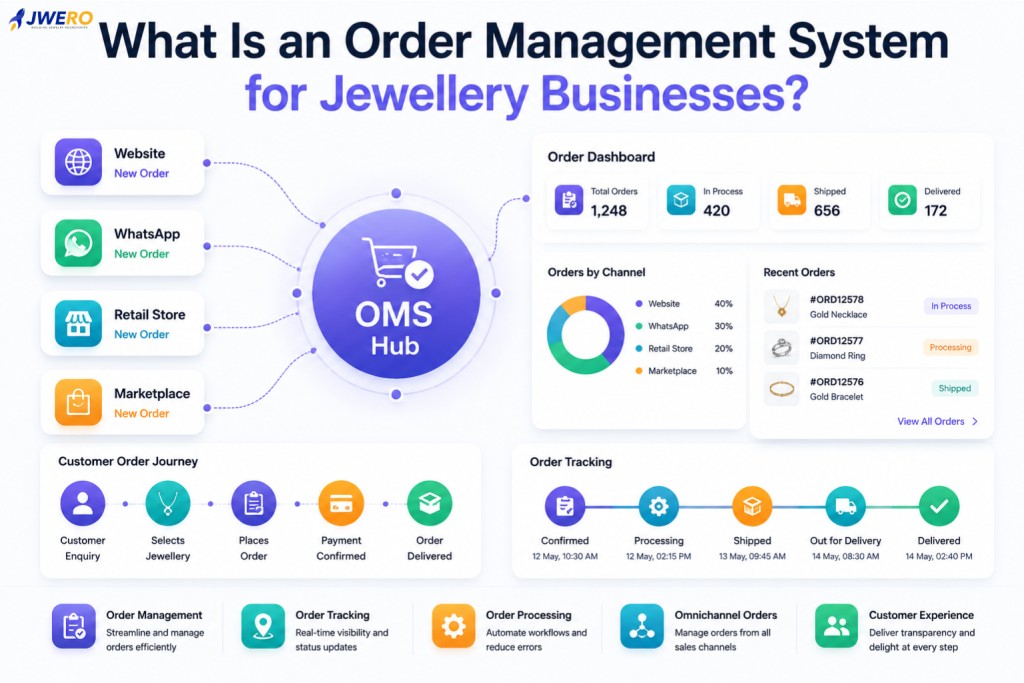
The jewellery industry has changed dramatically over the past decade.
Customers no longer purchase exclusively through physical stores. They browse products online, enquire through WhatsApp, visit showrooms, compare designs, request customizations, and expect regular updates throughout the buying process.
As a result, managing orders has become far more complex.
A single jewellery order may involve multiple teams, systems, approvals, inventory checks, production processes, and customer interactions.
Without a structured system, businesses often struggle with delays, communication gaps, order errors, and inconsistent customer experiences.
This is where an Order Management System (OMS) becomes essential.
A Jewellery OMS helps businesses manage every stage of the order lifecycle from order creation to fulfilment and delivery.
In this guide, we’ll explain what a Jewellery Order Management System is, how it works, and why it has become a critical technology for modern jewellers.
Understanding Order Management
Order management refers to the process of receiving, processing, tracking, fulfilling, and delivering customer orders.
For jewellery businesses, this process often includes:
- Customer Enquiries
- Order Creation
- Product Allocation
- Inventory Verification
- Custom Design Requests
- Production Tracking
- Delivery Coordination
- Customer Communication
Every order follows a journey.
The challenge is ensuring every stage is tracked accurately and completed efficiently.
What Is a Jewellery Order Management System?
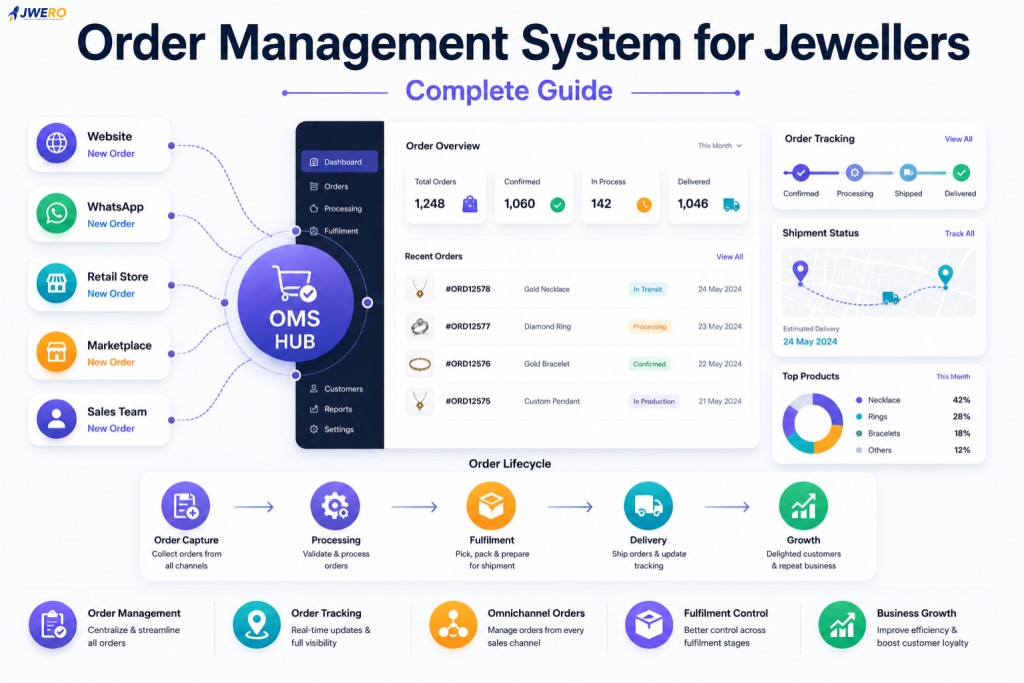
A Jewellery Order Management System is software designed to manage and monitor the complete lifecycle of jewellery orders.
It acts as a central platform where businesses can:
- Capture Orders
- Process Orders
- Track Order Status
- Manage Custom Orders
- Coordinate Fulfilment
- Communicate with Customers
- Monitor Delivery Progress
Instead of managing orders through spreadsheets, WhatsApp messages, emails, and disconnected tools, businesses can manage everything from a single system.
Why Jewellery Businesses Need an OMS
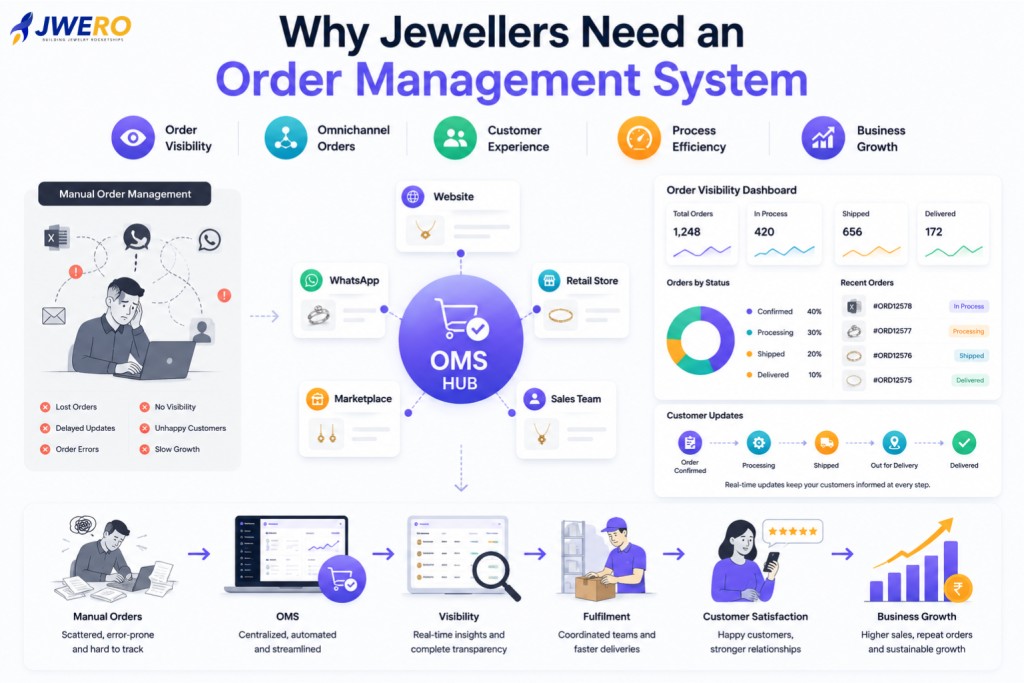
Many jewellers begin with manual order management.
Orders may be tracked using:
- Excel Sheets
- WhatsApp Messages
- Paper Records
- Shared Documents
- Individual Staff Knowledge
These methods often work initially.
However, as order volumes increase, businesses face challenges such as:
- Lost Orders
- Delayed Fulfilment
- Customer Complaints
- Inventory Conflicts
- Order Processing Errors
- Communication Breakdowns
An OMS provides the structure needed to manage growth.
How a Jewellery OMS Works
A Jewellery OMS manages the entire order journey.
A typical workflow looks like this:
Customer Inquiry
       ↓
Order Creation
       ↓
Inventory Validation
       ↓
Approval Process
       ↓
Production / Allocation
       ↓
Fulfilment
       ↓
Delivery
       ↓
Customer Updates
Every stage becomes visible and manageable.
This reduces confusion and improves accountability.
Orders Come From Multiple Channels
Today’s jewellery businesses receive orders from many sources.
These may include:
- Retail Stores
- Ecommerce Websites
- Marketplaces
- Sales Teams
- Franchise Locations
Managing these channels separately creates operational complexity.
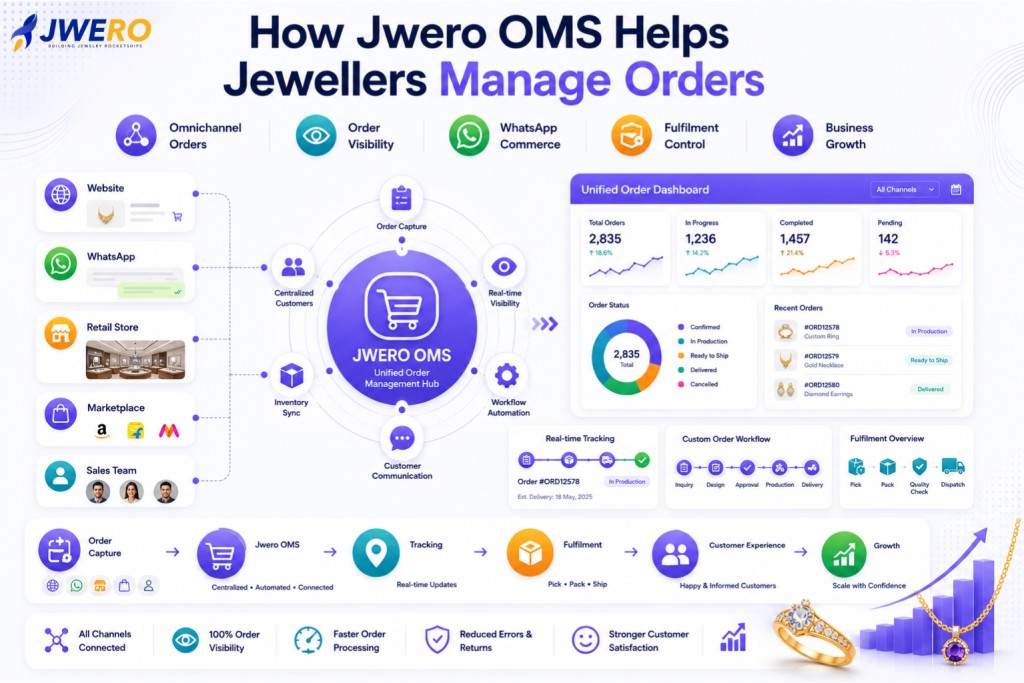
A Jewellery OMS centralizes orders into a single system.
This creates better visibility and control.
Managing Custom Jewellery Orders
Custom jewellery orders require special attention.
Examples include:
- Bridal Jewellery
- Bespoke Designs
- Stone Modifications
- Size Adjustments
- Personalized Pieces
Unlike standard products, these orders often involve:
- Design Reviews
- Customer Approvals
- Production Updates
- Delivery Milestones
A Jewellery OMS helps businesses track these additional stages effectively.
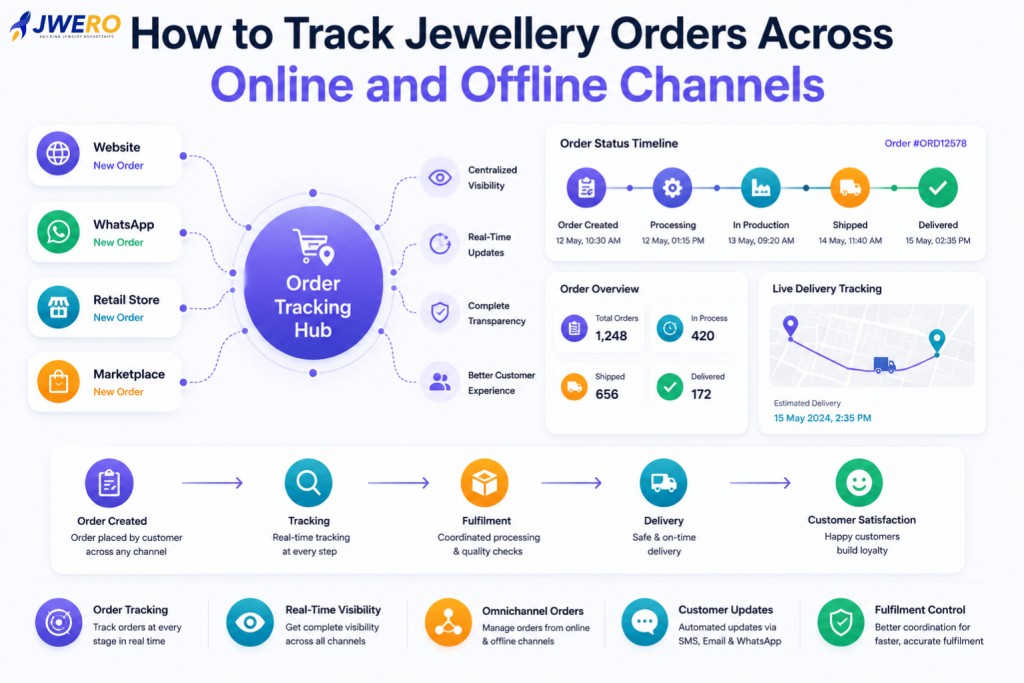
Order Tracking and Visibility
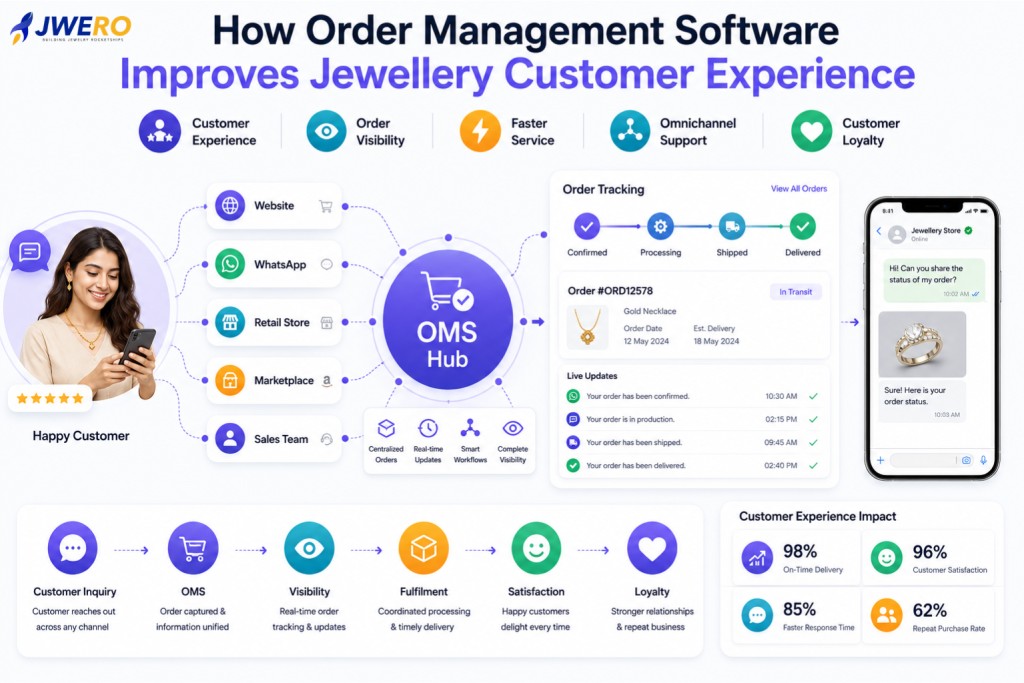
Customers increasingly expect transparency.
Common questions include:
- Has my order been confirmed?
- Is my jewellery being manufactured?
- When will it be delivered?
- What is the current order status?
Without an OMS, answering these questions often requires multiple phone calls and manual checks.
An OMS provides real-time visibility for both teams and customers.
Reducing Order Processing Errors
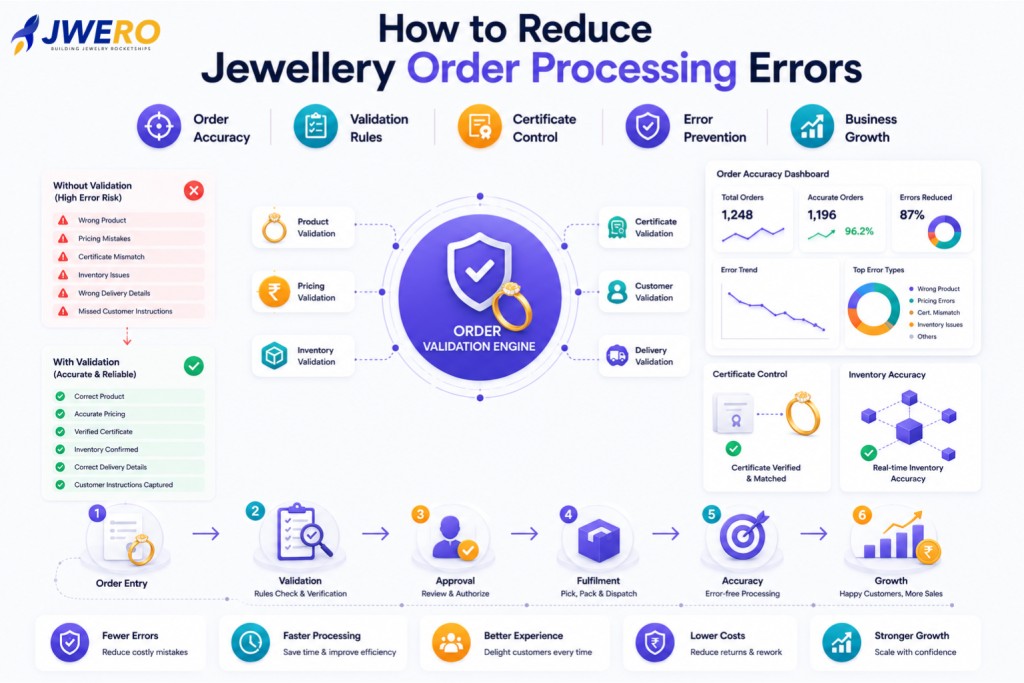
Order errors can be costly.
Common mistakes include:
- Wrong Product Selection
- Incorrect Pricing
- Incorrect Specifications
- Delivery Errors
- Missed Customer Instructions
Many of these issues occur because information is scattered across multiple systems.
A centralized OMS helps reduce these errors through structured workflows and validation processes.
Inventory and Order Synchronization
One of the biggest challenges in jewellery retail is inventory coordination.
Businesses often experience:
- Overselling
- Stock Conflicts
- Duplicate Allocations
- Inventory Visibility Issues
An OMS helps synchronize order activity with inventory availability.
This improves operational accuracy.
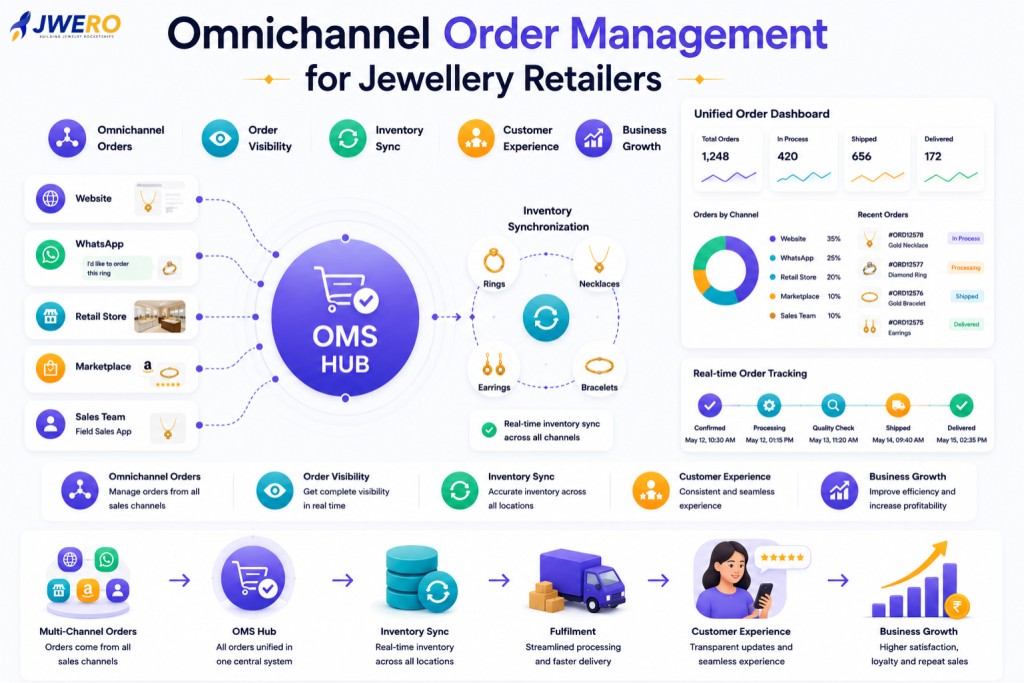
Omnichannel Order Management
Customers expect consistent experiences regardless of where they place an order.
They may:
- Start on Instagram
- Continue on WhatsApp
- Visit the Store
- Complete the Purchase Online
Without a centralized OMS, managing these interactions becomes difficult.
This is why omnichannel order management is increasingly important.
WhatsApp and Order Management
WhatsApp has become one of the most important sales channels in jewellery retail.
Customers frequently use WhatsApp to:
- Request Product Information
- Confirm Purchases
- Share Design Preferences
- Track Orders
- Request Updates
A Jewellery OMS helps connect WhatsApp conversations to structured order workflows.
OMS vs ERP vs POS
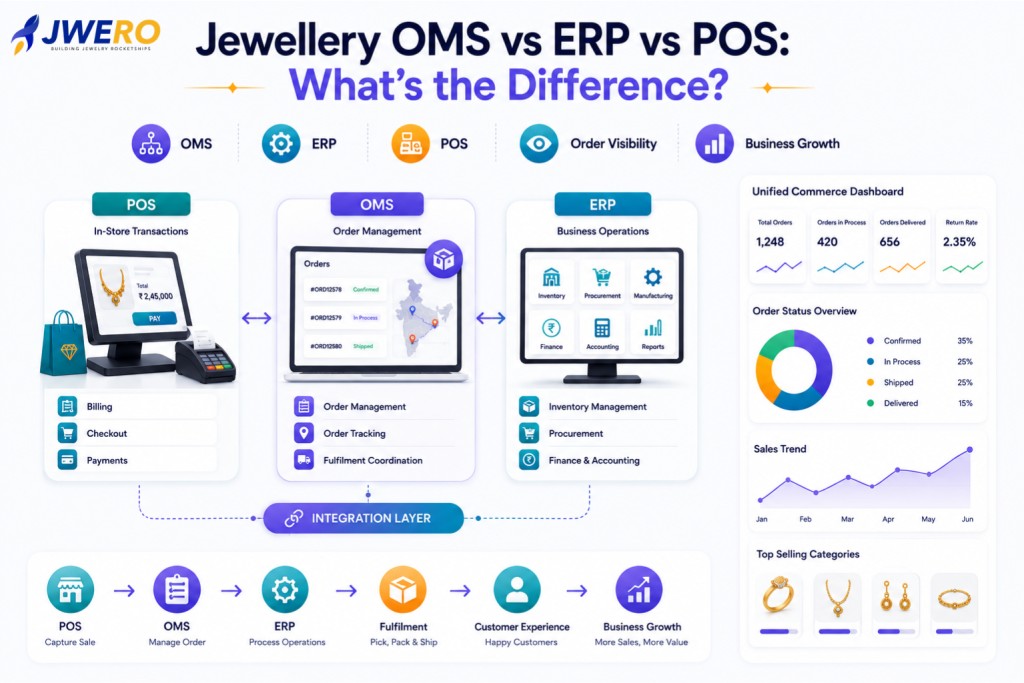
Many jewellers confuse OMS, ERP, and POS systems.
While these systems often work together, they serve different purposes.
| System | Primary Purpose |
|---|---|
| OMS | Order Lifecycle Management |
| ERP | Business Operations |
| POS | Retail Transactions |
An OMS focuses specifically on managing orders from creation to fulfilment.
Benefits of a Jewellery OMS
Implementing an OMS can provide significant advantages.
Faster Order Processing
Orders move through workflows more efficiently.
Better Customer Experience
Customers receive timely updates and improved service.
Reduced Errors
Structured workflows improve accuracy.
Omnichannel Visibility
Orders from all channels become centralized.
Better Team Collaboration
Teams work from the same information.
Improved Scalability
Businesses can manage growth without increasing operational complexity.
Signs Your Jewellery Business Needs an OMS
You may benefit from a Jewellery OMS if:
- Orders are managed manually.
- Teams struggle to track order status.
- Customers frequently ask for updates.
- Custom orders create confusion.
- Multiple sales channels cause complexity.
- Order errors are increasing.
- Fulfilment delays are common.
These are often indicators that current processes are no longer sustainable.
The Future of Jewellery Order Management
Order management is becoming more intelligent and connected.
Future OMS platforms will increasingly include:
- AI-Powered Workflows
- Automated Customer Updates
- Predictive Fulfilment
- Omnichannel Visibility
- Real-Time Inventory Synchronization
- Connected Commerce Ecosystems
The goal is not simply managing orders.
The goal is creating exceptional customer experiences.
How Jwero OMS Helps Jewellers
Jwero OMS helps jewellery businesses manage orders across every customer touchpoint.
Capabilities include:
- Centralized Order Management
- Omnichannel Order Capture
- WhatsApp Order Tracking
- Custom Order Workflows
- Inventory Synchronization
- Fulfilment Coordination
- Customer Communication
- Real-Time Order Visibility
Rather than managing orders through disconnected systems, jewellers can operate through a connected Jewellery Commerce ecosystem.
The result is fewer errors, faster fulfilment, improved visibility, and better customer experiences.
Final Thoughts
As jewellery businesses grow, order management becomes increasingly complex.
Managing orders across multiple channels, teams, and workflows requires more than spreadsheets and manual processes.
A Jewellery Order Management System provides the visibility, structure, and automation needed to manage orders efficiently.
Businesses that invest in modern order management systems are better positioned to deliver exceptional customer experiences while scaling operations successfully.
FAQs
What is an Order Management System?
An Order Management System is software that helps businesses manage orders from creation through fulfilment and delivery.
Why do jewellery businesses need an OMS?
A Jewellery OMS improves visibility, reduces errors, supports omnichannel operations, and enhances customer experiences.
Can OMS manage custom jewellery orders?
Yes. Modern OMS platforms support custom order workflows, approvals, production tracking, and delivery management.
How does OMS differ from ERP?
ERP manages broader business operations, while OMS focuses specifically on the order lifecycle.
Can OMS integrate with WhatsApp?
Yes. Modern Jewellery OMS platforms can connect WhatsApp conversations with order workflows.