


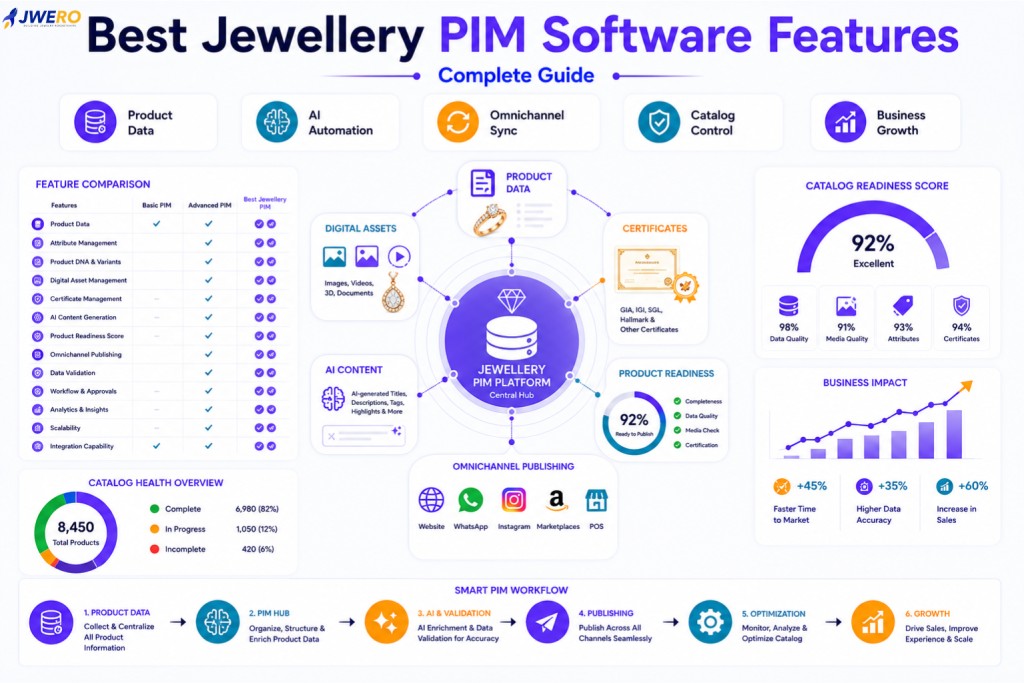
Choosing a Product Information Management (PIM) platform is one of the most important technology decisions a jewellery business can make.
As product catalogues grow and sales channels multiply, managing product information through spreadsheets, ecommerce platforms, and disconnected systems becomes increasingly difficult.
The right Jewellery PIM can help businesses:
- Centralise product information
- Improve product accuracy
- Manage digital assets
- Support omnichannel selling
- Improve catalog quality
- Accelerate product launches
However, not all PIM platforms are built for jewellery businesses.
Before investing in a solution, it’s important to understand which features actually matter.
What Is a Jewellery PIM?
A Jewellery Product Information Management (PIM) platform is a centralised system used to manage:
- Product Data
- Product Attributes
- Product Images
- Product Videos
- Product Certificates
- Product Variants
- Product Content
- Product Relationships
- Omnichannel Publishing
It becomes the single source of truth for product information.
Why Generic Product Management Tools Often Fail
Jewellery products are more complex than standard retail products.
A typical product may contain:
- Metal Information
- Purity Data
- Diamond Specifications
- Stone Details
- Certifications
- Product Variants
- Collection Information
- Product Media
Generic systems often struggle to manage this complexity.
Feature 1: Centralised Product Information Management
The most important feature is a centralised product repository.
The platform should manage:
- Product Names
- SKUs
- Product DNA
- Categories
- Collections
- Product Attributes
- Certifications
- Product Media
Everything should exist in one location.
Feature 2: Jewellery Attribute Management
Attribute management is critical.
The PIM should support:
- Metal Type
- Metal Purity
- Stone Type
- Stone Weight
- Diamond Quality
- Ring Size
- Product Dimensions
- Certification Information
Flexible attribute management improves scalability.
Feature 3: Product DNA and Variant Management
Jewellery businesses often manage:
- Metal Variants
- Size Variants
- Stone Variants
- Weight Variants
The platform should support:
- Parent Products
- Variant Products
- Product Relationships
- Variant SKU Structures
This simplifies catalogue management.
Feature 4: SKU and Product Master Data Management
A strong PIM should help manage:
- Product DNA
- SKU Structures
- Variant SKUs
- Product Master Data
- Product Relationships
This creates consistency across the catalogue.
Feature 5: Digital Asset Management (DAM)
Modern jewellery catalogues require extensive media management.
The PIM should support:
- Product Images
- Product Videos
- Certificates
- Hallmark Documents
- Marketing Assets
- Product PDFs
Built-in digital asset management improves efficiency.
Feature 6: Certificate Management
Certificate management is often overlooked.
The platform should support:
- GIA Certificates
- IGI Certificates
- SGL Certificates
- Hallmark Certificates
- Certificate Linking
- Certificate Search
This improves customer trust.
Feature 7: Product Completeness and Readiness Scores
One of the most valuable jewellery PIM features is readiness scoring.
The system should measure:
- Product Completeness
- Missing Attributes
- Missing Media
- Missing Certifications
- Ecommerce Readiness
This ensures products are ready before publication.
Feature 8: AI Product Content Generation
Modern PIM platforms increasingly use AI.
The system should support:
- Product Titles
- Product Descriptions
- Product Tags
- SEO Metadata
- Product Captions
- Product Summaries
AI reduces manual effort significantly.
Feature 9: Image-to-Product Data AI
Advanced PIM software should support AI-powered catalogue enrichment.
Capabilities may include:
- Image Recognition
- Product Categorization
- Tag Generation
- Attribute Suggestions
- Product Classification
This accelerates catalogue creation.
Feature 10: Omnichannel Publishing
Jewellery products must be distributed across multiple channels.
The PIM should publish to:
- Website
- Ecommerce Store
- WhatsApp Catalogue
- Instagram Shop
- Facebook Shop
- Marketplaces
- POS Systems
Centralised publishing reduces duplication.
Feature 11: Channel-Ready Product Management
Every channel has unique requirements.
The PIM should help prepare:
- Website Listings
- Marketplace Listings
- WhatsApp Catalogues
- Social Commerce Products
- Retail Catalogues
Channel readiness improves speed and consistency.
Feature 12: Product Data Validation
Data quality is critical.
The system should automatically validate:
- Missing Information
- Duplicate Products
- Incorrect Attributes
- Missing Media
- Invalid Values
- Catalog Errors
Validation improves accuracy.
Feature 13: Workflow and Approval Management
Product governance becomes essential as catalogues grow.
The PIM should support:
- Product Creation
- Product Review
- Product Approval
- Publishing Workflows
- User Permissions
This improves quality control.
Feature 14: Search and Discovery
Finding products quickly is important.
The system should provide:
- SKU Search
- Product Search
- Category Search
- Attribute Search
- Certificate Search
- Asset Search
Fast search improves productivity.
Feature 15: SEO Optimisation Tools
SEO should be built into the platform.
Capabilities should include:
- SEO Titles
- Meta Descriptions
- Product URLs
- Product Tags
- Structured Data
- Product Metadata
This improves discoverability.
Feature 16: AI Search Readiness
As AI-powered search grows, product information must be structured correctly.
The platform should support:
- Rich Product Attributes
- Structured Product Data
- Product Relationships
- Metadata Management
- AI-Friendly Product Content
This improves future readiness.
Feature 17: Single Source of Truth Architecture
A PIM should become the authoritative source for:
- Product Data
- Product Media
- Product Attributes
- Product Relationships
- Product Content
- Product Certifications
This eliminates duplication.
Feature 18: Integration Capabilities
The PIM should connect with:
- ERP
- CRM
- Ecommerce Platforms
- POS Systems
- Marketing Tools
- Analytics Platforms
Integration is essential for scalability.
Feature 19: Scalability
A jewellery catalogue may grow from:
Hundreds of Products
to
Hundreds of Thousands of Products
The platform should scale without performance issues.
Feature 20: Analytics and Catalogue Insights
The best jewellery PIM software provides visibility into catalogue performance.
Analytics may include:
- Product Completeness
- Product Readiness
- Missing Attributes
- Missing Media
- Catalog Health
- Publishing Status
This helps teams continuously improve.
Questions to Ask Before Buying a Jewellery PIM
Before selecting a solution, ask:
- Can It Manage Product DNA?
- Can It Handle Jewellery Attributes?
- Does It Include DAM?
- Does It Support Certificates?
- Does It Support AI?
- Does It Support Omnichannel Publishing?
- Can It Calculate Product Readiness?
- Does It Scale?
The answers reveal whether the platform is truly built for jewellery businesses.
Why Jwero PIM Hub Is Built for Jewellery Businesses
Jwero PIM Hub helps jewellery businesses:
- Centralise Product Data
- Manage Product Attributes
- Manage Product Media
- Manage Certificates
- Generate AI Content
- Support Product DNA
- Improve Product Readiness
- Publish Across Channels
- Support AI Search
- Scale Catalogue Operations
All from a centralised platform designed specifically for jewellery commerce.
Final Thoughts
The best jewellery PIM software is not simply a database.
It is a platform that helps businesses:
- Improve Product Accuracy
- Improve Catalogue Quality
- Accelerate Product Publishing
- Support Omnichannel Commerce
- Improve Customer Experience
- Prepare for AI Search
Choosing the right PIM today can create a significant competitive advantage tomorrow.
FAQs
What is the best jewellery PIM software?
The best jewellery PIM software supports product attributes, digital assets, certificates, product DNA, AI content generation, and omnichannel publishing.
What features should jewellery PIM software include?
Key features include product management, attribute management, DAM, certificates, AI content, readiness scoring, and channel publishing.
Does jewellery PIM software support ecommerce?
Yes. Modern PIM platforms help publish products to ecommerce websites, marketplaces, WhatsApp, Instagram, and POS systems.
Why is DAM important in jewellery PIM?
DAM helps manage product images, videos, certificates, and marketing assets from one centralised platform.
Can AI improve jewellery catalogue management?
Yes. AI can improve jewellery catalogue management by generating descriptions, titles, tags, attributes, and product enrichment data while improving catalogue efficiency.