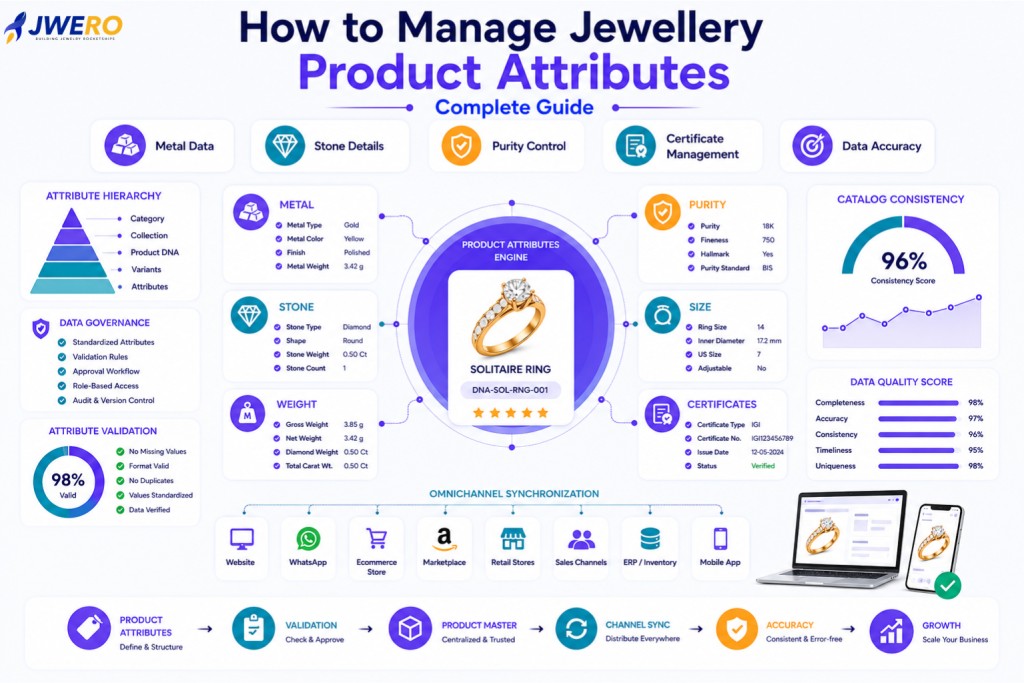


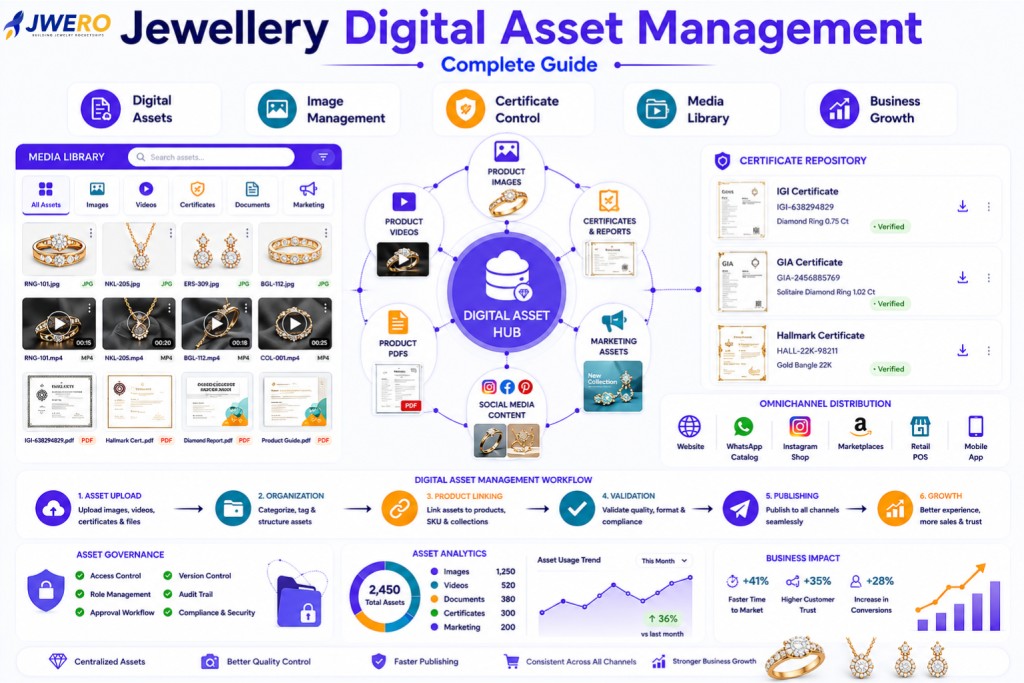
Every jewellery product relies on more than just product data.
A modern jewellery catalogue also requires:
- Product Images
- Product Videos
- Diamond Certificates
- Hallmark Documents
- Product Brochures
- Marketing Assets
- Lifestyle Photography
- Social Media Content
Together, these assets help customers trust, evaluate, and purchase jewellery products.
However, most jewellery businesses store these assets across multiple systems.
Images may be stored in Google Drive.
Certificates may sit in email folders.
Videos may exist on individual employee laptops.
Marketing content may be scattered across shared folders.
As catalogues grow, managing digital assets becomes increasingly difficult.
This is why modern jewellery retailers are investing in Jewellery Digital Asset Management (DAM) strategies.
What Is Jewellery Digital Asset Management?
Jewellery Digital Asset Management (DAM) is the process of organising, storing, managing, and distributing all product-related digital assets from a centralised location.
Digital assets typically include:
- Product Images
- Product Videos
- Product Certificates
- Hallmark Documents
- Marketing Materials
- Product Brochures
- Social Media Assets
- Campaign Creatives
- Product Catalogue PDFs
- Product Media Files
A DAM system ensures every asset is easy to find, manage, and publish.
Why Digital Asset Management Matters for Jewellers
Jewellery is a visual category.
Customers often make purchase decisions based on:
- Product Images
- Lifestyle Photography
- Product Videos
- Certifications
- Product Details
Poor asset management creates:
- Customer Confusion
- Slow Product Launches
- Missing Product Media
- Inconsistent Catalogs
- Reduced Trust
- Lower Conversions
The Hidden Cost of Scattered Digital Assets
Many jewellery businesses operate with assets spread across:
- Google Drive
- Dropbox
- Employee Computers
- Shared Folders
- WhatsApp Groups
- Email Attachments
- Ecommerce Platforms
- ERP Systems
The result is digital asset chaos.
Teams waste hours searching for files.
What Assets Should Be Managed Centrally?
A complete jewellery asset library should include:
- Product Images
- Product Videos
- Product Certificates
- Hallmark Certificates
- Diamond Reports
- Gemstone Certifications
- Product PDFs
- Marketing Graphics
- Brand Assets
- Product Catalogues
- Social Media Content
- Campaign Assets
Everything should connect directly to product records.
Why Jewellery Image Management Is Critical
Images are often the most important conversion factor in jewellery ecommerce.
Customers expect:
- High-Resolution Images
- Multiple Angles
- Zoom Images
- Lifestyle Photography
- White Background Images
- Product Videos
Poor image management leads to poor customer experiences.
Common Jewellery Image Management Problems
Retailers often struggle with:
- Duplicate Images
- Missing Images
- Outdated Product Photography
- Incorrect Product Associations
- Low-Resolution Images
- Inconsistent Naming
These issues impact sales performance.
Best Practices for Jewellery Image Management
Every product should maintain:
- Primary Image
- Alternate Angle Images
- Lifestyle Images
- Close-Up Images
- Detail Images
- 360° Images
A structured image hierarchy improves product quality.
Why Video Asset Management Is Becoming Essential
Video is increasingly influencing jewellery purchases.
Common video assets include:
- Product Demonstrations
- Product Rotations
- Collection Videos
- Customer Testimonials
- Brand Stories
- Educational Videos
Managing videos alongside product information improves consistency.
Jewellery Certificate Management Challenges
Certificates are critical trust-building assets.
However, many businesses manage certificates manually.
Common problems include:
- Missing Certificates
- Wrong Certificate Attachments
- Expired Certifications
- Duplicate Documents
- Certificate Retrieval Delays
These issues impact customer confidence.
What Should Jewellery Certificate Management Include?
Every certificate record should include:
- Certificate Number
- Certification Authority
- Certification Date
- Certificate Type
- Product Association
- Certificate Status
Examples include:
- GIA
- IGI
- SGL
- HRD
- Hallmark Certifications
Why Product Media Management Matters
Product media includes all visual content associated with a product.
This may include:
- Images
- Videos
- Certificates
- PDFs
- Product Sheets
- Marketing Assets
Effective jewellery product media management improves product readiness.
Connecting Assets to Product Records
One of the biggest challenges is linking assets to products.
Every asset should connect directly to:
- Product SKU
- Product DNA
- Product Variant
- Product Category
- Collection
This improves traceability.
Why Asset Searchability Matters
As catalogues grow, finding assets becomes difficult.
A modern DAM system should support:
- SKU Search
- Product Search
- Category Search
- Collection Search
- Certificate Search
- Metadata Search
Fast retrieval improves productivity.
Digital Asset Management and Omnichannel Commerce
Assets must support multiple channels.
Products may be published across:
- Website
- Ecommerce
- Marketplaces
- Retail Stores
The same asset library should serve every channel.
Why Asset Governance Matters
Without governance, asset libraries become disorganised.
Businesses should define:
- Upload Standards
- Naming Standards
- Approval Processes
- Version Control
- Ownership Rules
Governance improves long-term quality.
Digital Asset Management and Product Readiness
A product is not ready to sell if it lacks:
- Images
- Videos
- Certifications
- Marketing Assets
Asset completeness directly impacts product readiness scores.
Digital Asset Management and SEO
Search engines increasingly value visual content.
High-quality assets improve:
- Product Engagement
- Product Discoverability
- Rich Results
- Customer Experience
- Conversion Rates
Visual assets support SEO performance.
Digital Asset Management and AI Search
AI-powered search engines evaluate:
- Product Images
- Product Metadata
- Product Descriptions
- Product Relationships
- Product Certifications
A centralised DAM improves AI readiness.
Signs You Need a Jewellery DAM Strategy
You likely need centralised asset management if:
- Assets Are Stored Across Multiple Systems
- Teams Cannot Find Product Media
- Product Launches Are Delayed
- Certificate Retrieval Is Difficult
- Image Duplication Is Common
- Asset Quality Is Inconsistent
These are common growth bottlenecks.
Why PIM and DAM Work Better Together
A PIM manages:
- Product Data
- Product Attributes
- Product Relationships
A DAM manages:
- Images
- Videos
- Certificates
- Media Assets
Together, they create a complete product management ecosystem.
How Jwero PIM Hub Helps Manage Digital Assets
Jwero PIM Hub helps jewellery businesses:
- Manage Product Images
- Manage Product Videos
- Manage Product Certificates
- Manage Hallmark Documents
- Connect Assets to Products
- Improve Asset Governance
- Support Omnichannel Publishing
- Improve Product Readiness
All from a centralised platform.
Final Thoughts
As jewellery catalogues grow, digital asset management becomes a strategic requirement.
Businesses that centralise:
- Images
- Videos
- Certificates
- Product Media
Gain better control over product quality, publishing speed, customer experience, and business growth.
The future belongs to jewellery businesses that treat digital assets as a core part of product management.
FAQs
What is jewellery digital asset management?
Jewellery digital asset management is the centralised management of product images, videos, certificates, and related media assets.
Why is jewellery image management important?
Jewellery image management is important because it improves product quality, customer trust, ecommerce performance, and catalogue consistency.
What is jewellery certificate management?
Jewellery Certificate management is the process of storing, organising, linking, and distributing product certificates and compliance documents.
What assets should be managed in a jewellery DAM?
Images, videos, certificates, PDFs, marketing materials, product sheets, and social media content should be managed in a Jewellery DAM.
How does DAM improve ecommerce performance?
DAM improve ecommerce performance by ensuring products have complete, accurate, and accessible media assets across every sales channel.