


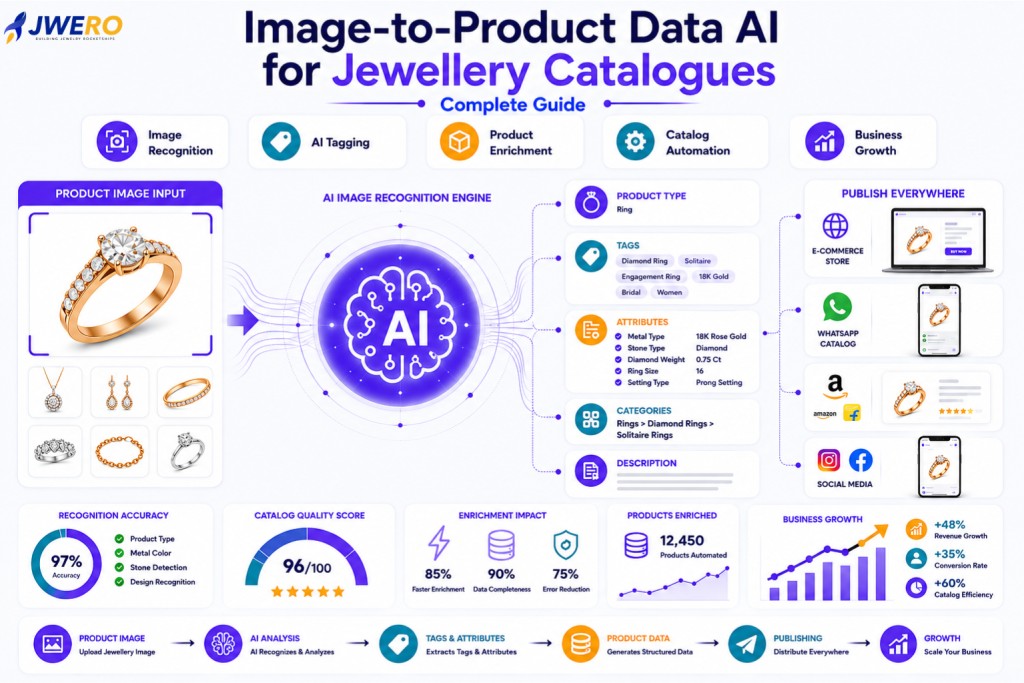
One of the biggest challenges in jewellery product management is creating complete product records.
Most jewellery businesses already have thousands of product images.
What they often lack is:
- Product Attributes
- Product Tags
- Product Titles
- Product Descriptions
- Product Categories
- Product Metadata
Traditionally, teams manually enter this information.
The process is slow, expensive, and error-prone.
Today, Artificial Intelligence is changing that.
Modern AI can analyse a jewellery image and automatically generate structured product data.
This capability is transforming how jewellers build, enrich, and scale product catalogues.
Instead of manually creating every product record, businesses can now use AI to convert images into product information.
What Is Image-to-Product Data AI?
Image-to-product data AI uses computer vision and machine learning to analyse jewellery images and extract meaningful information.
The AI can identify:
- Product Category
- Jewellery Type
- Metal Type
- Stone Type
- Design Style
- Product Features
- Visual Characteristics
- Collection Similarities
The result is structured product data that can be used throughout the catalogue.
Why Catalogue Enrichment Matters
A product image alone is not enough for ecommerce success.
Customers need:
- Product Names
- Product Attributes
- Product Descriptions
- Product Tags
- Product Categories
- Product Specifications
- Product Filters
Without enrichment, products become difficult to discover and sell.
The Traditional Product Enrichment Problem
Most jewellery businesses still enrich products manually.
A typical workflow looks like:
Upload Product Image
↓
Create Product Record
↓
Add Attributes
↓
Add Product Tags
↓
Write Description
↓
Publish Product
This process may take 10–20 minutes per product.
For thousands of products, the workload becomes overwhelming.
How AI Image Recognition Works
Modern jewellery image recognition systems analyse visual elements within an image.
AI can identify:
- Ring
- Necklace
- Bracelet
- Pendant
- Earrings
- Bangle
The system can also identify style characteristics and visual attributes.
This dramatically speeds up catalogue creation.
AI Image Tagging for Jewellery
One of the most valuable capabilities is automatic tagging.
Traditionally, teams manually create tags such as:
- Diamond Ring
- Solitaire
- Engagement Ring
- White Gold
- Bridal Jewellery
AI image tagging jewellery systems generate these tags automatically.
This improves:
- Search
- Filtering
- Recommendations
- Product Discovery
From Image to Product Attributes
AI can extract likely product attributes from images.
Examples include:
- Product Type
- Metal Color
- Stone Presence
- Design Category
- Style Type
- Occasion
- Collection Type
While human review may still be required, AI dramatically reduces manual effort.
How AI Accelerates Catalogue Creation
Instead of creating products from scratch:
AI workflow:
Upload Image
↓
AI Analysis
↓
Attribute Generation
↓
Tag Generation
↓
Product Description Generation
↓
Product Approval
↓
Publishing
This reduces product onboarding time significantly.
AI Catalogue Enrichment for Jewellery
Catalogue enrichment involves improving product records with useful information.
AI can enrich products by generating:
- Product Titles
- Product Tags
- Product Categories
- Product Descriptions
- Product Highlights
- SEO Metadata
- Collection Assignments
- Related Products
This creates richer product experiences.
Why Product Images Are an Untapped Data Source
Most jewellery businesses possess thousands of product images.
These images contain valuable information that often remains unused.
AI converts visual assets into structured business data.
Images become a source of:
- Product Intelligence
- Product Classification
- Product Discovery
- Product Organization
- Product Automation
AI and Product Categorisation
Category management is often inconsistent.
AI can automatically classify products such as:
- Rings
- Earrings
- Necklaces
- Bracelets
- Pendants
- Bridal Jewellery
- Diamond Jewellery
This improves catalogue organisation.
AI and Product Title Generation
After analysing an image, AI can generate product titles.
Example:
Image Input:
Diamond solitaire ring
AI Output:
- Elegant Solitaire Diamond Ring in White Gold
- Classic Diamond Engagement Ring
- Premium Solitaire Ring for Women
This speeds up product publishing.
AI and Product Description Generation
AI can also generate descriptions based on:
- Product Image
- Product Attributes
- Product Category
- Product Metadata
This creates customer-friendly product content automatically.
AI and SEO Optimisation
Well-structured product data improves SEO.
AI-generated content helps improve:
- Product Titles
- Product Descriptions
- Product Metadata
- Product Tags
- Structured Data
- Internal Search
This supports organic visibility.
AI and Omnichannel Commerce
Product data generated from images can be published across:
- Website
- Ecommerce
- WhatsApp Catalogue
- Marketplace
- CRM
- Retail Systems
This improves consistency.
AI and Product Discovery
Customers discover products through:
- Search
- Filters
- Recommendations
- Category Pages
- AI Search Engines
Better product data improves discovery.
AI and Visual Search
The future of jewellery commerce includes visual search.
Customers increasingly search using:
- Photos
- Screenshots
- Similar Product Images
AI image recognition creates the foundation for visual commerce.
AI and Product Governance
AI does not replace governance.
The best approach combines:
- AI Automation
- Human Review
- Product Standards
- Product Approval Workflows
This creates scalable and accurate catalogues.
Benefits of AI-Powered Product Enrichment
Jewellery businesses gain:
- Faster Product Creation
- Better Product Data
- Better Search Visibility
- Better Product Discovery
- Better Catalog Organization
- Reduced Manual Work
- Faster Product Launches
- Improved Ecommerce Performance
Why AI Is Becoming Essential for Jewellery Catalogues
As product catalogues grow, manual enrichment becomes unsustainable.
AI enables businesses to:
- Scale Faster
- Publish Faster
- Improve Consistency
- Improve Accuracy
- Improve Customer Experience
- Support Omnichannel Commerce
The competitive advantage is significant.
How Jwero AI PIM Enables Image-to-Product Data
Jwero AI PIM helps jewellery businesses:
- Analyse Product Images
- Generate Product Attributes
- Create Product Tags
- Generate Product Titles
- Generate Product Descriptions
- Classify Products Automatically
- Improve Catalogue Quality
- Accelerate Product Publishing
All from a centralised product management platform.
Final Thoughts
Jewellery businesses already possess one of the most valuable catalogue assets:
Product Images
AI transforms those images into structured product information.
By converting images into:
- Product Data
- Product Tags
- Product Titles
- Product Descriptions
- Product Categories
Businesses can dramatically improve catalogue quality and operational efficiency.
The future of jewellery product management is not manual data entry.
It is AI-powered catalogue enrichment.
FAQs
What is image-to-product data AI?
Image-to-product data AI analyses jewellery images and automatically generates structured product information such as attributes, tags, categories, and descriptions.
Can AI identify jewellery products from images?
Yes. Modern AI image recognition can identify jewellery categories, styles, metal colours, stone types, and visual characteristics.
What is AI image tagging for jewellery?
AI image tagging automatically generates relevant product tags based on image analysis.
How does AI improve catalogue enrichment?
AI reduces manual work by generating product data, descriptions, categories, and metadata automatically.
Can AI create product descriptions from images?
Yes. AI can combine image analysis with product data to generate customer-friendly product descriptions.