


Most jewellery brands believe walk‑in tracking fails because:
- Staff forget
- Staff don’t log
- Staff are inconsistent
This is only half the truth.
The deeper issue is that jewellery walk‑ins are behavioural, not transactional — and behaviour is almost impossible to capture manually at scale.
High‑performing brands are moving away from staff‑dependent logging and toward passive, system‑led walk‑in tracking that works even when no one remembers to do anything.
1. Why Staff‑Led Walk‑In Tracking Always Breaks
Sales‑staff‑based tracking fails because:
- Peak hours leave no time for logging
- Browsers don’t want to share details
- Advisors prioritise selling over recording
- Interest often feels “too early” to capture
- Staff changes break continuity
This creates a dangerous outcome:
Only buyers get recorded.Browsers — the future buyers — disappear.
2. The Myth: “Just Train the Staff Better”
Training helps behaviour.
It doesn’t solve structural friction.
No matter how well trained:
- Humans forget
- Humans shortcut
- Humans avoid awkward asks
- Humans optimise for immediate sales
Jewellery walk‑in tracking must work:
Even when staff are busy, distracted, or absent.
That requires systems — not reminders.
3. What Walk‑In Tracking Really Means (And What It Doesn’t)
Tracking walk‑ins does not mean:
- Forcing registration
- Interrupting browsing
- Adding admin burden
- Turning stores into check‑in counters
It means:
- Knowing how many visitors came
- Understanding where they engaged
- Capturing when interest deepened
- Remembering what they cared about
- Identifying who raised a hand voluntarily
The goal is intent visibility, not data collection.
4. The Core Principle: Passive First, Voluntary Second
The most effective walk‑in tracking follows this order:
- Passive behaviour tracking
- Voluntary identity capture when intent rises
- CRM memory across visits
Anything that flips this order increases resistance and data loss.
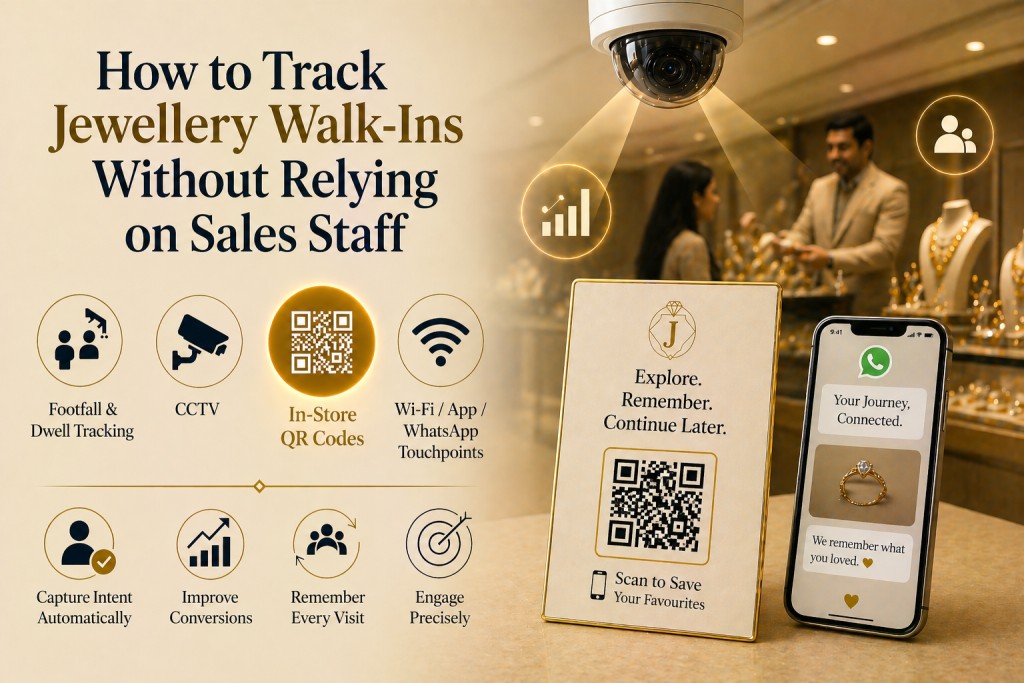
5. Systems That Track Walk‑Ins Without Staff Input
1. Footfall & Dwell Tracking
Tracks:
- Entry counts
- Zone dwell time
- Repeat visits
- Engagement hotspots
This answers:
“Did interest happen — even if no one spoke?”
2. CCTV‑Based Behaviour Intelligence
Captures:
- Counter engagement
- Repeat handling
- Visit duration
- Return patterns
This reveals:
“Who is buying in progress, not just browsing.”
No staff action required.
3. In‑Store QR Codes
Placed at:
- Design trays
- Mirrors
- Collection signage
- Exit points (“Continue later”)
QR scans act as:
Silent self‑identification at peak interest
Staff don’t ask.
Customers opt in.
4. Wi‑Fi / App / WhatsApp Touchpoints
When customers:
- Connect to Wi‑Fi
- Open catalog links
- Message later on WhatsApp
Their visit becomes:
A connected journey, not an isolated event.
6. When Staff Should Be Involved (And When They Shouldn’t)
Staff should not:
- Log every walk‑in
- Ask every browser for details
- Fill CRMs mid‑conversation
Staff should:
- Resume conversations with context
- Engage when systems flag readiness
- Build trust — not capture data
Systems collect.
Humans convert.
7. How Walk‑In Tracking Improves Conversion Automatically
When walk‑ins are tracked systematically:
- Second visits feel remembered
- WhatsApp follow‑ups become relevant
- Silence is interpreted correctly
- Advisors stop guessing
- Pressure reduces
- Confidence builds faster
Tracking doesn’t increase selling.
It improves timing.
8. Why Jewellery Needs This More Than Any Other Retail
Jewellery decisions are:
- Slow
- Emotional
- Multi‑visit
- High‑trust
- Family‑influenced
Which means:
The first visit rarely converts — but it decides the future sale.
If you don’t track the first visit,
you lose the sale you haven’t earned yet.
9. CXO Insight: Walk‑In Tracking Is a Revenue Control System
Leadership often asks:
- “How many walk‑ins today?”
- “What was conversion?”
The better question is:
“How much buying intent did we create — and remember?”
System‑led walk‑in tracking gives:
- Demand visibility
- Store‑level intent metrics
- Predictable future revenue
- Reduced dependency on individual staff
10. The Strategic Shift: From Staff Memory to System Memory
Winning jewellery brands are shifting from:
- “Did the advisor log it?” to
- “Did the system see it?”
From:
- Manual tracking to
- Automatic intent capture
Because:
Sales staff should sell.Systems should remember.
Final Thought
Jewellery walk‑ins don’t get lost because staff forget.They get lost because brands rely on people to do a system’s job.
The future of jewellery retail is not more discipline —
it’s less dependency.
Track behaviour passively.
Capture intent voluntarily.
Engage precisely.
That’s how you track jewellery walk‑ins —
even when no one remembers to log them.