


Executive Summary
Most jewellery brands treat walk‑ins as:
Free demand.
No CAC.
No media spend.
No platform fees.
This is one of the most dangerous misconceptions in jewellery retail.
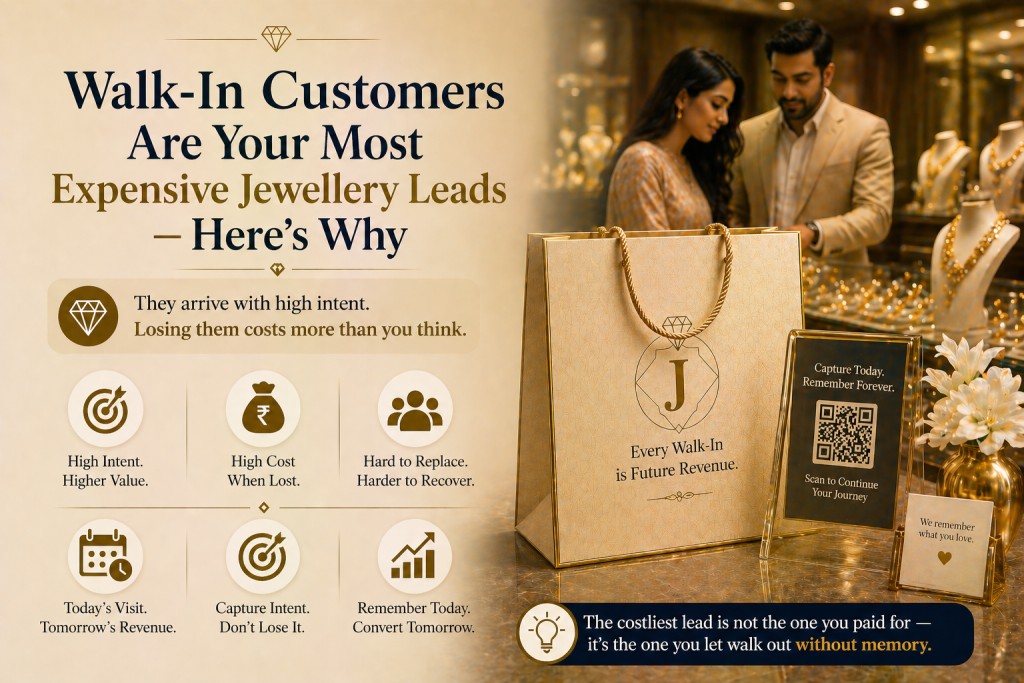
In reality, walk‑in customers are your most expensive leads — not because of advertising costs, but because of how much intent you lose if you don’t convert or remember them.
1. The Illusion of “Free” Walk‑Ins
Walk‑ins feel free because their costs are invisible.
But every walk‑in is funded by:
- Store rent
- Inventory exposure
- Sales staff salaries
- Time spent at counters
- Brand reputation
- Prior marketing influence (Instagram, Google, referrals)
By the time a customer walks in,
the business has already paid heavily.
The only question left is:
Do you capture the value — or let it walk out?
2. Walk‑Ins Arrive With the Highest Intent Density
Compared to digital leads, walk‑ins:
- Have crossed physical friction
- Have invested time
- Have seen real products
- Are emotionally engaged
- Are closer to a decision
A walk‑in is rarely discovery.
It’s usually late‑stage evaluation.
Which means:
Losing a walk‑in hurts more than losing any other lead.
3. Why Walk‑Ins Cost More When They Don’t Convert
When a walk‑in doesn’t convert:
- The advisor’s time is unrecovered
- Inventory handling has cost
- Emotional momentum is lost
- Follow‑up becomes impossible
- Future conversion probability drops sharply
Unlike digital leads:
- You can’t retarget anonymously
- You can’t remind them cheaply
- You can’t rebuild context easily
The cost isn’t just lost revenue —
it’s lost intent that can’t be re‑bought.
4. The Hidden Cost: Resetting the Journey
When walk‑ins aren’t captured:
- Second visits start from zero
- Customers repeat their story
- Advisors guess preferences
- Confidence erodes subtly
- Price sensitivity increases
Customers think:
“They don’t remember me.”
In jewellery, that feeling kills trust.
5. Why Brands Miscalculate Walk‑In Economics
Leadership often measures:
- Footfall
- Conversion rate
- Average bill value
But misses:
- Intent depth per visit
- Visit‑to‑visit progression
- Lost future probability
- Silent buyers who never return
A walk‑in that doesn’t convert today
may have been worth far more tomorrow — if remembered.
6. Walk‑Ins vs Digital Leads: The Cost Comparison
| Lead Type | Easy to Re‑engage | Context Retained | Replacement Cost |
|---|---|---|---|
| Instagram Lead | High | Medium | Low |
| Website Enquiry | Medium | Medium | Low |
| WhatsApp Lead | High | High | Medium |
| Walk‑In | Low | Low (if not captured) | Very High |
Walk‑ins are expensive not to acquire —
but to lose.
7. Why Staff‑Dependent Capture Makes It Worse
Relying on sales staff to:
- Remember visitors
- Log interest
- Capture details
Fails because:
- Peak hours prevent logging
- Browsers resist questioning
- Advisors prioritise selling
- Human memory doesn’t scale
The more premium the store,
the more intent quietly disappears.
8. The Real Fix: Treat Walk‑Ins as High‑Value Leads
High‑performing jewellery brands:
- Track behaviour passively
- Capture identity voluntarily
- Preserve browsing memory
- Connect visits across time
- Resume journeys instead of restarting them
They assume:
Every walk‑in is a future buyer unless proven otherwise.
9. CXO Insight: Walk‑Ins Are Delayed Revenue
Most walk‑ins don’t convert immediately because:
- Jewellery decisions mature slowly
- Family validation is needed
- Price anchoring happens over time
- Confidence builds across visits
Which means:
Walk‑ins represent future revenue already paid for.
Losing them is not a sales issue.
It’s a revenue leakage issue.
10. The Strategic Shift: From Footfall to Intent Capital
Winning jewellery brands stop asking:
- “How many walk‑ins did we get?”
And start asking:
- “How much buying intent did we capture and remember today?”
They stop treating walk‑ins as free traffic —
and start treating them as their most valuable, fragile asset.
Final Thought
Walk‑in customers are expensive because they are rare, ready, and hard to replace.
You can always buy more clicks.
You can always run more ads.
But you cannot easily recreate:
- A customer who walked in
- Touched your jewellery
- Imagined owning it
- And left undecided
In jewellery,
the costliest lead is not the one you paid for —it’s the one you let walk out without memory.