


One of the biggest operational challenges in jewellery retail is getting products online quickly.
Every new product requires:
- Product Images
- Product Attributes
- Product Descriptions
- Product Categories
- Product Certificates
- Product Tags
- Product Variants
- Channel Publishing
When these tasks are performed manually, product onboarding becomes slow and expensive.
Many jewellery businesses spend:
15–30 Minutes Per Product
Sometimes even longer.
When hundreds or thousands of products need to be uploaded, delays become a major growth bottleneck.
This is where a Jewellery Product Information Management (PIM) platform can make a significant difference.
Why Product Uploads Take So Long
Most jewellers still manage product onboarding using disconnected systems.
A typical process looks like:
Product Photography
↓
Excel Entry
↓
Image Upload
↓
Product Description Creation
↓
Attribute Entry
↓
Certificate Attachment
↓
Ecommerce Upload
↓
WhatsApp Upload
↓
Marketplace Upload
Every step introduces manual work.
The Hidden Cost of Slow Product Uploads
Slow onboarding impacts more than productivity.
It also affects:
- Time-to-Market
- Revenue Generation
- Catalog Growth
- Product Visibility
- Customer Experience
- Team Efficiency
Products cannot generate revenue until they are available for sale.
What Is Jewellery Product Onboarding?
Product onboarding is the process of preparing a product for publication across sales channels.
Typical onboarding tasks include:
- Product Creation
- SKU Assignment
- Product Attributes
- Product Images
- Product Certificates
- Product Content
- Product Validation
- Channel Publishing
The more manual the process, the slower it becomes.
Why Growing Jewellers Struggle with Upload Speed
As businesses grow, product complexity increases.
Catalogues contain:
- More Variants
- More Attributes
- More Images
- More Certificates
- More Channels
- More Compliance Requirements
Manual processes do not scale effectively.
Where Most Upload Time Is Lost
The biggest delays usually occur in:
Product Data Entry
Teams repeatedly enter the same information.
Product Image Management
Images are uploaded and organised manually.
Product Content Creation
Descriptions and titles are written from scratch.
Product Validation
Teams manually verify completeness.
Multi-Channel Publishing
Products are uploaded separately to each channel.
How Jewellery PIM Reduces Product Upload Time
A Jewellery PIM eliminates repetitive tasks by centralising product information.
Instead of managing products in multiple systems, everything is managed from one platform.
This dramatically reduces onboarding effort.
Benefit 1: Centralised Product Information
Without a PIM:
Teams update multiple systems.
With a PIM:
One Product Record
feeds every channel.
This removes duplicate work.
Benefit 2: Standardised Product Templates
Many product uploads are delayed because information is entered inconsistently.
A Jewellery PIM provides:
- Product Templates
- Attribute Templates
- Category Templates
- Variant Templates
Teams spend less time creating products from scratch.
Benefit 3: Faster Attribute Management
Jewellery products require numerous attributes.
Examples:
- Metal Type
- Purity
- Weight
- Stone Information
- Certification Details
A PIM automatically structures these attributes.
This significantly accelerates data entry.
Benefit 4: Automated Product Validation
Manual quality checks consume time.
A PIM can automatically identify:
- Missing Images
- Missing Attributes
- Missing Certificates
- Missing Product Content
- Missing Metadata
Teams focus only on exceptions.
Benefit 5: Product Readiness Scores
Instead of manually checking every product, readiness scoring automatically measures:
- Completeness
- Accuracy
- Ecommerce Readiness
- Channel Readiness
Products become easier to approve.
Benefit 6: Digital Asset Management
Image management often slows onboarding.
A Jewellery PIM centralises:
- Images
- Videos
- Certificates
- Product PDFs
- Marketing Assets
Assets remain linked to products automatically.
Benefit 7: AI Product Content Generation
Writing content manually takes significant time.
AI can generate:
- Product Titles
- Product Descriptions
- Product Tags
- Product Captions
- SEO Metadata
This can reduce content creation time dramatically.
Benefit 8: Image-to-Product Data Automation
Modern AI can analyse product images and suggest:
- Categories
- Product Types
- Attributes
- Tags
- Product Information
This reduces manual data entry.
Benefit 9: Variant Management Automation
Without a PIM, every variant may be created individually.
Examples:
- Ring Sizes
- Gold Colors
- Stone Variations
- Weight Variations
A Jewellery PIM creates relationships automatically.
Benefit 10: Omnichannel Publishing
Publishing is often the biggest bottleneck.
Without PIM:
- Website Upload
- WhatsApp Upload
- Marketplace Upload
- Ecommerce Upload
All managed separately.
With PIM:
- Publish Once
- Distribute Everywhere
This creates major time savings.
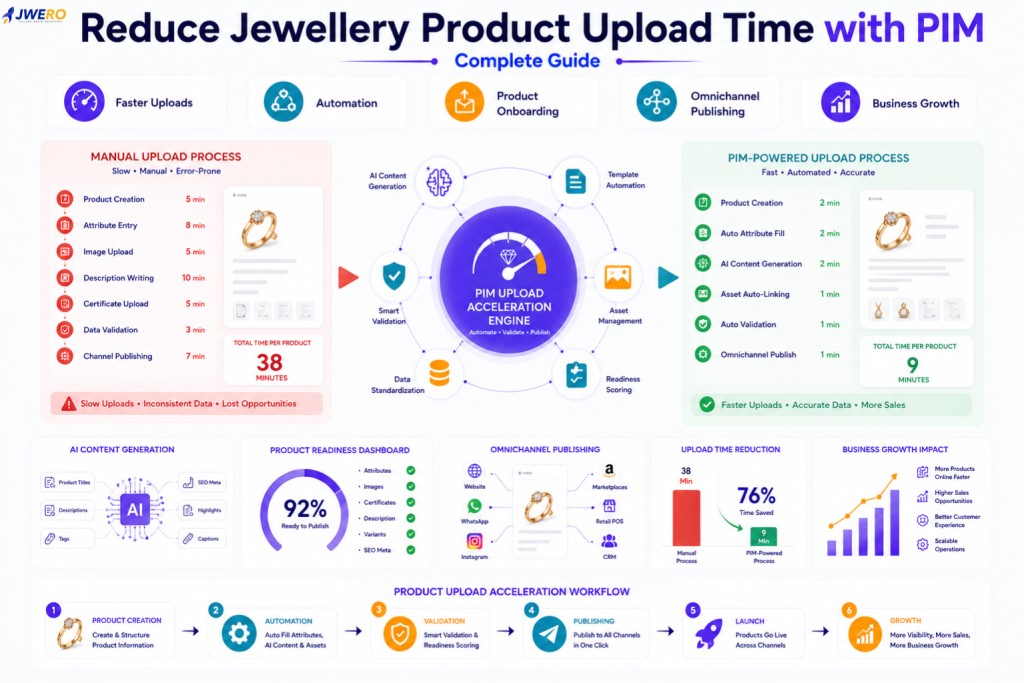
Example: Product Upload Before PIM
- Product Creation – 5 Minutes
- Attribute Entry – 8 Minutes
- Content Creation – 10 Minutes
- Asset Upload – 5 Minutes
- Validation – 3 Minutes
- Channel Publishing – 7 Minutes
Total:
38 Minutes Per Product
Example: Product Upload After PIM
- Product Template – 2 Minutes
- Attribute Automation – 2 Minutes
- AI Content Generation – 2 Minutes
- Asset Linking – 1 Minute
- Automated Validation – 1 Minute
- Omnichannel Publishing – 1 Minute
Total:
9 Minutes Per Product
The difference becomes significant at scale.
The Impact on Large Catalogues
For:
1,000 Products
Manual Process:
633+ Hours
PIM-Driven Process:
150 Hours
Potential Savings:
75%+ Reduction
This creates a major operational advantage.
Why Faster Product Uploads Drive Revenue
Faster onboarding means:
- Faster Product Launches
- More Products Available
- Better Catalogue Freshness
- Better Customer Experience
- More Selling Opportunities
Speed directly impacts growth.
Why Product Upload Speed Matters for Omnichannel Commerce
Modern jewellers sell across:
- Website
- Marketplaces
- Retail Stores
A PIM ensures products become available everywhere faster.
Signs Your Business Needs Faster Product Onboarding
You likely need a Jewellery PIM if:
- Product Uploads Take More Than 15 Minutes
- Teams Re-Enter Product Information
- Images Are Managed Separately
- Product Publishing Is Manual
- Product Validation Is Manual
- Catalogue Growth Is Slowing
These are common indicators.
How Jwero PIM Hub Accelerates Product Uploads
Jwero helps jewellery businesses:
- Centralise Product Data
- Standardise Product Templates
- Automate Attribute Management
- Manage Digital Assets
- Generate AI Product Content
- Automate Product Validation
- Calculate Product Readiness
- Publish Across Channels
- Accelerate Product Onboarding
All from one platform built specifically for jewellery businesses.
Final Thoughts
Product upload speed is no longer just an operational metric.
It is a competitive advantage.
Jewellery businesses that reduce onboarding time can:
- Launch Faster
- Sell Faster
- Scale Faster
- Improve Catalogue Quality
- Improve Customer Experiences
- Increase Revenue
A Jewellery PIM provides the structure, automation, and intelligence needed to make that happen.
FAQs
Can a Jewellery PIM reduce product upload time?
Yes. A Jewellery PIM automates data entry, validation, content generation, asset management, and publishing workflows.
How much time can a PIM save?
Many businesses reduce onboarding time by 50–80% depending on catalogue complexity and current processes.
What is jewellery product onboarding?
It is the process of preparing products for publication, including attributes, images, content, validation, and channel publishing.
How does AI help with product uploads?
AI can generate product descriptions, titles, tags, categories, and attribute suggestions automatically.
Does a PIM support omnichannel publishing?
Yes. Modern Jewellery PIM platforms publish products across websites, WhatsApp, ecommerce platforms, marketplaces, and retail systems.