


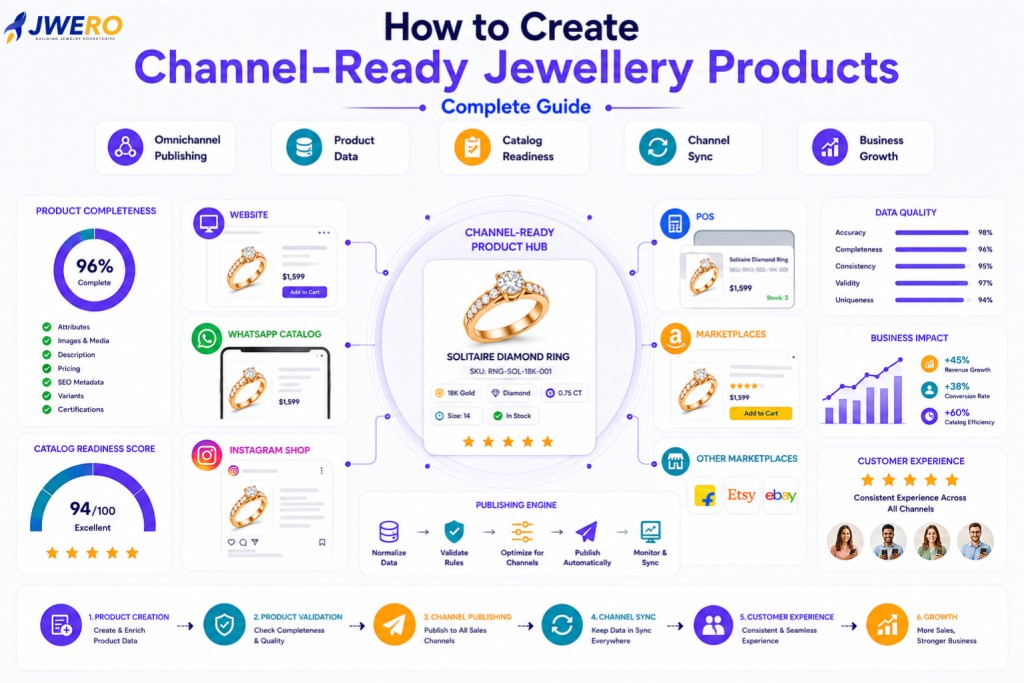
Modern jewellery retail is no longer limited to a single sales channel.
Today’s customers discover, evaluate, and purchase jewellery across multiple touchpoints.
A typical customer journey may look like:
Instagram Discovery
↓
Website Browsing
↓
WhatsApp Inquiry
↓
Store Visit
↓
Final Purchase
Because customers move seamlessly between channels, jewellery businesses must ensure that products are ready to sell everywhere.
Unfortunately, many retailers still prepare products separately for each channel.
This creates:
- Product Data Inconsistencies
- Catalog Errors
- Missing Product Information
- Poor Customer Experiences
- Slow Product Publishing
The solution is creating channel-ready jewellery products.
What Are Channel-Ready Jewellery Products?
A channel-ready product is a product record that contains all the information required to be published consistently across every sales channel.
Instead of creating separate product records for:
- Website
- POS
- Marketplaces
A business creates one complete product record that can automatically adapt to each channel.
Why Channel Readiness Matters
Customers expect the same information everywhere.
They expect:
- Same Images
- Same Pricing
- Same Product Specifications
- Same Availability
- Same Certifications
Across all touchpoints.
When information differs, customer trust declines.
The Omnichannel Jewellery Challenge
Most jewellery businesses sell across:
- Ecommerce Website
- WhatsApp Catalogue
- Instagram Shop
- Facebook Shop
- Retail POS
- Amazon
- Flipkart
- Etsy
- Sales Team Catalogues
Each platform has different requirements.
Managing them manually quickly becomes difficult.
What Makes a Product Channel-Ready?
A channel-ready product contains complete and structured information.
Core elements include:
- Product Name
- Product Title
- Product Description
- Product Images
- Product Videos
- Product Category
- Product Attributes
- SKU
- Variant Information
- Pricing
- Inventory Status
- Certifications
- SEO Metadata
- Product Tags
Without these elements, publishing becomes difficult.
Channel Requirement 1: Website Product Data
Your website typically requires the most detailed product information.
Website-ready products should include:
- Long Product Descriptions
- Product Specifications
- Product Attributes
- SEO Metadata
- Multiple Images
- Product Videos
- Related Products
- Product Reviews
The website often becomes the master customer-facing catalogue.
Channel Requirement 2: Jewellery WhatsApp Catalogue
WhatsApp has become a major jewellery sales channel.
Customers expect instant access to:
- Product Images
- Pricing
- Availability
- Product Highlights
- Certifications
- Product Variants
A properly structured jewellery WhatsApp catalogue improves customer engagement and response times.
Channel Requirement 3: Instagram Shop Product Data
Instagram users engage differently from website visitors.
Products require:
- High-Quality Images
- Short Product Titles
- Lifestyle Visuals
- Product Tags
- Shopping Integration
- Collection Organization
Good jewellery Instagram shop product data improves product discoverability and social commerce performance.
Channel Requirement 4: POS Product Data
Store teams require accurate product information during sales conversations.
POS-ready products should include:
- SKU
- Variant Information
- Pricing
- Inventory Availability
- Product Attributes
- Certification Details
- Product Images
Store teams need fast access to product information.
Channel Requirement 5: Jewellery Marketplace Listings
Marketplaces typically have strict publishing requirements.
Examples include:
- Amazon
- Etsy
- Flipkart
- eBay
Products often require:
- Category Mapping
- Product Attributes
- Product Images
- Product Titles
- Product Specifications
- Product Tags
- Marketplace Metadata
This makes structured product data essential.
Why Most Product Records Fail Channel Readiness
Many jewellery businesses store incomplete product information.
Common problems include:
- Missing Images
- Missing Product Attributes
- Inconsistent Pricing
- Missing Certifications
- Poor Product Titles
- Missing Product Tags
- Duplicate Product Records
As a result, products require manual rework before publishing.
The Cost of Non-Channel-Ready Products
When products are not publication-ready:
- Product Launches Slow Down
- Teams Repeat Work
- Product Errors Increase
- Catalog Quality Declines
- Customer Experience Suffers
- Revenue Opportunities Are Lost
The hidden operational cost is substantial.
Creating a Channel-Ready Product Framework
A strong framework includes:
- Product Identity
- Product Name
- SKU
- Product DNA
- Collection
- Product Attributes
- Metal
- Stone
- Purity
- Weight
- Size
- Certification
Product Content
- Product Titles
- Descriptions
- Tags
- SEO Content
Product Media
- Images
- Videos
- Lifestyle Content
This creates a reusable product foundation.
Why Product Attributes Drive Channel Success
Different channels consume product attributes differently.
Website:
Full Attribute Display
Instagram:
Simplified Attributes
Marketplace:
Structured Attributes
WhatsApp:
Key Highlights
Without structured attributes, publishing becomes inconsistent.
Why Product Content Must Be Channel-Aware
Not every channel needs the same content format.
Website:
Detailed Product Description
Instagram:
Short Marketing Caption
WhatsApp:
Quick Product Summary
Marketplace:
Structured Product Listing
Channel-ready products support multiple content formats.
Why Product Images Must Be Channel-Ready
Images are often the most important conversion factor.
Businesses should maintain:
- White Background Images
- Lifestyle Images
- Close-Up Images
- Product Videos
Different channels use different media formats.
Why Product Data Standardisation Matters
Standardised product data improves:
- Publishing Speed
- Product Accuracy
- Catalog Consistency
- Product Discoverability
- Omnichannel Operations
- AI Readiness
Consistency creates scalability.
Channel-Ready Products and SEO
Structured product data improves:
- Product Rankings
- Search Visibility
- Rich Snippets
- Product Discoverability
- Organic Traffic
Channel readiness supports SEO performance.
Channel-Ready Products and AI Search
AI platforms increasingly evaluate:
- Product Structure
- Product Attributes
- Product Descriptions
- Product Metadata
- Product Relationships
Businesses with structured product data gain an advantage in AI search.
Why PIM Is Essential for Channel Readiness
Managing products manually across channels does not scale.
A Product Information Management (PIM) platform helps businesses:
- Centralise Product Data
- Standardise Product Information
- Manage Product Attributes
- Manage Product Media
- Automate Publishing
- Improve Governance
- Support Omnichannel Commerce
This makes channel readiness achievable.
How Jwero PIM Hub Creates Channel-Ready Jewellery Products
Jwero PIM Hub helps jewellery businesses:
- Structure Product Data
- Manage Product Attributes
- Generate Product Content
- Manage Product Media
- Validate Product Completeness
- Publish Across Channels
- Synchronise Product Information
- Improve Catalogue Quality
From one centralised platform.
Final Thoughts
The future of jewellery retail is omnichannel.
Customers expect consistent experiences across:
- Website
- POS
- Marketplaces
Businesses that create channel-ready jewellery products can:
- Launch Faster
- Sell More Efficiently
- Improve Customer Experiences
- Improve Product Accuracy
- Scale Omnichannel Commerce
The key is creating one complete product record that works everywhere.
FAQs
What are channel-ready jewellery products?
Channel-ready jewellery products contain complete product information, media, attributes, and metadata required for publishing across multiple sales channels.
Why is channel readiness important?
It improves consistency, customer experience, publishing speed, and omnichannel operations.
What information should a channel-ready product include?
Product titles, descriptions, images, attributes, certifications, pricing, SEO metadata, and product tags.
How does channel readiness help ecommerce?
It reduces manual work, improves catalogue quality, and accelerates product publishing.
Can a PIM automate product publishing?
Yes. A Jewellery PIM can centralise product information and distribute it across websites, WhatsApp, Instagram, marketplaces, and POS systems.