


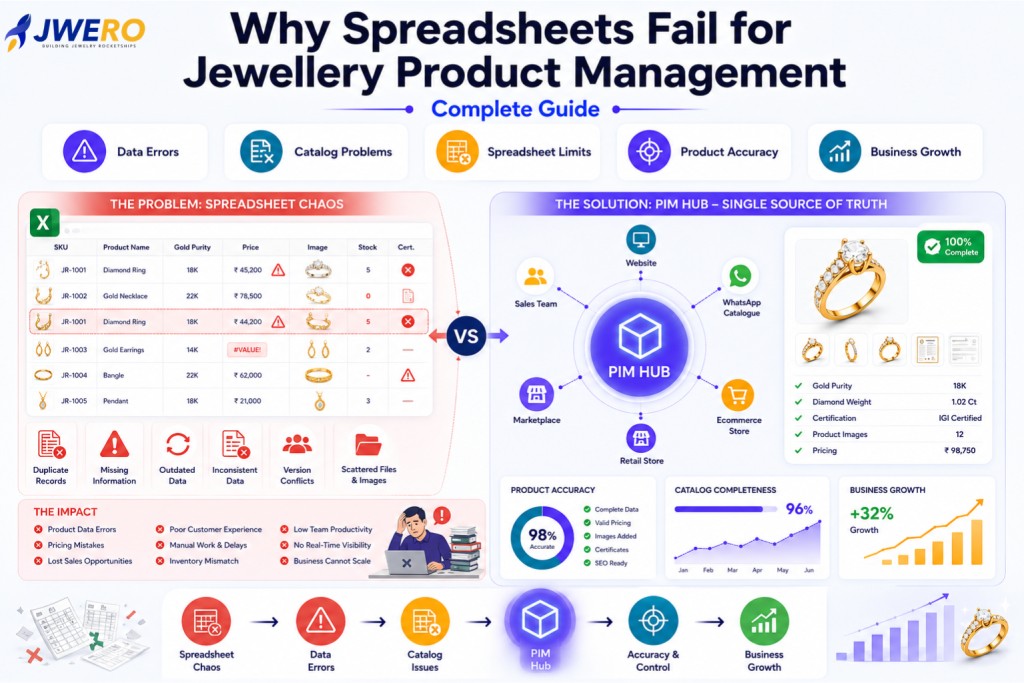
Many jewellery businesses begin their product management journey with spreadsheets.
It makes sense.
Spreadsheets are familiar, inexpensive, and easy to set up. A jeweller can create columns for product names, SKUs, gold purity, diamond details, pricing, and inventory quantities within minutes.
For a small catalogue of 50 or 100 products, spreadsheets often seem sufficient.
The problem starts when the business grows.
A modern jewellery retailer may manage thousands of products across multiple collections, categories, locations, and sales channels. Product information must be synchronised across websites, ecommerce stores, WhatsApp catalogues, marketplaces, sales teams, and physical stores.
At this stage, spreadsheets stop being a productivity tool and start becoming a business risk.
This is why many growing jewellery businesses eventually abandon spreadsheet-based product management and move to dedicated Product Information Management (PIM) platforms.
Why Jewellery Product Data Is More Complex Than Other Retail Industries
Most retail products have relatively simple data requirements.
Jewellery products are different.
A single jewellery product may include:
- Product Name
- SKU
- Collection Name
- Product Category
- Gold Purity
- Metal Weight
- Diamond Weight
- Diamond Clarity
- Diamond Color
- Gemstone Details
- Certification Information
- Product Images
- Product Videos
- Pricing
- Making Charges
- SEO Metadata
- Product Descriptions
- Product Variants
Now imagine managing this information for:
- 5,000 products
- 20 collections
- 3 store locations
- Ecommerce website
- WhatsApp catalogue
- Marketplace listings
The complexity grows exponentially.
Problem 1: Spreadsheet Data Errors Are Inevitable
One of the biggest risks of a jewellery product management spreadsheet is human error.
Every manual update creates opportunities for mistakes.
Common jewellery product data errors include:
- Incorrect Pricing
- Wrong SKU Assignment
- Missing Product Images
- Incorrect Purity Information
- Duplicate Products
- Missing Certifications
- Broken Product Links
Even a single pricing mistake can affect customer trust and profitability.
Unlike a dedicated PIM system, spreadsheets do not validate data automatically.
The responsibility falls entirely on employees.
Problem 2: Multiple Spreadsheet Versions Create Chaos
Most jewellery businesses eventually experience this scenario:
Someone creates:
- Product_Master.xlsx
Then:
- Product_Master_Final.xlsx
Then:
- Product_Master_Final_v2.xlsx
Then:
- Product_Master_Updated_Final.xlsx
Soon, nobody knows which file is correct.
Marketing uses one version.
Ecommerce uses another version.
Sales teams reference a different version.
The result is inconsistent product information across the business.
Problem 3: Jewellery Catalogue Spreadsheet Problems Increase as the Catalogue Grows
A spreadsheet may work for:
100 Products
It becomes difficult for:
1,000 Products
It becomes nearly impossible for:
10,000 Products
Searching, filtering, updating, and maintaining large catalogues through spreadsheets consumes significant time.
Every new collection adds complexity.
Every new product variant increases maintenance requirements.
Catalogue management eventually becomes a full-time administrative task.
Problem 4: Images, Videos and Certificates Cannot Be Managed Properly
Modern jewellery selling relies heavily on visual content.
Customers expect:
- High-Resolution Images
- Product Videos
- Diamond Certificates
- Hallmark Documents
- Lifestyle Photography
- Product Brochures
Spreadsheets cannot manage these assets effectively.
Most businesses end up storing files across:
- Google Drive
- Dropbox
- Shared Folders
- Employee Systems
This creates fragmentation and inefficiency.
Problem 5: Omnichannel Commerce Breaks Spreadsheet Workflows
Today’s jewellery customer moves between:
- Website
- Marketplace
- Retail Store
- Sales Consultant
The customer expects the same information everywhere.
However, spreadsheets are not designed for omnichannel product distribution.
Updating product information in a spreadsheet does not automatically update:
- Ecommerce listings
- WhatsApp catalogues
- Sales applications
- Marketplace listings
This creates inconsistencies that damage trust.
Problem 6: No Product Approval Workflow
Modern product management requires governance.
Before a product goes live, businesses often need:
- Product Review
- Content Validation
- Image Approval
- Pricing Approval
- Compliance Checks
Spreadsheets offer no structured approval process.
Anyone with access can modify critical product information.
Problem 7: No Product Completeness Monitoring
How many products are missing images?
Which products do not have SEO descriptions?
Which products lack certification data?
Which products have incomplete attributes?
A spreadsheet cannot answer these questions automatically.
A dedicated PIM platform can.
This becomes increasingly important as catalogues grow.
Problem 8: Jewellery Inventory Spreadsheet Limitations
Many jewellers attempt to use spreadsheets for inventory visibility.
This creates additional problems.
Inventory spreadsheets struggle with:
- Real-Time Updates
- Multi-Store Visibility
- Inventory Synchronization
- Product Variants
- Omnichannel Stock Availability
- Inventory Forecasting
As inventory complexity grows, spreadsheets become unreliable.
Problem 9: Team Collaboration Becomes Difficult
Product management involves multiple departments:
- Merchandising
- Marketing
- Ecommerce
- Retail Operations
- Sales
- Inventory Teams
Managing collaboration through spreadsheets creates bottlenecks.
Employees overwrite changes.
Information gets lost.
Version conflicts increase.
Product launches slow down.
Problem 10: Spreadsheets Are Not Built for Growth
Every growing jewellery business eventually faces:
- More Products
- More Channels
- More Stores
- More Employees
- More Customers
- More Product Variants
Spreadsheets do not scale effectively.
What worked at 100 products rarely works at 10,000 products.
The Hidden Cost of Spreadsheet Management
Many businesses assume spreadsheets are free.
They are not.
The hidden costs include:
- Employee Time
- Product Errors
- Delayed Product Launches
- Customer Complaints
- Revenue Loss
- Catalog Inconsistency
- Duplicate Work
- Lost Opportunities
These costs often exceed the cost of implementing proper software.
Why Modern Jewellers Are Moving to PIM Software
Product Information Management (PIM) software was designed specifically to solve these problems.
A Jewellery PIM provides:
- Centralised Product Data
- Product Validation
- Approval Workflows
- Media Management
- Catalog Governance
- Omnichannel Distribution
- Product Analytics
- Team Collaboration
Everything is managed from one platform.
Spreadsheet vs Jewellery PIM
| Feature | Spreadsheet | Jewellery PIM |
|---|---|---|
| Product Data Management | Manual | Automated |
| Approval Workflow | No | Yes |
| Product Validation | No | Yes |
| Omnichannel Distribution | No | Yes |
| Media Management | Limited | Full |
| Scalability | Low | High |
| Product Accuracy | Inconsistent | Controlled |
| Team Collaboration | Difficult | Built-In |
Why This Matters for SEO, GEO, AEO and AI Search
Product information is no longer used only by customers.
It is now consumed by:
- Google AI Overviews
- ChatGPT
- Gemini
- Perplexity
- Voice Assistants
Structured product data improves:
- SEO
- GEO
- AEO
- AI Visibility
Businesses with organised product information will increasingly outperform competitors in search visibility.
How Jwero PIM Hub Solves Spreadsheet Problems
Jwero PIM Hub helps jewellery businesses:
- Centralise Product Data
- Manage Product Attributes
- Control Product Accuracy
- Organise Images and Certifications
- Synchronise Product Information Across Channels
- Improve Team Collaboration
- Launch Products Faster
- Scale Product Operations
Instead of managing products through disconnected spreadsheets, businesses gain a single source of truth.
Final Thoughts
Spreadsheets are useful for starting a business.
They are not designed for managing modern jewellery catalogues.
As product complexity, sales channels, and customer expectations grow, spreadsheets create more problems than they solve.
Businesses that invest in structured product management gain:
- Better product accuracy
- Faster product launches
- Better customer experiences
- Better ecommerce performance
- Better SEO visibility
- Better AI discoverability
The future of jewellery product management is centralised, connected, and scalable.
FAQs
Why do spreadsheets fail for jewellery product management?
Spreadsheets create product data errors, version conflicts, catalogue inconsistencies, and scalability challenges that increase as catalogues grow.
What are common jewellery catalogue spreadsheet problems?
Duplicate records, missing product information, outdated catalogues, poor collaboration, and inconsistent omnichannel data are common problems in jewellery catalogue spreadsheets.
What are the limitations of the jewellery inventory spreadsheet?
Lack of real-time synchronisation, multi-store visibility, inventory forecasting, and automated updates are the limitations of the jewellery inventory spreadsheet.
What is a better alternative to spreadsheets?
A Jewellery Product Information Management (PIM) platform is a better alternative to spreadsheets because it centralises and automates product data management.
Can PIM software improve ecommerce performance?
Yes. Better product data improves customer experience, search visibility, product discovery, and conversion rates.