


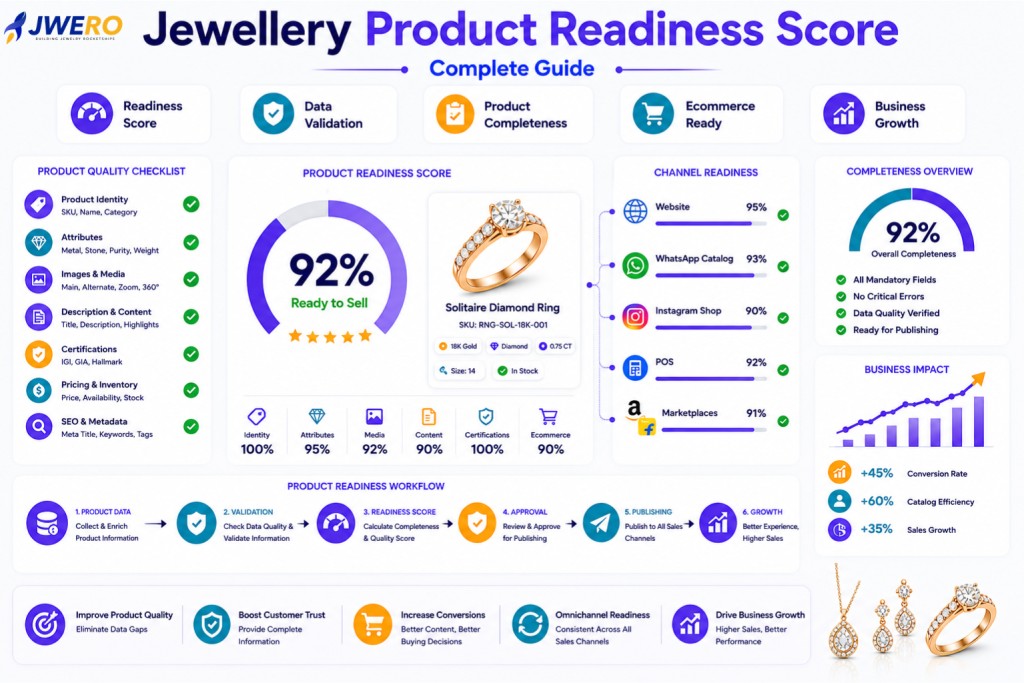
Many jewellery businesses assume a product is ready to sell once it has:
- A product image
- A SKU
- A price
Unfortunately, that is rarely enough.
Modern ecommerce customers expect complete product information before making a purchase.
A missing image, incomplete attribute, incorrect certification, or weak description can reduce trust and impact conversions.
This is why leading jewellery retailers are adopting a Jewellery Product Readiness Score.
A readiness score helps determine whether a product is truly prepared for:
- Website Publishing
- WhatsApp Catalogues
- Instagram Shops
- Marketplaces
- Ecommerce Stores
- Omnichannel Commerce
Instead of relying on guesswork, businesses can use measurable criteria to determine whether a product is ready to generate sales.
What Is a Jewellery Product Readiness Score?
A Jewellery Product Readiness Score is a structured scoring framework that measures the completeness and quality of a product record.
The score evaluates whether all required information exists before a product is published.
Think of it as a quality control system for product data.
A product with:
95–100% Score
Is ready for publication.
A product with:
50–60% Score
still requires enrichment and validation.
Why Product Readiness Matters
Customers make buying decisions based on information.
The more complete the product information, the higher the customer confidence.
Incomplete products often result in:
- Lower Conversion Rates
- Poor Customer Experience
- Product Returns
- Customer Questions
- Lost Revenue
- Reduced Trust
Readiness scoring helps eliminate these issues.
The Hidden Cost of Publishing Incomplete Products
Many jewellery businesses publish products with:
- Missing Images
- Missing Specifications
- Missing Certifications
- Missing Product Attributes
- Weak Product Descriptions
- Incomplete Metadata
The result is lower product performance.
Products may be visible online but not truly ready to sell.
What Makes a Jewellery Product Ready?
A channel-ready jewellery product typically includes:
- Product Identity
- Product Attributes
- Product Images
- Product Videos
- Product Descriptions
- Product Certifications
- Pricing
- Inventory Status
- SEO Metadata
- Product Tags
- Product Categories
Each component contributes to the readiness score.
The Core Components of a Product Readiness Score
Product Identity Score
This measures whether the basic product structure exists.
Required elements:
- Product Name
- SKU
- Product DNA
- Product Category
- Collection Assignment
Without identity data, products become difficult to manage.
Product Attribute Score
Attributes help customers understand products.
Examples:
- Metal Type
- Purity
- Weight
- Stone Information
- Ring Size
- Certificate Information
The more complete the attributes, the higher the score.
Product Media Score
Images are one of the most important conversion factors.
A product should ideally contain:
- Primary Product Image
- Alternate Views
- Lifestyle Images
- Zoom Images
- Product Videos
Media quality directly affects ecommerce readiness.
Product Content Score
Content quality affects:
- Customer Trust
- SEO
- Product Discovery
- Conversion Rates
Scoring factors include:
- Product Title
- Product Description
- Product Highlights
- Product Tags
- SEO Metadata
Certification Score
Certification is critical in jewellery retail.
Products should contain:
- Certification Authority
- Certificate Number
- Certificate Type
- Certification Status
Examples include:
- IGI
- GIA
- SGL
- Hallmark Certifications
Ecommerce Readiness Score
A product should be optimised for ecommerce publication.
Requirements include:
- SEO Title
- Meta Description
- Product URL
- Product Categories
- Product Tags
- Structured Product Data
This improves discoverability.
Understanding Product Completeness Score Jewellery
The product completeness score is one of the most common readiness indicators.
Example:
Product Requirements:
- 50 Required Fields
Completed:
- 45 Fields
Completeness Score:
90%
This helps teams identify missing information quickly.
Why Jewellery Product Data Validation Matters
Completeness alone is not enough.
Information must also be correct.
Validation checks may include:
- Missing Attributes
- Duplicate Products
- Invalid Purity Values
- Missing Certifications
- Missing Images
- Incorrect Categories
- Invalid Pricing
Validation improves quality.
Common Reasons Products Fail Readiness Checks
Many products fail because of:
- Missing Images
- Missing Product Titles
- Incomplete Attributes
- Missing Certifications
- Missing Variants
- Poor Product Descriptions
- Missing SEO Data
- Missing Tags
These issues are often easy to fix once identified.
Why Readiness Scores Improve Ecommerce Performance
Products with higher readiness scores typically achieve:
- Better Conversion Rates
- Better Search Visibility
- Better Customer Experiences
- Better Marketplace Acceptance
- Better Product Discovery
- Better Omnichannel Publishing
The relationship is direct.
Readiness Scores and Omnichannel Commerce
A product that is ready for ecommerce should also be ready for:
- Website
- POS
- Marketplaces
- CRM
The readiness score ensures consistency across channels.
Readiness Scores and SEO
Search engines favour complete product information.
Readiness scoring improves:
- Product Titles
- Product Descriptions
- Product Metadata
- Product Categories
- Product Attributes
This improves search visibility.
Readiness Scores and AI Search
AI-powered search platforms evaluate:
- Product Structure
- Product Attributes
- Product Content
- Product Metadata
- Product Relationships
Products with stronger readiness scores are better positioned for AI discovery.
Creating a Product Readiness Framework
A practical readiness framework may look like:
| Category | Weight |
|---|---|
| Product Identity | 15% |
| Attributes | 25% |
| Media | 20% |
| Content | 15% |
| Certifications | 10% |
| Ecommerce Readiness | 15% |
Total:
100%
This creates a measurable standard.
Why Manual Readiness Checks Fail
Many businesses rely on spreadsheets.
Teams manually verify:
- Images
- Attributes
- Certifications
- Content
- Pricing
As catalogues grow, this becomes unsustainable.
Automation becomes necessary.
How PIM Automates Product Readiness
A Jewellery PIM can automatically:
- Calculate Completeness Scores
- Validate Product Data
- Identify Missing Information
- Block Incomplete Products
- Trigger Approval Workflows
- Improve Product Governance
This improves catalogue quality at scale.
How Jwero PIM Hub Measures Product Readiness
Jwero PIM Hub helps jewellery businesses:
- Calculate Product Readiness Scores
- Validate Product Information
- Measure Completeness
- Identify Missing Attributes
- Improve Ecommerce Readiness
- Improve Omnichannel Publishing
- Support AI Search Readiness
- Improve Product Quality
All from a centralised platform.
Final Thoughts
Publishing products without measuring readiness is risky.
Incomplete product information creates:
- Customer confusion
- Lower conversions
- Poor SEO performance
- Weak ecommerce experiences
A Jewellery Product Readiness Score provides a structured way to evaluate product quality before publication.
The businesses that measure readiness consistently will create:
- Better Catalogs
- Better Customer Experiences
- Better Omnichannel Operations
- Better Revenue Outcomes
FAQs
What is a jewellery product readiness score?
A readiness score measures how complete and accurate a product record is before publication.
What is a product completeness score?
A completeness score measures how many required product fields have been completed.
Why is jewellery product data validation important?
Validation ensures that product information is accurate, consistent, and ready for publication.
How does product readiness improve ecommerce performance?
More complete products create better customer experiences, improve SEO, and increase conversions.
Can a PIM automatically calculate readiness scores?
Yes. Modern Jewellery PIM platforms can automatically calculate readiness scores and validate product quality.