

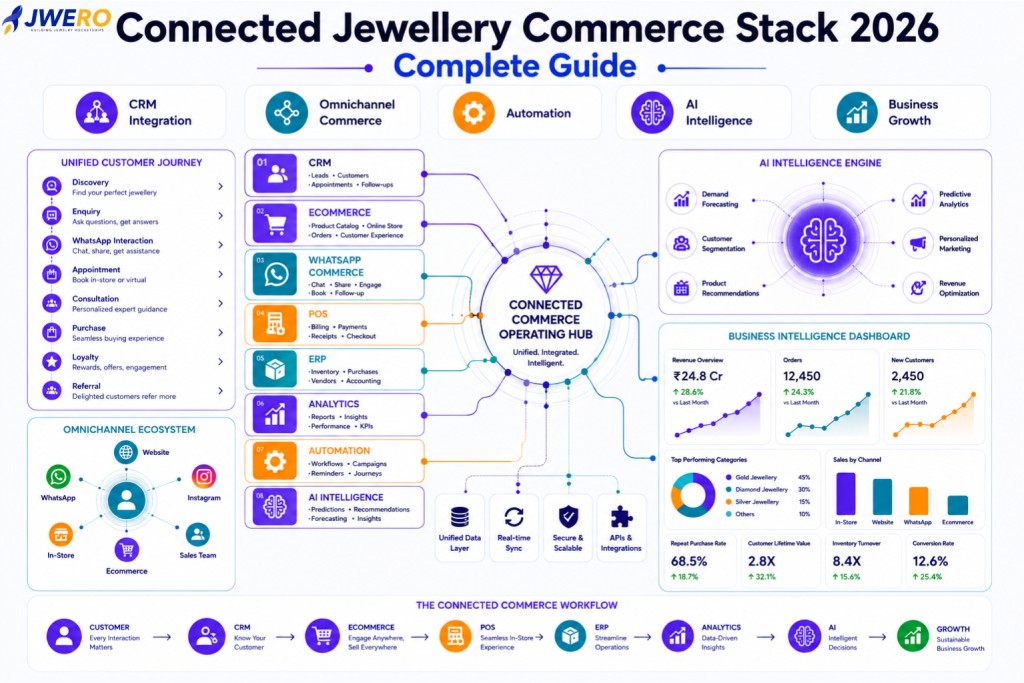
Modern jewellery businesses use many software systems.
However, the real competitive advantage comes when those systems work together.
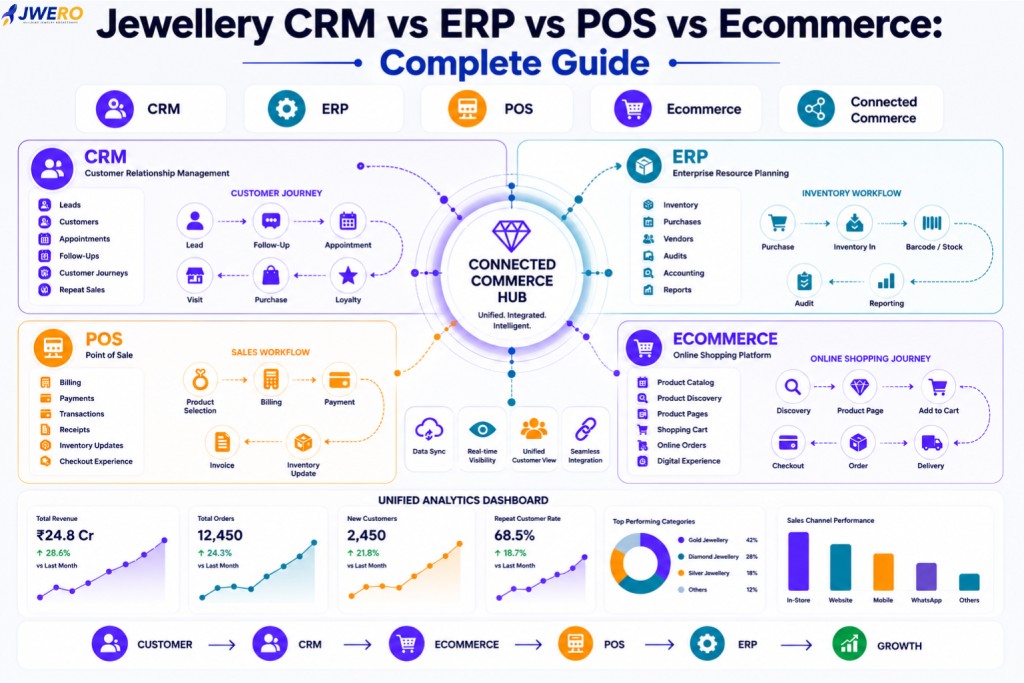
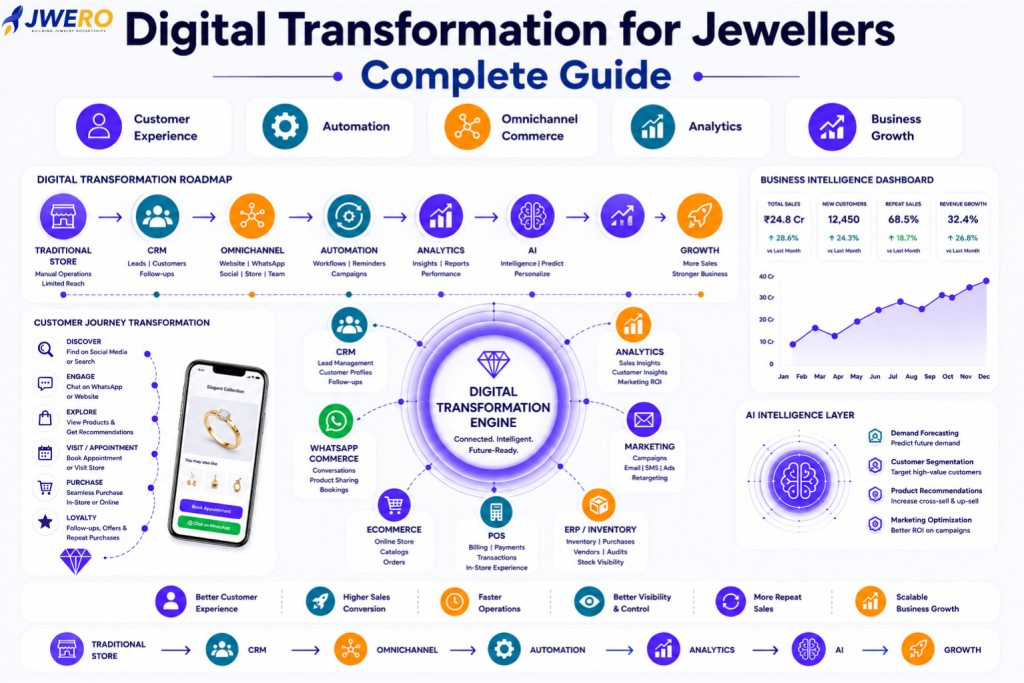
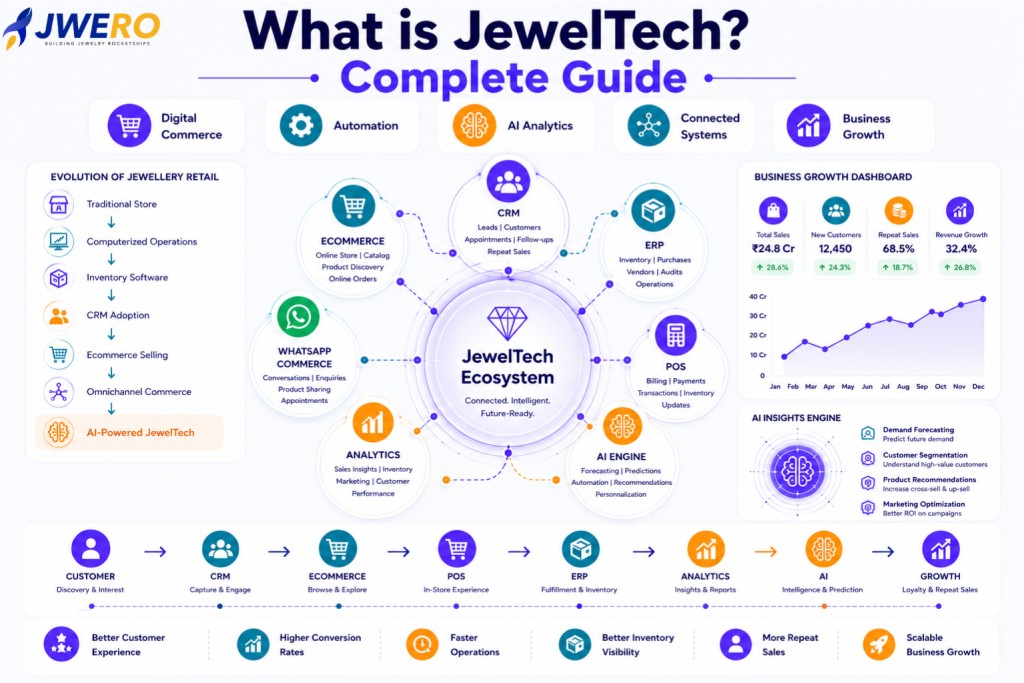
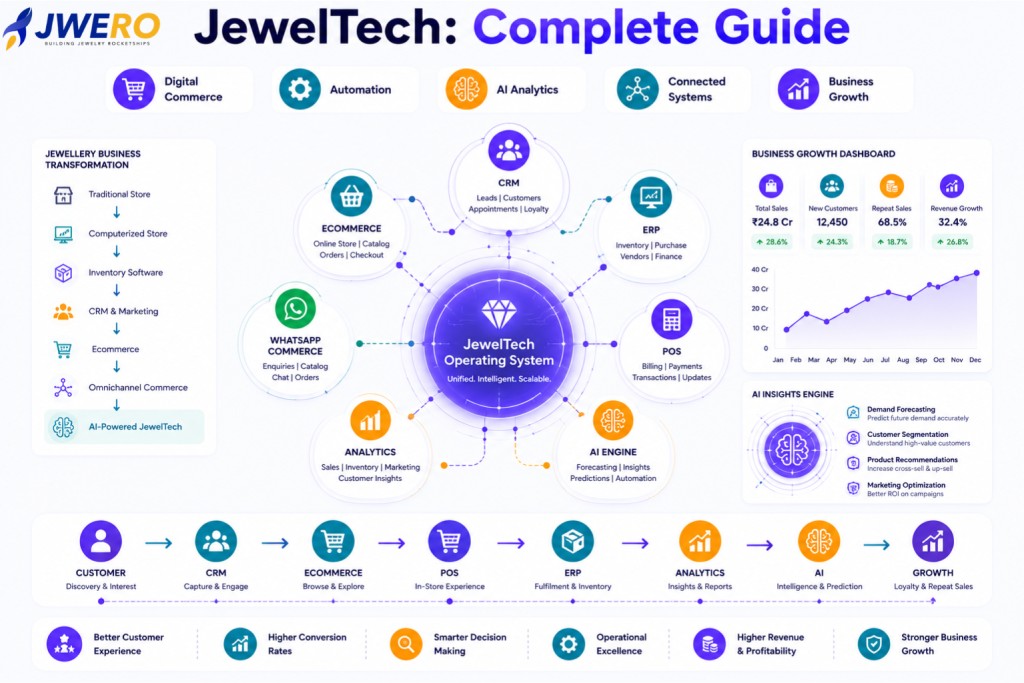
A connected commerce stack links customer engagement, inventory, sales, operations, analytics, and AI into a single ecosystem.
What is a Connected Commerce Stack?
A connected commerce stack is a technology architecture where every business system shares data and works together.
Instead of isolated tools, retailers operate through an integrated platform.
The result is:
- Better Visibility
- Better Customer Experience
- Better Operations
- Better Growth
Why Connected Systems Matter
Disconnected systems create:
- Duplicate Data
- Manual Work
- Inventory Errors
- Poor Customer Visibility
- Reporting Gaps
- Missed Opportunities
Connected systems eliminate these problems.
The Modern Jewellery Commerce Stack
↓
Ecommerce
↓
WhatsApp Commerce
↓
POS
↓
ERP
↓
Analytics
↓
Automation
↓
AI
↓
Business Growth
Every layer contributes to growth.
Layer 1: CRM
CRM manages:
- Leads
- Customers
- Appointments
- Follow-Ups
- Customer Journeys
- Repeat Sales
CRM becomes the customer intelligence layer.
Layer 2: Ecommerce
Ecommerce manages:
- Product Discovery
- Online Catalogues
- Shopping Experiences
- Online Orders
- Customer Convenience
Ecommerce expands reach.
Layer 3: WhatsApp Commerce
WhatsApp manages:
- Product Sharing
- Conversations
- Appointment Booking
- Follow-Ups
- Customer Engagement
Messaging becomes a key commerce channel.
Layer 4: POS
POS manages:
- Billing
- Payments
- Transactions
- Receipts
- Checkout
POS powers showroom operations.
Layer 5: ERP
ERP manages:
- Inventory
- Purchases
- Vendors
- Audits
- Reporting
ERP provides operational control.
Layer 6: Analytics
Analytics provides:
- Revenue Insights
- Customer Insights
- Inventory Insights
- Marketing Insights
- Staff Performance Insights
Data becomes actionable.
Layer 7: Automation
Automation powers:
- Lead Follow-Ups
- Appointment Reminders
- Marketing Campaigns
- Customer Journeys
- Reporting
Automation improves efficiency.
Layer 8: Artificial Intelligence
AI supports:
- Demand Forecasting
- Personalization
- Predictive Analytics
- Revenue Forecasting
- Customer Intelligence
AI drives smarter decisions.
The Connected Customer Journey
Discovery
↓
Enquiry
↓
↓
Appointment
↓
Consultation
↓
Purchase
↓
Loyalty
↓
Referral
The stack supports every interaction.
Benefits of a Connected Commerce Stack
- Better Customer Experience
- Better Inventory Visibility
- Faster Operations
- Better Decision-Making
- Higher Conversion Rates
- Better Customer Retention
- Scalable Growth
Integration creates leverage.
Common Commerce Stack Mistakes
- Too Many Disconnected Tools
- No CRM
- Weak Analytics
- No Automation
- Poor Integrations
- No Customer Journey Visibility
Technology should be connected.
Future of Connected Commerce
Future stacks will include:
- AI-Native Systems
- Real-Time Analytics
- Omnichannel Commerce
- Intelligent Automation
- Unified Customer Profiles
- Predictive Commerce
The stack becomes increasingly intelligent.
How Jwero Fits into the Commerce Stack
Jwero acts as the customer growth layer through:
- CRM
- WhatsApp Commerce
- Customer Analytics
- Marketing Automation
- Customer Journey Tracking
- AI Insights
Jwero connects customer acquisition and retention activities.
Final Thoughts
The future of jewellery retail is not individual software tools.
It is a connected commerce stack.
Businesses that connect:
- CRM
- ERP
- POS
- Ecommerce
- Analytics
- Automation
- AI
Gain better visibility, efficiency, customer experiences, and growth.
Frequently Asked Questions
What is a connected commerce stack?
A technology ecosystem where CRM, ERP, POS, Ecommerce, Analytics, Automation, and AI work together is called a connected commerce stack.
Why is integration important?
Integration is important because it improves visibility, customer experience, and operational efficiency.
What is the most important layer?
CRM is often the most important layer because it manages customer relationships.
Is AI becoming part of the commerce stack?
Yes. AI is increasingly used for forecasting, analytics, personalisation, and automation.
What is the future of connected commerce?
AI-powered, unified platforms that manage the entire customer and operational journey are the future of connected commerce.