

Every jewellery salesperson hears this daily:
“Just browsing.”
Most stores interpret that as low buying intent.
So they relax.
Stop observing closely.
Move attention elsewhere.
But in jewellery retail, that assumption is often wrong.
Many serious buyers begin exactly this way.
They enter cautiously.
Avoid pressure.
Stay emotionally guarded.
Then slowly reveal intent through behaviour.
That is why strong jewellery brands no longer rely only on what customers say.
They pay attention to what customers actually do inside the store.
Table of Contents
- Why Jewellery Customers Hide Intent
- Why In-Store Behaviour Matters More Than Words
- The Jewellery Intent Ladder Inside Stores
- Why Browsing Is More Valuable Than Most Stores Realise
- How Offline Behaviour Mirrors Online Intent
- Why Most Jewellery Stores Lose Browsing Data
- What In-Store Behaviour Tracking Actually Means
- How AI Helps Identify Jewellery Buying Intent
- From Footfall Tracking to Intent Tracking
1. Why Jewellery Customers Hide Intent
Jewellery purchases are emotionally sensitive.
Customers often protect themselves socially before protecting their wallets.
That changes how they behave inside stores.
Many customers avoid sounding “too interested” because they:
- dislike sales pressure
- want emotional space
- are comparing multiple jewellers
- are still discussing decisions with family
- do not want immediate follow-ups
So they say:
“Just browsing.”
But the sentence rarely tells the full story.
The real signals appear afterwards.
Inside behaviour reveals far more than verbal responses.
2. Why In-Store Behaviour Matters More Than Words
Jewellery buying follows a behavioural progression.
Not instant declarations.
Customers may verbally appear uncertain while physically behaving like serious buyers.
For example:
- Revisiting the same counter
- comparing multiple variants
- asking availability questions
- discussing designs with family
- taking product photos
- trying pieces repeatedly
These are not casual actions.
They usually indicate growing emotional confidence.
This is why showroom behaviour matters enormously in jewellery retail.
Observed actions often predict buying readiness more accurately than conversation.
3. The Jewellery Intent Ladder Inside Stores
Most jewellery stores track only final sales.
But high-performing retailers track intent progression before purchase happens.
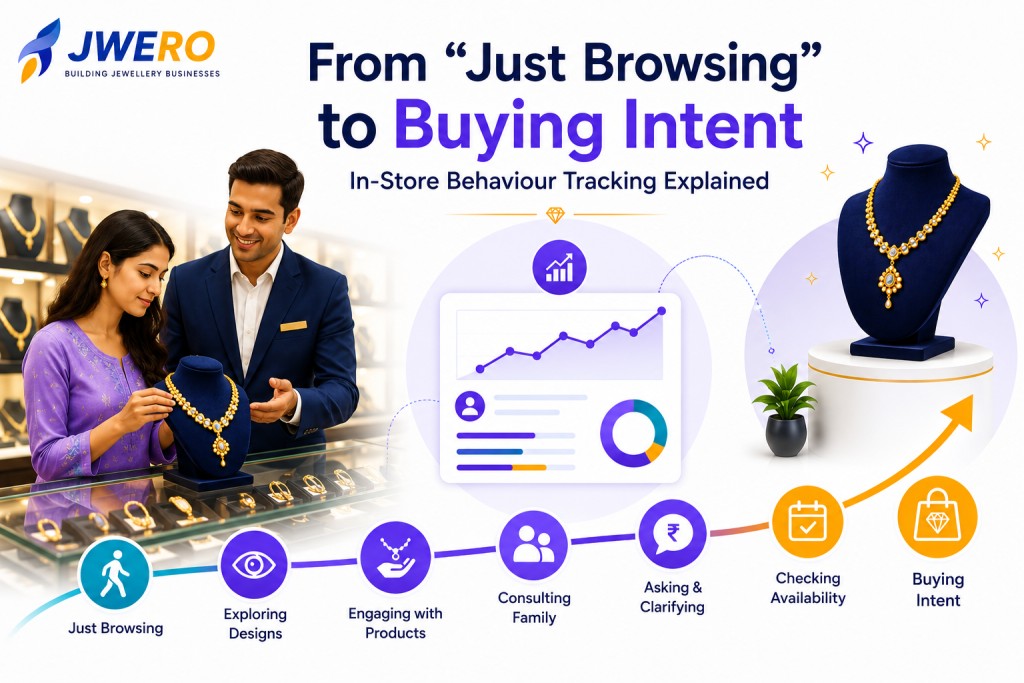
A typical jewellery intent ladder looks like this:
- Quick showroom walkthrough
- Casual browsing
- Pausing at a display
- Product handling
- Repeat handling
- Variant comparison
- Photo taking
- Family consultation
- Price clarification
- Availability discussion
- Trial or fitting
- Purchase conversation
Every step upward reflects stronger confidence formation.
The sale rarely begins at the billing counter.
It begins much earlier during browsing behaviour.
4. Why Browsing Is More Valuable Than Most Stores Realise
Browsing behaviour contains valuable emotional signals.
It reveals:
- style preference
- budget comfort
- hesitation level
- decision speed
- reassurance needs
Customers who browse deeply and leave are often misunderstood internally.
Many stores assume they are “lost.”
But that is rarely true in jewellery retail.
Customers frequently:
- Compare across brands
- revisit later
- continue discussions at home
- return after emotional alignment
That makes browsing one of the strongest future-purchase indicators.
Especially for bridal and high-ticket categories.
5. How Offline Behaviour Mirrors Online Intent
The interesting part is this:
Offline jewellery behaviour closely resembles digital behaviour.
| Digital Behaviour | In-Store Behaviour |
|---|---|
| Wishlist activity | Repeat product handling |
| Add-to-cart | Availability questions |
| Product revisits | Returning to same counter |
| Saving product images | Taking showroom photos |
| Cart abandonment | Leaving after deep engagement |
The psychology is almost identical.
Only the environment changes.
That is why jewellery brands increasingly connect showroom journeys with platforms like Jwero Ecommerce and Jwero Chats to preserve customer continuity across channels.
Because intent rarely exists in isolation anymore.
6. Why Most Jewellery Stores Lose Browsing Data
This is where most jewellery businesses struggle operationally.
Browsing behaviour disappears after the customer exits.
Usually because:
- Staff rely on memory
- Browsing data is never logged
- CRM systems capture only buyers
- No customer context gets preserved
- store journeys remain disconnected
The customer may later:
- send a WhatsApp message
- Revisit the store,
- enquire online
But internally, nobody recognises the earlier journey.
That weakens customer continuity significantly.
7. What In-Store Behaviour Tracking Actually Means
Many people misunderstand behaviour tracking.
It does not mean surveillance.
It means understanding customer progression respectfully.
Good jewellery behaviour tracking simply records:
- product categories viewed
- browsing depth
- confidence indicators
- repeat interactions
- stage in the buying journey
Even lightweight tracking improves future engagement quality.
Because future conversations become more contextual and less repetitive.
That creates calmer customer experiences.
Not more aggressive selling.
8. How AI Helps Identify Jewellery Buying Intent
This is where AI becomes operationally useful.
Not because it “automates sales.”
But because it preserves intent continuity.
AI systems can help:
- recognise repeat customer behaviour
- connect showroom and WhatsApp journeys
- Identify confidence escalation
- Reduce disconnected follow-ups
- surface stronger buying signals early
Instead of depending entirely on staff memory, brands using platforms like Jwero.ai can maintain customer context across multiple visits and channels.
That becomes increasingly important as jewellery businesses scale.
Because human memory weakens.
Customer journeys do not.
9. From Footfall Tracking to Intent Tracking
Traditional jewellery reporting focuses heavily on footfall.
But footfall alone explains very little.
The better question is:
“How many customers progressed emotionally today?”
That changes how stores think completely.
Instead of tracking only:
- showroom entries
- billing numbers
- daily conversions
Leading brands increasingly track:
- browsing depth
- repeat visits
- engagement quality
- confidence progression
That creates a much clearer understanding of future revenue potential.
Final Thought
Jewellery customers rarely announce buying intent clearly.
They reveal it gradually.
Through movement.
Questions.
Reassurance-seeking.
Repeated engagement.
“Just browsing” is often not a rejection.
It is the beginning of emotional evaluation.
The jewellery brands growing strongest today understand something subtle:
The real opportunity starts before the purchase conversation begins.
Because in jewellery retail, buying intent usually appears quietly long before customers say they are ready.
FAQs
What is in-store jewellery intent tracking?
It is the process of observing and recording customer behaviour inside jewellery stores to identify buying readiness and engagement levels.
Why do jewellery customers say “just browsing”?
Most customers say this to avoid pressure while they emotionally evaluate designs, pricing, and purchase timing.
Does browsing behaviour predict jewellery purchases?
Yes. Deep browsing behaviour often signals growing confidence and future purchase likelihood in jewellery retail.
How can jewellery stores improve walk-in conversion?
By tracking behavioural signals, preserving customer context, and reducing disconnected follow-ups across channels.
How does AI help jewellery showrooms?
AI helps preserve customer history, identify stronger buying signals, and connect showroom interactions with digital conversations.
Suggested CTA Block
Turn Showroom Browsing Into Better Customer Understanding
Jewellery buying journeys begin long before billing happens.
The right systems help brands preserve customer context, connect showroom interactions with digital journeys, and improve future conversions naturally.
Explore:
- Jwero.ai
- Jwero Chats
- Jwero Ecommerce